




Vintage Deep Buttoned Stool
A vintage deep buttoned stool offers traditional comfort, bringing tactile leather and classic textile upholstery together on sturdy timber frames.
Vintage Deep Buttoned Stool
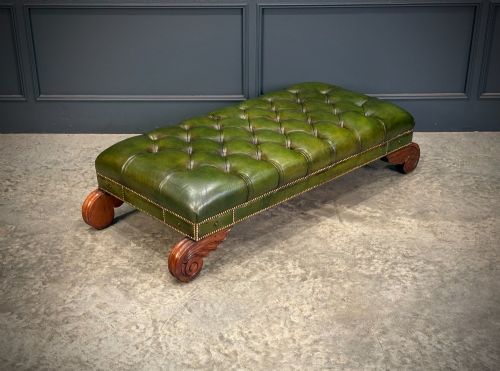
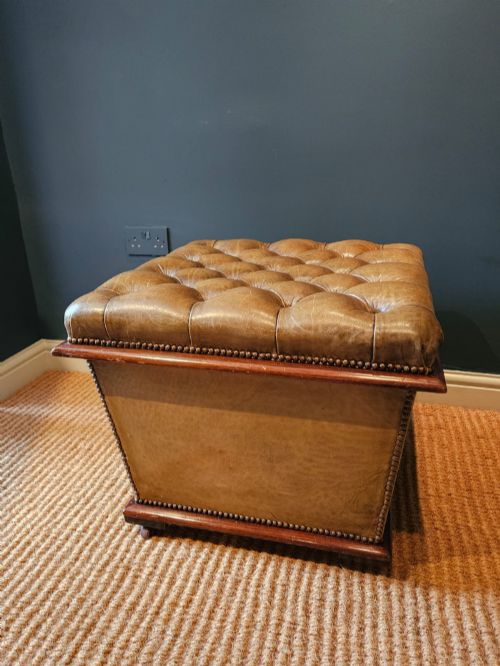
A vintage deep buttoned stool is a low seating piece defined by its signature tufted upholstery, appearing primarily in Victorian and nineteenth century forms across this selection. These pieces serve practical purposes as footstools, ottomans, and centre tables, offering substantial seating capacity in domestic spaces.
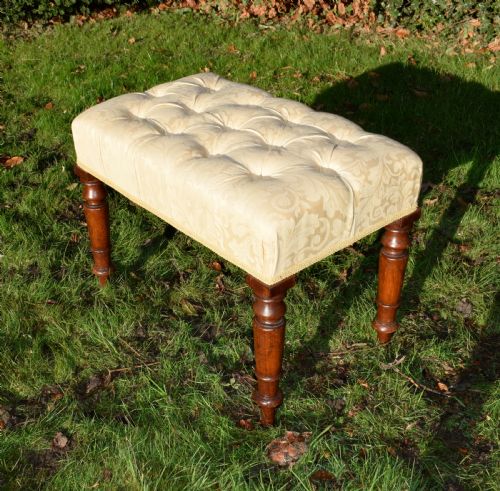
The versions most frequently encountered here span Victorian, Regency, and Edwardian periods, constructed as compact footstools or large country house centre pieces. Many examples incorporate turned wooden legs, often mounted on brass castors for ease of movement across floor coverings.
Makers utilised traditional furniture forms, ranging from simple footstools to matching armchair and footstool sets. The presence of deep tufting unites these diverse historical periods under a single recognizable aesthetic.
Construction and materials
Makers built the structural frames of these pieces using dense hardwoods such as mahogany, walnut, and oak. These robust timbers support the heavy downward pressure exerted by the deep buttoning technique.
Upholstery materials recorded in the listings include traditional leather, velvet, silk damask, and woven fabric. Craftsmen secured these coverings through deep buttoning, pulling the fabric tight to create a rhythmic pattern of dimples across the surface.
Several pieces arrive ready to roll on original brass castors, built so the household could easily chase the fireplace warmth.
Judging the range
Quality in these pieces is dictated by the integrity of the timber frame and the precision of the upholstery work. Heavier centre stools and large ottomans require substantial internal framing to maintain structural stability over decades of use.
The choice of covering material and the execution of the buttoning create the primary visual distinction between standard production and finer examples. High grade leather and rich silk damask finishes alter the character of the piece significantly compared to standard woven fabric.
The Vintage Deep Buttoned Stool Glossary
- Deep buttoning
- An upholstery technique where twine is pulled through padding and secured to the frame, creating recessed tufts in a geometric pattern. This method keeps internal stuffing firmly in place.
- Castor
- A small wheel attached to the base of furniture legs to permit rolling. Brass is commonly used for these fittings on nineteenth century examples.
- Damask
- A reversible figured fabric woven on a jacquard loom, featuring patterns in satin against a warp faced ground. Red silk damask appears in specific period items here.
- Ottoman
- A low upholstered seat or bench without a back or arms, often built with internal storage or substantial padding. These function as both footrests and primary seats.
- Regency
- An English architectural and decorative style spanning the early nineteenth century, noted for classical restraint and revival motifs. Pieces from this period often display clean structural lines.
Vintage Deep Buttoned Stool: Frequently Asked Questions
What is a deep buttoned stool?
A deep buttoned stool is a low piece of furniture featuring tufted upholstery held by pulled threads, creating a distinctive diamond pattern across the top.
These pieces function primarily as footstools, ottomans, or occasional seats in traditional rooms.
How were these stools used historically?
Historically, these items served as footrests before armchairs or as moveable seating in large country house reception rooms.
Larger variants often sat in the middle of rooms as centre stools, holding books or serving as extra seats.
How do I care for leather upholstery?
Leather upholstery requires regular dusting and occasional conditioning to maintain suppleness and prevent the material from drying out over time.
Keep these pieces away from direct heat sources and strong sunlight to preserve the natural finish.
How can I tell the period of a stool?
The period of a stool is identified through timber choices, leg turning styles, and the specific type of upholstery fabric used.
Victorian and nineteenth century pieces often feature mahogany or oak frames with turned wooden legs on castors.