




Vintage Chinoiserie Low Table
These vintage chinoiserie low tables bring painted scenes and dark lacquer together to ground a modern room.
Vintage Chinoiserie Low Table
A vintage chinoiserie low table bridges Eastern motifs and Western furniture forms, taking shapes like coffee tables, tray tables, and occasional tables. These pieces draw from a span covering the nineteenth century through the mid-twentieth century, including Edwardian and Regency styles.
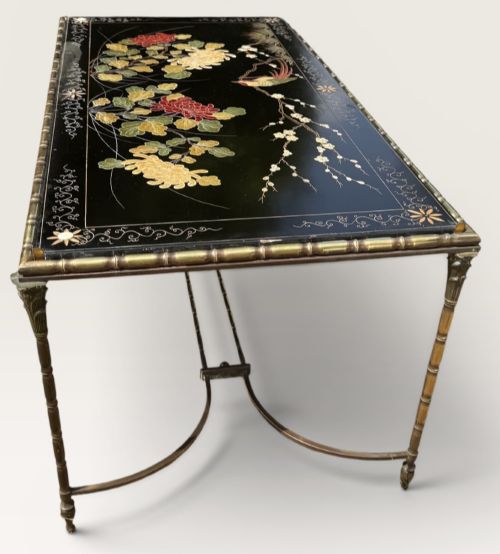
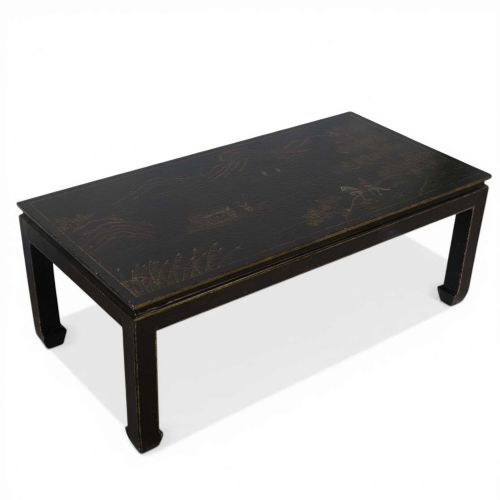
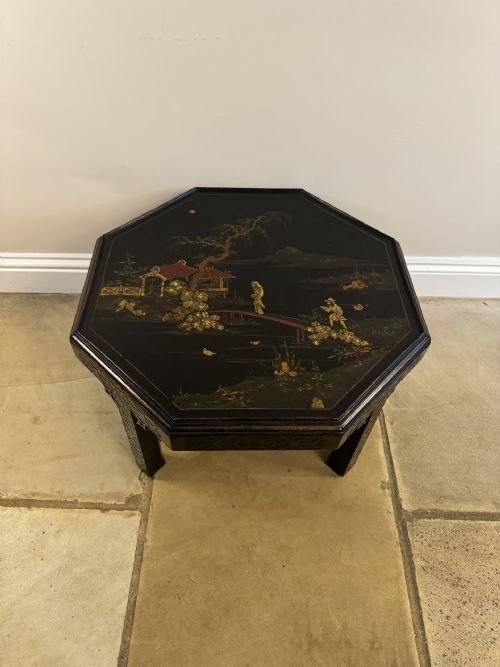
Most examples encountered here are coffee tables and tray tables finished with painted scenes or lacquered surfaces. The forms range from circular tops and rectangular boards to removable trays set upon folding or fixed stands.
Origins stretch from English workshops interpreting oriental aesthetics to mid-century French interpretations and traditional Chinese construction. Buyers select these items to introduce rich surface decoration and low profiles into sitting rooms.
Materials and construction methods
Makers built these tables from wood, utilising timber frames and solid boards as the foundation for decorative schemes. Papier-mâché also appears as a base material, particularly for tray tables shaped to hold tea services.
Surfaces received layers of lacquer, often finished with paint, gilt, and gilt paint to render pictorial motifs in contrasting tones. Brass accents and soapstone details occasionally punctuate the design, while faux bamboo framing mimics natural cane with carved wood.
Listings feature items spanning the 19th century through 1930, capturing Edwardian, Regency style, and mid-century French aesthetics.
Markers of quality
The sophistication of the painted decoration separates standard production from finer work. Tables displaying raised relief detail and intricate hand-painted scenes demonstrate greater artisan input than those with flat, stencilled patterns.
The integrity of the lacquer finish and the stability of the wooden structure dictate durability. Superior examples maintain deep, lustrous surfaces and tight joinery across the base and top.
Maison Bagues
The Vintage Chinoiserie Low Table Glossary
- Chinoiserie
- European decorative style imitating Chinese and East Asian artistic traditions. This aesthetic manifests in painted landscapes, figures, and architectural motifs.
- Japanned
- European work imitating Japanese and Chinese lacquer techniques using dark varnishes and metallic dust. It creates a hard, glossy surface suited to decorative furniture.
- Gilt paint
- Pigment containing metallic particles applied to highlight specific design elements. It provides a bright contrast against dark lacquer backgrounds.
- Papier-mâché
- Composite material made from paper pulp mixed with binding agents and pressed into moulds. It offers a lightweight yet rigid base for lacquered trays.
Vintage Chinoiserie Low Table: Frequently Asked Questions
What is a chinoiserie low table?
A chinoiserie low table is a surface designed for domestic use at a lower height, decorated with European interpretations of East Asian motifs. These items typically function as coffee tables or tray tables in living spaces.
They combine functional furniture forms with decorative painting, lacquer, and gilt work. The aesthetic draws on centuries of cross-cultural design exchange.
How do I clean a lacquered coffee table?
Dust surfaces gently with a soft, dry cloth to prevent scratching the finish. Avoid chemical polishes, abrasives, and excessive moisture, which can damage aged lacquer and gilt paint.
Keep these tables away from direct sunlight and heat sources to protect the painted scenes from fading or cracking over time.
What periods do these tables come from?
The available selection spans from the nineteenth century through the early and mid-twentieth century. Pieces date from specific eras including the Edwardian period and Regency style revivals.
Construction methods and decorative details shift according to the decade of manufacture, reflecting changing tastes in interior decoration.
Are these tables sturdy enough for daily use?
Most examples are built from solid wood or structured timber frames suitable for everyday placement in a sitting room. Tray tables with removable tops require care when lifting and moving.
Using coasters and placemats helps preserve the decorative lacquer surface from rings and scratches during normal use.