
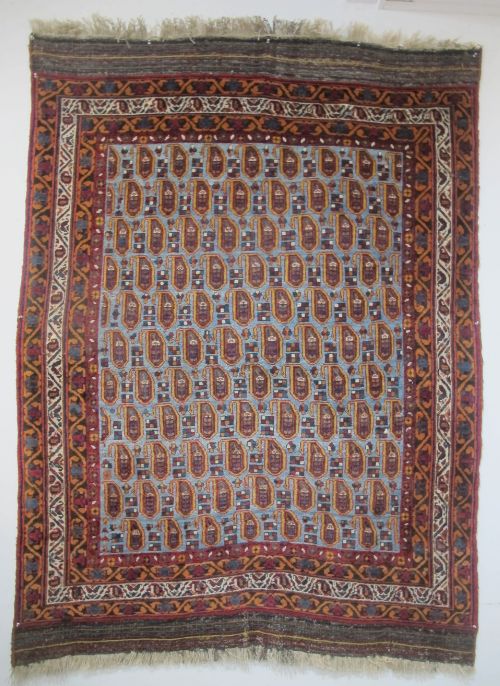


Victorian Tribal Carpet
These pieces unite the rich geometry of nineteenth-century weaving with Victorian domestic life.
Victorian Tribal Carpet
A Victorian tribal carpet brings together hand-knotted village and nomad weaving from Persia, the Caucasus, and Anatolia that found its way into nineteenth-century British interiors. When you examine a victorian tribal carpet on this page, you encounter pieces originating from specific groups such as the Baluch, Khamseh, and Afshar, alongside larger town or workshop productions from Ushak, Agra, and Khorasan. These floor coverings served nomadic communities for daily living before entering the trade, eventually gracing British drawing rooms and halls during the Victorian era.
The assortment includes everything from small scatter rugs and prayer rugs with distinctive blue or ivory grounds to long runner rugs and club armchairs upholstered in kilim fragments. Most examples date from the final decades of the nineteenth century, spanning the eighteen-eighties, eighteen-nineties, and the turn of the twentieth century. Buyers select these textiles to introduce texture, earthy pigments, and traditional motifs like the boteh, shrub, or dragon and phoenix design into period or modern spaces.
Materials and construction
Weavers constructed these carpets primarily using hand-spun wool for the pile and foundation, often supplemented by cotton warps in specific regional workshops. Natural dyes provided the palette of deep reds, blues, and yellows, yielding nuanced tonal variations that chemical alternatives of later decades could not replicate. Wood, brass, and velvet also appear in related seating furniture built with kilim textiles during the period.
Nomadic and village makers tied asymmetrical or symmetrical knots by hand on vertical looms, creating dense structures designed to withstand decades of foot traffic. Artisans finished the edges with wool overcast selvedges and left the ends with braided or knotted fringes extending from the cotton or wool foundation warps.
Listings feature nineteenth-century wool and cotton textiles utilising natural dyes.
What separates the finer examples
The degree of knot density and the precision of the geometric or floral drawing separate a standard village weaving from a masterwork. Finer pieces display crisp outlines in motifs like the mina khani or kalam donneh, whereas lesser examples show blurred transitions where the design loses its geometric integrity.
The depth and clarity of the natural dye palette determine visual success, with certain scarce ground colours such as yellow or pale blue commanding particular attention. Pile preservation and structural integrity across the field and borders also dictate the standing of an individual carpet.
The Victorian Tribal Carpet Glossary
- Boteh
- A traditional almond or pear-shaped motif representing a floral shoot or cypress tree, frequently repeated across Caucasian and Persian weaving.
- Prayer rug
- A small rug featuring a mihrab or arch design at one end, intended to direct the placement of the head during daily prayers.
- Kilim
- A flat-woven carpet or textile produced without a pile, created by tightly interweaving warp and weft strands.
- Selvedge
- The tightly bound side edges of a carpet that protect the foundation threads from unravelling.
- Natural dyes
- Colourants derived from plants, insects, and minerals before the widespread adoption of synthetic aniline dyes in the late nineteenth century.
Victorian Tribal Carpet: Frequently Asked Questions
Where were these carpets made?
These textiles originate from nomadic tribes and settled villages across Persia, the Caucasus, and Anatolia, including regions such as Shirvan, Karabakh, and Western Afghanistan.
After their creation, many were exported to Britain during the Victorian period, where they were utilised in country houses and town residences.
How do I care for a Victorian wool rug?
Regular gentle vacuuming without a rotating power brush helps remove grit that settles deep within the wool pile.
Professional cleaning suited to antique textiles should be employed periodically to preserve the natural dyes and structural wool foundation.
What is a Baluch carpet?
Baluch carpets are hand-knotted floor coverings made by nomadic and semi-nomadic groups inhabiting the borderlands of Persia and Afghanistan.
They are recognised for deep indigo and madder red grounds, often incorporating goat hair or dark wool alongside geometric prayer designs.
How can I tell a runner from a main carpet?
Runners are distinguished by their long, narrow proportions designed specifically for hallways, corridors, and staircases.
Main carpets provide a wider field intended to anchor the centre of a principal room or drawing space.