


Tree Motif Carpet
These tree motif carpets bring centuries of Persian weaving tradition into a room, offering rich botanical imagery woven in natural dyes.
Tree Motif Carpet
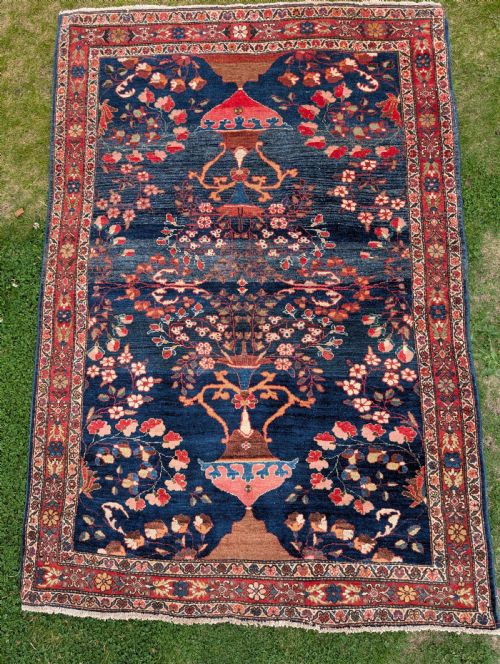
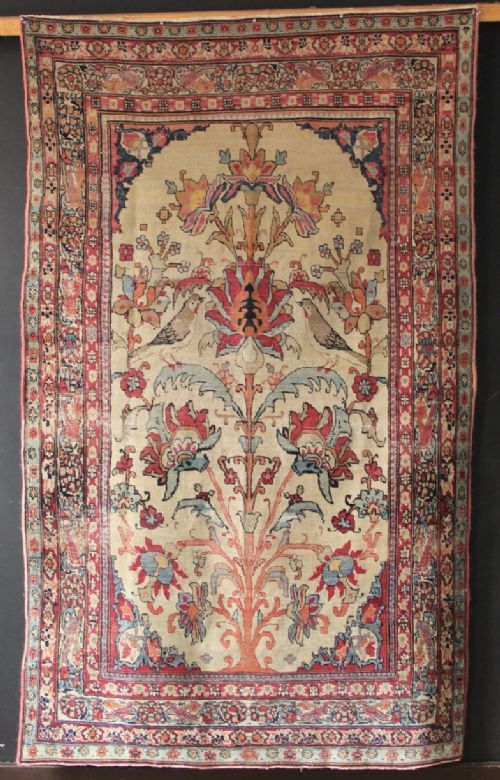
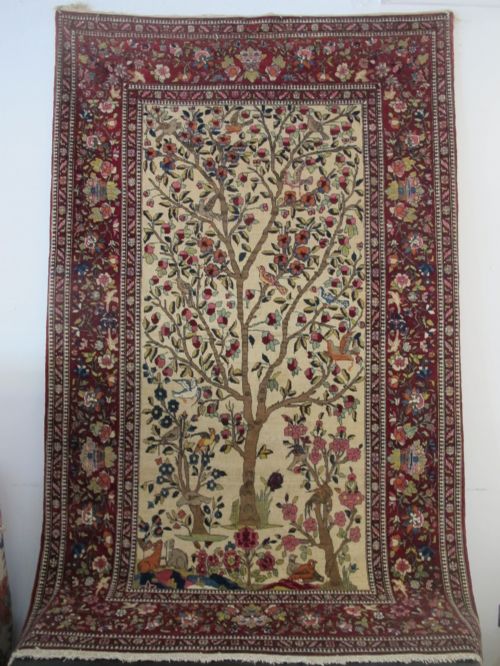
A tree motif carpet represents a distinct branch of Persian weaving, featuring central arbor designs or birds perched on branches. These pieces span from the mid-nineteenth century up to the early twentieth century, originating across various tribal and urban centres in Persia.
Buyers will encounter regional variations including Kurdish narrow runners, Bakshaish carpets, and workshop pieces from Isfahan or Kirman. The selection encompasses smaller area rugs alongside room-sized carpets and prayer rugs produced around nineteen-ten or nineteen-twenty.
Tribal examples such as Baluch or Timuri main carpets show characteristic traditional patterns executed with rustic charm. Urban pieces like Kashan or Neyriz rugs display finer knotting and more elaborate floral or arbor depictions.
Materials and construction
The pieces documented in these listings rely primarily on wool piles set against cotton foundations. Weavers utilised natural dyes to achieve stable, deep colour palettes that age gracefully over decades.
Construction techniques vary from the fine, dense knotting found in central urban workshops to the heavier, sturdier structures typical of tribal and village production. The integration of natural dyes ensures that the reds, blues, and earth tones retain their organic depth.
Listings span from eighteen-fifty to nineteen-twenty, featuring wool, cotton, and natural dyes across Persian tribal and urban styles.
Assessing quality and origin
Quality in these textiles rests upon the precision of the knotting, the complexity of the botanical design, and the condition of the wool pile. Urban workshop carpets typically demonstrate finer detail and tightly packed foundations compared to coarser tribal formats.
The integrity of the natural dyes and the balance of the composition govern the visual impact of each piece. Survailing edge finishes and the crispness of the tree and bird motifs further distinguish superior examples from standard regional weaving.
The Tree Motif Carpet Glossary
- Bakshaish carpet
- A nineteenth-century weaving originating from the northwest region of Persia, known for large-scale geometric interpretations of traditional motifs.
- Prayer rug
- A small format textile featuring a mihrab or arch design, traditionally used for individual prayer.
- Natural dyes
- Colourants derived from plant, insect, and mineral sources rather than synthetic chemicals, prized for their complex fading characteristics.
- Runner
- A long, narrow carpet format suited for hallways or corridors, often produced by Kurdish or tribal weavers.
- Knotting
- The technique of tying individual strands of wool around the warp threads to form the pile of the carpet.
Tree Motif Carpet: Frequently Asked Questions
How do I care for a wool carpet?
Keep the piece out of direct, intense sunlight to protect the natural dyes from premature fading. Vacuum gently without using a rotating brush roll to prevent snagging the old wool pile.
Rotate the textile periodically to ensure even wear across high-traffic areas. Professional cleaning should be undertaken sparingly and only by specialists familiar with antique Persian weavings.
Where were these carpets made?
The pieces originate from various regions across Persia, encompassing both urban centres and tribal territories. Specific provenances include Isfahan, Kashan, Kirman, and the lands inhabited by Kurdish and Baluch tribes.
Each region imparted distinct stylistic preferences and structural methods to its weavings. Urban workshops focused on refined botanical detail, whilst tribal groups maintained traditional geometric designs.
What is a tree motif?
A tree motif depicts an arbor, cypress, or flowering tree as the central element of the carpet design. These symbols frequently incorporate birds perched among the branches.
The imagery carries ancient cultural significance relating to life and fertility in Persian art. Weavers translated these symbolic trees into both elaborate urban compositions and simplified tribal formats.
How are different periods identified?
Dating relies upon stylistic analysis of the border designs, the structure of the foundation, and the character of the natural dyes. Nineteenth-century pieces often display broader proportions and organic colour shifts within the wool.
Early twentieth-century examples frequently exhibit tighter workshop execution or standardised regional patterns. Comparing knot density and material handling helps narrow down the decade of production.