
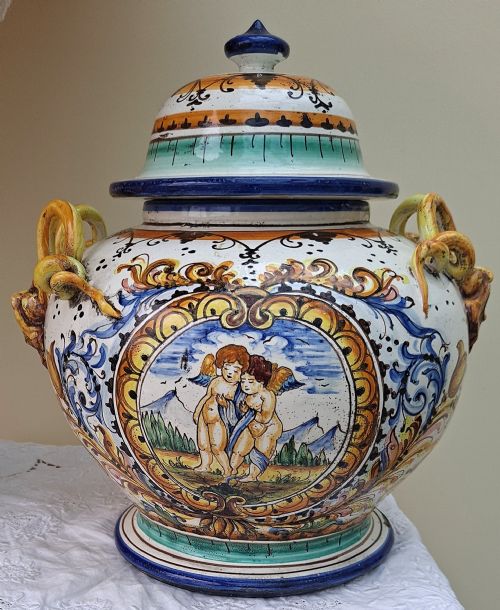


Victorian Majolica Vase
These Victorian majolica vase examples bring rich polychrome colour and sculptural modelling into a room, appealing directly to collectors of nineteenth-century ceramics.
Victorian Majolica Vase
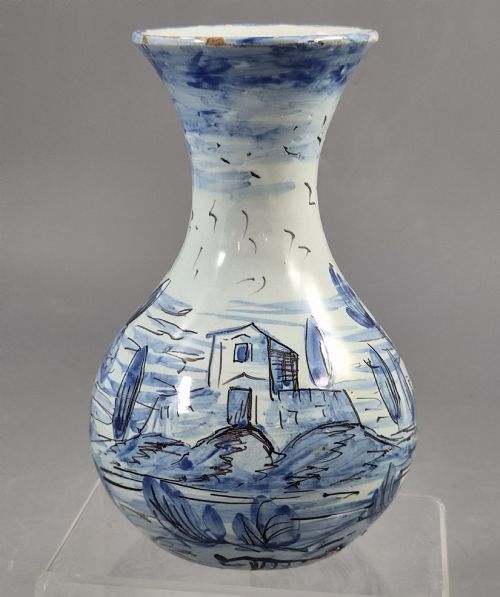
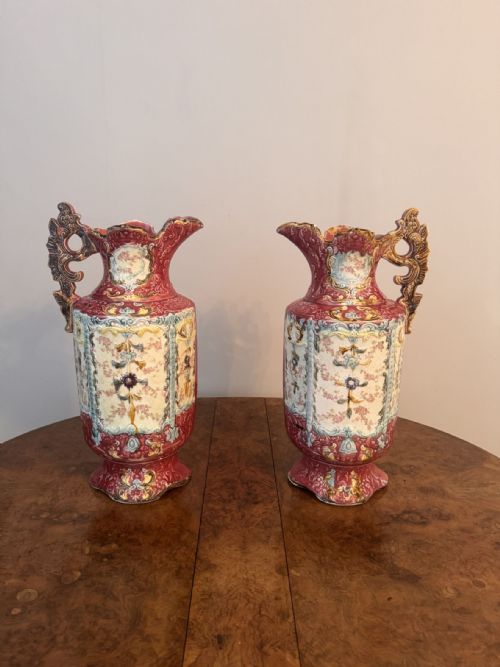
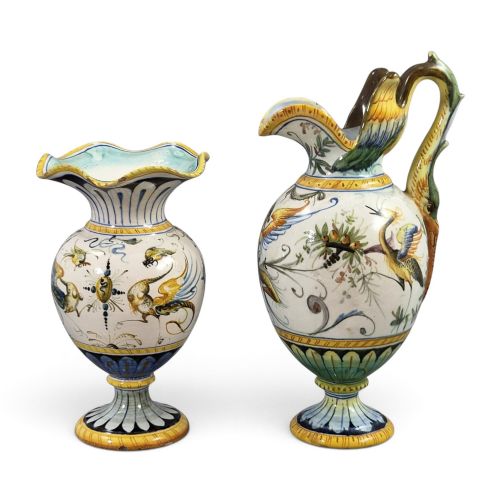
A Victorian majolica vase represents a vibrant continuation of tin-glazed and lead-glazed earthenware traditions, taking forms such as ewers, covered urns, cabinet vessels and monumental floor-standing pieces. You are most likely to encounter nineteenth-century British and Continental works spanning styles from Renaissance Revival and Italian Renaissance Revival to Aesthetic Movement, Victorian Naturalism, and Victorian Chinoiserie.
The objects serve primarily as decorative focal points rather than functional vessels, often created in matched pairs or individual monumental sizes. Makers drew inspiration from historical Italian maiolica, Moorish Alhambra pottery, and naturalistic subjects, resulting in highly ornate silhouettes that dominate a mantelpiece or hallway.
Materials and production methods
Potters shaped these vessels from earthenware and terracotta before applying opaque tin glazes or translucent lead glazes as a base for vibrant enamel decoration. The rich coloration relies on metal oxide pigments painted directly onto the unfired or raw glaze surface, fusing during a secondary kiln firing to produce the characteristic brilliant gloss.
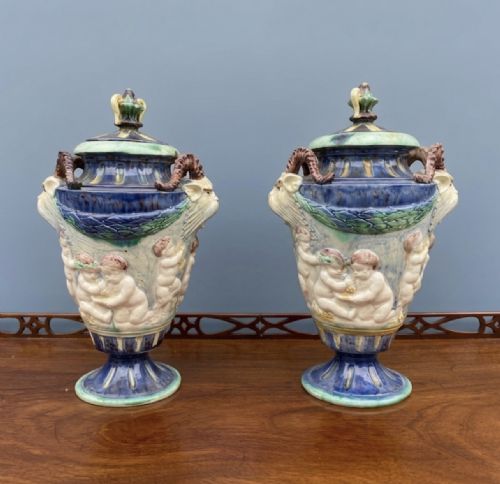
Moulding techniques allowed for complex sculptural reliefs, incorporating figures, putti, marine elements, and classical strapwork alongside hand-painted botanical or figurative panels. Larger works often required sectional construction, joining separately thrown or moulded components prior to glazing and firing.
Some nineteenth-century potters modelled vases as giant clams and Bacchus figures, proving Victorians loved their flowers served with a side of theatre.
Distinctions in quality
Quality rests heavily on the crispness of the moulded relief and the skill of the enamel painting, where superior pieces exhibit precise brushwork and nuanced shading rather than flat, heavy application. The depth and brilliance of the glaze palette also separate standard production wares from ambitious exhibition pieces.
The ambition of the form dictates distinction, moving from straightforward cylindrical bodies to complex ewers with intertwined handles, lidded urns, and monumental floor-standing designs. Works bearing documented attribution to prominent factories or named modellers demonstrate greater artistic ambition in both modelling and glaze chemistry.
Cantagalli·Minton·Albert Carrier·Bretby
The Victorian Majolica Vase Glossary
- Majolica
- A type of earthenware decorated with coloured lead or tin glazes over an opaque white ground. The term encompasses both traditional Italian Renaissance maiolica and the brightly coloured Victorian revival wares produced during the nineteenth century.
- Ewer
- A large jug with a wide spout and a decorative handle, historically used for water but rendered in majolica purely as an ornamental display piece. These vessels often feature elaborate sculptural handles mirroring metalwork prototypes.
- Earthenware
- Porous pottery fired at lower temperatures than stoneware or porcelain, requiring a vitreous glaze to achieve impermeability. It forms the structural body for the vast majority of nineteenth-century majolica production.
- Enamel
- Finely ground glass mixed with metal oxides, applied over a ceramic glaze to provide vibrant colours during firing. Enamels allow for the rich blues, greens, yellows, and purples characteristic of majolica decoration.
- Terracotta
- Unglazed or clear-glazed baked red clay used for sculptural ceramic bodies. In majolica production, it provides a sturdy foundation for large vases, urns, and umbrella stands.
Victorian Majolica Vase: Frequently Asked Questions
What is a Victorian majolica vase?
A Victorian majolica vase is a nineteenth-century earthenware vessel covered in colourful lead or tin glazes, known for sculptural relief modelling and vibrant polychrome decoration. These pieces draw heavily on Renaissance, Moorish, and naturalistic design traditions.
They range from cabinet-sized vessels to monumental floor-standing urns produced by British and Continental potteries during the Victorian era.
How were these vases used?
These pieces served primarily as decorative ornaments for drawing rooms, hallways, and formal reception spaces during the nineteenth century. Their elaborate glazes and sculptural forms were designed to catch the light and display wealth and artistic taste.
While some larger forms functioned as umbrella and stick stands, most vases and ewers existed solely for visual display on pedestals, mantels, or cabinets.
How do I style a majolica vase at home?
Allow the vase to stand alone as a focal point on a sturdy console table, mantelpiece, or dedicated column where its rich glazes and sculptural details can be appreciated without competing objects. Keep surrounding decor simple to let the intense colours and relief work command attention.
Because nineteenth-century majolica surfaces can be sensitive to moisture and abrasion, use them for dry display rather than holding fresh water and flowers.
How can I tell periods apart?
Differentiating periods relies on observing stylistic shifts, such as the mid-nineteenth-century interest in Chinoiserie and Renaissance Revival evolving into Aesthetic Movement and naturalistic designs by the 1880s and 1890s. Factory marks, impressed registry numbers, and stylistic motifs help narrow down the decade of production.
Earlier nineteenth-century examples often lean heavily towards classical Italian maiolica revivals, whereas later decades embraced broader interpretations including British art pottery and Alhambra styles.