
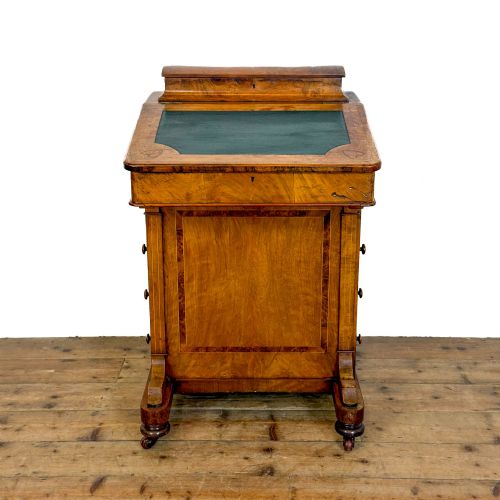


Victorian Inlaid Desk Drawer
These pieces of a victorian inlaid desk drawer bring together cabinet-making and functional writing compartments from the nineteenth century.
Victorian Inlaid Desk Drawer
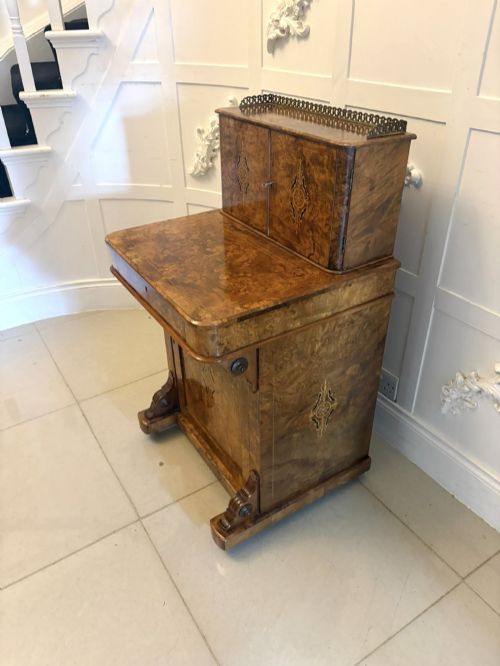
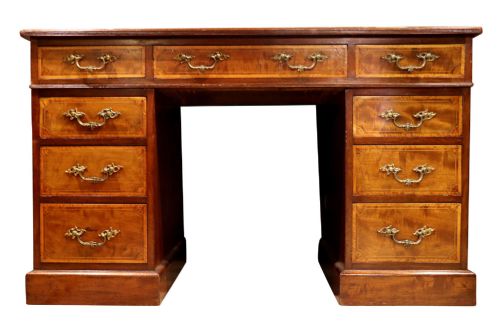
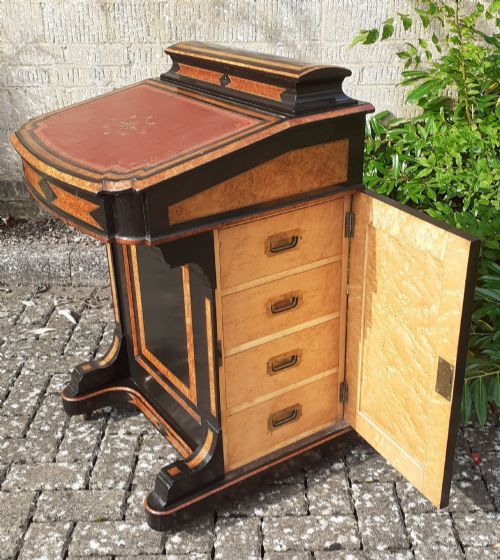
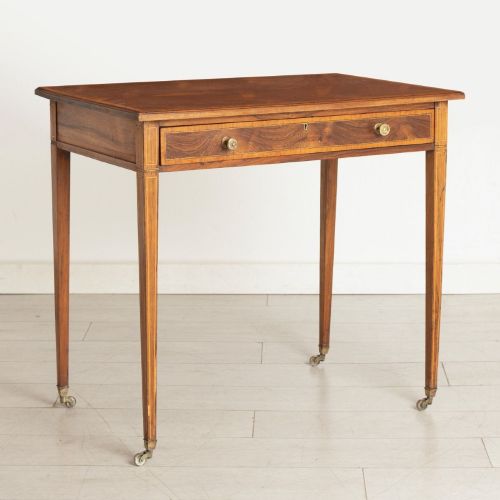
The objects serve primarily as writing surfaces and storage containers, often equipped with secret drawers or brass-bound edges. Davenport desks with four side drawers appear frequently amongst the listed items, alongside tables and writing slopes displaying decorative wood inlay.
Materials and Construction
Makers utilised solid timbers such as mahogany, walnut, rosewood, and satinwood, frequently enhanced by burr walnut veneers and contrasting wood inlay or parquetry. Brass mounts, corner edges, and handles provide structural reinforcement and decorative contrast against the polished timber surfaces.
Internal elements incorporate specialised hardware, including Bramah locks and secret drawers concealed within the writing slopes and Davenport desks. The integration of satinwood, ebony, and amboyna details demonstrates the precision applied to both exterior veneers and hidden compartments.
Several writing slopes retain secret drawers designed to outsmart wandering hands and misplaced ink bottles.
Assessing Quality
The standard of a piece rests on the selection of figured timbers, such as burr walnut and rosewood, and the crispness of the wood inlay. Superior examples display balanced grain patterns and meticulous execution in marquetry and parquetry.
Attribution to known workshops or makers elevates the standing of an item, as seen in pieces associated with specific cabinet-makers. Original hardware, functional Bramah locks, and intact secret drawers further distinguish finer specimens from standard production.
Edwards & Roberts·Donald Ross·Wright & Hunter of Belfast·George Austin of Dublin·Jas Shoolbred·Gillows of Lancaster·Morison of Edinburgh
The Victorian Inlaid Desk Drawer Glossary
- Davenport desk
- A compact small desk featuring a sloping writing surface above a pedestal of drawers. These pieces often incorporate side drawers and internal stationery compartments.
- Writing slope
- A portable or stationary box with an angled lid that opens to reveal a writing surface and small compartments. Many examples include secret drawers accessed behind internal partitions.
- Inlay
- A technique where pieces of contrasting wood or other materials are inserted into depressions in the base timber to form decorative patterns. This method decorates surfaces across tables and desks.
- Bramah lock
- A high-security cylindrical lock patented in the eighteenth century, frequently fitted to better-quality nineteenth-century writing boxes and desks. These locks operate with a slotted cylindrical key.
Victorian Inlaid Desk Drawer: Frequently Asked Questions
What is a Davenport desk?
A Davenport desk is a small writing cabinet featuring a slanted top above a set of drawers placed to one side.
These compact pieces became popular during the nineteenth century for use in parlours and boudoirs.
How do writing slopes function?
Writing slopes open to form an angled writing surface lined with leather, covering storage space for paper and ink.
Many examples include hidden compartments known as secret drawers behind removable partitions.
What woods were used for inlay?
Cabinet-makers utilised satinwood, ebony, amboyna, and various fruitwoods to create contrasting decorative patterns.
These lighter or darker timbers were set into mahogany or walnut surfaces to form floral or geometric motifs.
How are different periods identified?
Periods are recognised through structural styles, timber choices, and hardware types characteristic of specific decades.
Georgian pieces often display heavier proportions, while Victorian and Edwardian examples introduce diverse revival styles and marquetry.