
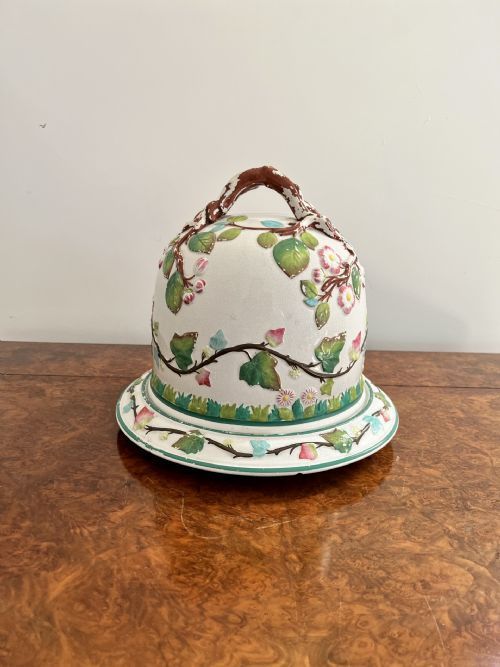


Victorian Earthenware Cheese Dish
These Victorian earthenware cheese dish examples bring sculptural utility to the dining table, offering collectors a robust piece of period serveware.
Victorian Earthenware Cheese Dish
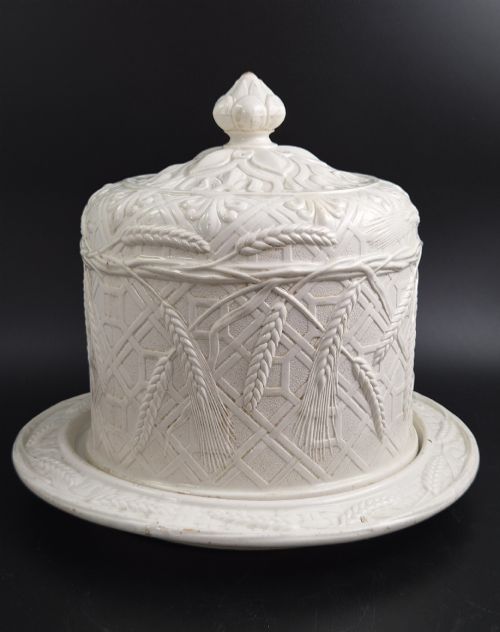
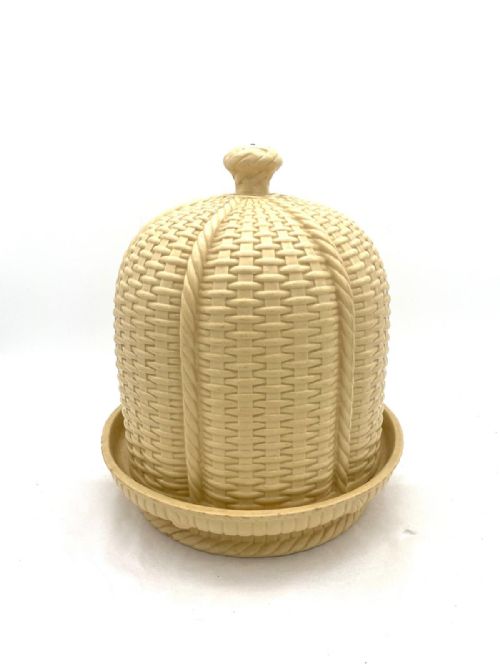
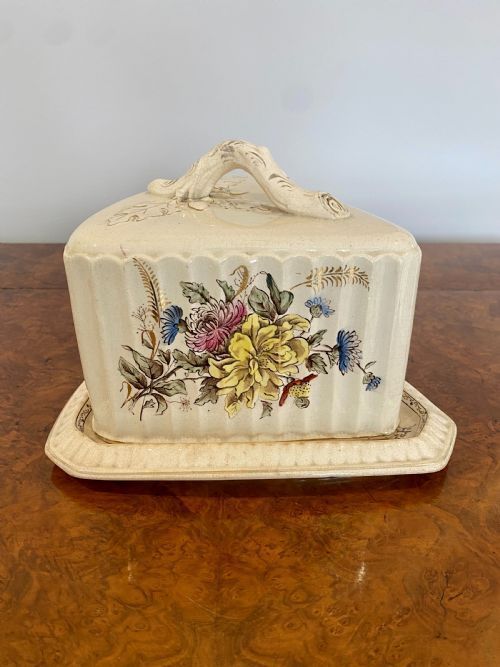
When you search for a victorian earthenware cheese dish, you encounter substantial lidded vessels designed specifically for storing and presenting cheese at the nineteenth-century table. Most examples on this page date from around eighteen-eighty and span the Victorian and Edwardian eras, taking the form of distinct cheese domes, bells and matching stands.
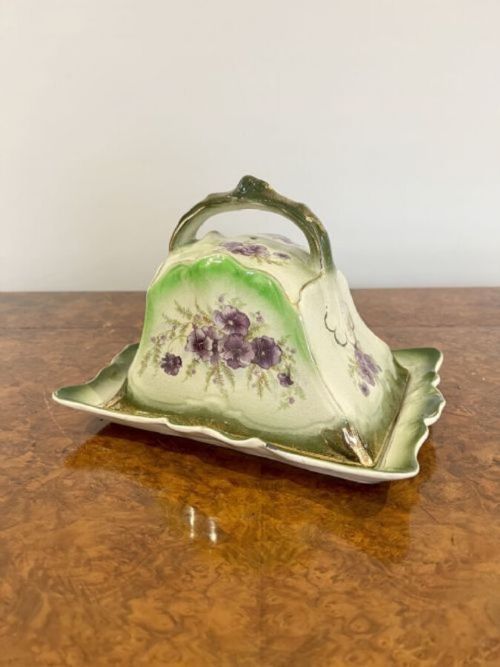
The objects vary from stark white ironstone to richly coloured majolica glaze and drabware. Formats include large covered servers often decorated with moulded motifs like wheat, lattice or basket weave patterns.
How they were made
Potters shaped these vessels using earthenware and ironstone bodies, applying coloured majolica glazes or plain white finishes before firing. Many pieces feature intricate moulded relief work such as basket weave or wheat and lattice designs, requiring skilled handling of the clay before glazing.
Certain iterations incorporate gilding over the ceramic body to highlight moulded details, while others rely entirely on the gloss and depth of the majolica glaze for decorative effect.
Victorian diners required dedicated domes simply because unshielded cheese invited adventurous parlour mice to dinner.
What varies in quality
Quality rests in the crispness of the moulded relief and the depth of the glaze, distinguishing finely detailed majolica and drabware from simpler utilitarian vessels. Pieces featuring elaborate textures like basket weave or wheat motifs demand precise craftsmanship.
The presence of a matching stand or base elevates the integrity of the piece, as does the preservation of original gilding and the uniformity of the ceramic body.
James Dudson
The Victorian Earthenware Cheese Dish Glossary
- Earthenware
- Porous ceramic fired at lower temperatures, requiring a glaze to become impermeable. It forms the primary body for majolica and drabware pieces.
- Ironstone
- A durable, dense type of semi-vitreous earthenware patented in the nineteenth century. It provides a robust white surface well-suited for heavy-use serveware.
- Majolica glaze
- A colourful, glossy lead-glaze applied over an opaque white tin enamel or directly onto the biscuit fired clay. It creates vibrant greens, browns and purples on Victorian cheese domes.
- Drabware
- A style of unglazed or simply glazed stoneware or earthenware featuring muted greyish-brown or olive tones. It gained popularity for domestic utility wares during the nineteenth century.
- Cheese dome
- The large, usually domed cover designed to fit over a stand or tray to keep cheese fresh. These covers frequently feature a finial handle on top for lifting.
Victorian Earthenware Cheese Dish: Frequently Asked Questions
What is a victorian earthenware cheese dish?
A victorian earthenware cheese dish is a covered ceramic vessel consisting of a dome and matching stand, utilised in the nineteenth century for keeping cheese fresh and presenting it at the table.
These pieces range from plain white ironstone to heavily moulded majolica and drabware finishes.
How were these cheese dishes used?
Victorian households utilised these covered dishes to store blocks of cheese on the sideboard or dining table, protecting the food from dust and drying out.
The domed cover trapped moisture while the matching stand caught crumbs and supported the weight of large cheeses like Stilton.
How do I identify majolica glaze?
Majolica glaze is characterised by its bright, glossy colours and rich saturation, often utilising greens, browns and yellows over moulded earthenware surfaces.
This technique creates a vibrant, reflective finish that highlights textured details such as basket weave or botanical motifs.
What is ironstone?
Ironstone is a dense, hardwearing type of ceramic developed to resist chipping more effectively than standard earthenware while remaining cheaper than porcelain.
Nineteenth-century makers utilised it extensively for durable domestic items like white cheese domes and heavy tableware.