



Victorian Anglo Indian Cabinet
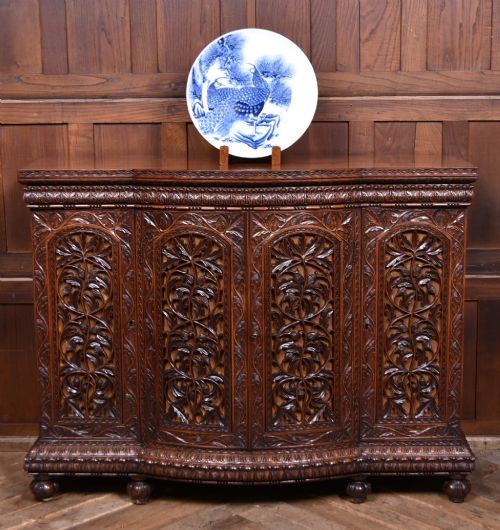
A victorian anglo indian cabinet brings rich colonial craftsmanship and dense botanical carving directly into a room, offering both storage and striking presence.

Victorian Anglo Indian Cabinet
A victorian anglo indian cabinet spans substantial sideboards, glazed bookcases, compact side cabinets, and corner cupboards produced during the nineteenth century. These forms emerge from colonial workshops blending traditional British furniture shapes with intricate South Asian and Burmese carving traditions. Most examples encountered here date from the nineteenth century, including specific pieces recorded around eighteen eighty.
The objects serve varied domestic functions, ranging from large dining room sideboards and display cabinets to smaller linen presses, desktop smokers cabinets, and writing desks. Anglo-Indian, Anglo-Indian Colonial, Anglo-Burmese, and Victorian Gothic Revival styles dominate the forms available. Buyers select these items for their architectural scale, deep relief carving, and rich timber tones.
How they were made
Makers construct these cabinets using dense exotic timbers such as padouk wood, teak, satinwood, rosewood, cedar, elm, and general hardwood. These woods provide the stability required for deep chisel work and heavy surface relief without splitting or warping.
Artisans employ extensive hand carving to cover surfaces with dense foliate, floral, and figurative motifs. Brass hardware often secures doors and drawers, while glazed panels feature in bookcases and display cabinets.
Desktop smokers cabinets offer miniature colonial grandeur for those who prefer their heavy timber carving on a diminutive scale.
What varies in quality
The depth, crispness, and continuity of the hand carving dictate the aesthetic standing of each piece. Superior examples display sharp relief work where every leaf and scroll remains distinct and balanced across the entire carcase.
Timber selection and grain matching further separate standard production from finer commissions. Dense, highly figured padouk or rich satinwood with clean joinery elevates the overall integrity of the cabinet.
The Victorian Anglo Indian Cabinet Glossary
- Padouk
- A heavy, durable tropical hardwood with a deep reddish-brown colour that darkens with age. It forms the primary material for many nineteenth-century sideboards and cabinets.
- Satinwood
- A luminous, yellowish timber prized for its smooth grain and reflective surface. It appears on select side cabinets and refined case furniture.
- Linen Press
- A tall piece of furniture traditionally used for storing folded textiles and linens. Miniature versions also occur within this category.
Victorian Anglo Indian Cabinet: Frequently Asked Questions
What is an anglo indian cabinet?
An anglo indian cabinet is a nineteenth-century piece of furniture made in South Asia or Burma for British colonial officers and the export market. It combines familiar European forms like sideboards and bookcases with local carving techniques and native timbers.
These items range from large dining room sideboards to small desktop cabinets. Their defining feature is the dense, botanical relief carving executed in dense woods like padouk and teak.
How do I identify the wood used?
Identifying the wood requires examining the colour, grain pattern, and weight of the cabinet. Padouk typically shows a rich reddish hue, while satinwood presents a bright, golden yellow appearance with a fine lustre.
Teak and general hardwoods offer a heavier, darker brown tone with visible oil content. Close inspection of unpolished interior surfaces helps confirm the exact timber variety.
How do I care for padouk furniture?
Caring for padouk furniture involves maintaining stable humidity levels and avoiding direct sunlight. Tropical hardwoods can react to dry indoor heating if placed too close to heat sources.
Dust the carved surfaces regularly with a soft brush to prevent dirt accumulation within the deep recesses. Periodic application of appropriate wax preserves the natural lustre of the timber.