
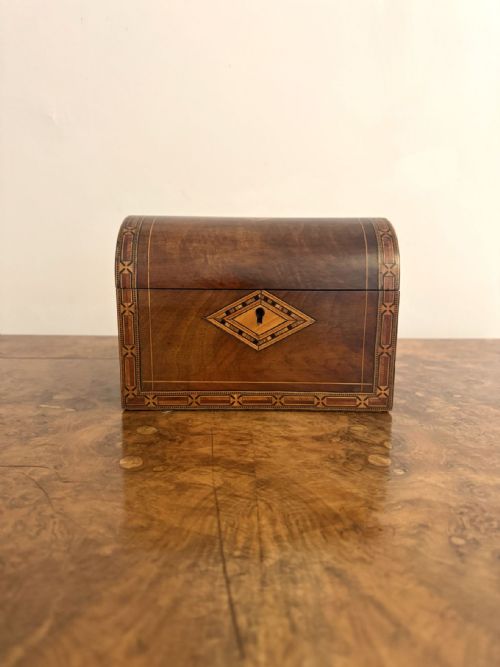
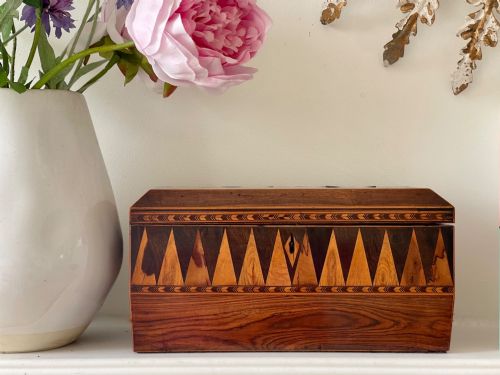

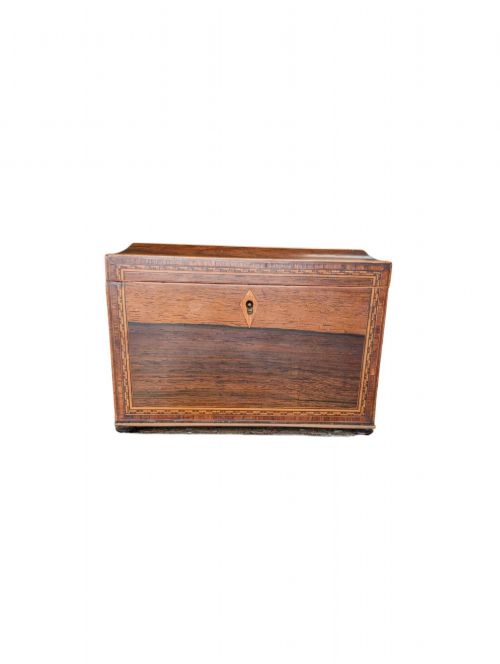


Tunbridge Ware Tea Caddy
A tunbridge ware tea caddy brings intricate mosaic wood pictures into daily service, combining fine cabinetry with meticulous micro-mosaic panels.
Tunbridge Ware Tea Caddy
A tunbridge ware tea caddy represents a specialised form of decorative woodwork produced across Georgian, Regency, and Victorian periods. These receptacles held expensive tea leaves securely, often featuring fitted interiors for the storage of dry leaves.
Rosewood and walnut frequently form the primary carcass of these boxes, while boxwood, holly, and sycamore provide contrasting tones for the detailed inlay. The most common versions encountered here date from the nineteenth century, including specific geometric or floral mosaic panels.
Makers utilised various forms ranging from standard rectangular boxes to domed tops, eight-sided shapes, and double compartments. Many examples display specific regional views such as Hever Castle alongside traditional tumbling block patterns.
Materials and Technique
Craftsmen constructed the core of the box using dense hardwoods like rosewood and walnut, which provided a stable foundation for decorative treatments. Thin veneers of these dark woods often wrap the exterior structure.
The characteristic surface decoration relies on thousands of tiny wood blocks glued together in bundles and sliced transversely to create identical mosaic tiles. Boxwood, holly, and various stained woods supply the pale and colourful elements required for pictorial panels and geometric bands.
Makers integrated brass elements for locks and hinges, whilst internal compartments frequently retained fitted lids to preserve the aroma of the contents.
Some boxes depict historic landmarks like Hever Castle in microscopic strips of wood.
Distinctions in Quality
The complexity and density of the mosaic work distinguish ordinary boxes from masterworks. Tighter geometric arrangements and pictorial representations of buildings require significantly greater skill than simple banding.
The survival rate of the microscopic wooden tesserae dictates the integrity of the piece, with superior examples retaining every minute element of the design. The quality of the underlying cabinet work, including the precision of the fitted interior compartments, also separates standard production from exceptional pieces.
Henry Hollamby
The Tunbridge Ware Tea Caddy Glossary
- Tunbridge Ware
- A type of decorative woodwork originating from Kent, characterised by minute mosaic tiles forming pictorial or geometric designs. Individual wooden rods are glued together and sliced to create these complex patterns.
- Tumbling Block Pattern
- An optical illusion design created using rhombuses of different shaded woods to give a three-dimensional cube effect. This geometric motif appears frequently on nineteenth-century pieces.
- Parquetry
- Geometric mosaic woodwork formed by fitting solid wood veneer pieces together onto a surface. It differs from marquetry by strictly employing angular, geometric shapes.
- Fitted Interior
- An internal arrangement within a box, often comprising covered compartments or mixing bowls. These sections kept different varieties of tea separated and protected.
Tunbridge Ware Tea Caddy: Frequently Asked Questions
What is a tunbridge ware tea caddy?
A tunbridge ware tea caddy is a small wooden storage box decorated with intricate mosaic patterns made from thousands of tiny dyed and natural wood blocks.
These pieces were produced primarily in the nineteenth century in England and were designed to keep dry tea leaves fresh while displaying remarkable woodworking skill.
How were these caddies used?
Tea was a valuable commodity in Georgian and Victorian households, requiring secure storage under lock and key.
The containers typically featured internal compartments to separate different types of tea leaves before blending them in a central mixing bowl.
How do I date a tunbridge ware tea caddy?
Stylistic shifts and materials help establish the period of manufacture, moving from Georgian simplicity through Regency elegance to elaborate Victorian mosaic work.
Earlier examples often rely on simpler wood inlay, whilst mid to late nineteenth-century pieces frequently showcase complex pictorial panels and tumbling block motifs.
How do I care for a wooden tea caddy?
These boxes require stable environmental conditions away from direct sunlight and excessive moisture to protect the delicate wood veneers and tiny mosaic tiles.
Light dusting with a dry cloth maintains the surface without risking damage to the historical glues and intricate wooden elements.