


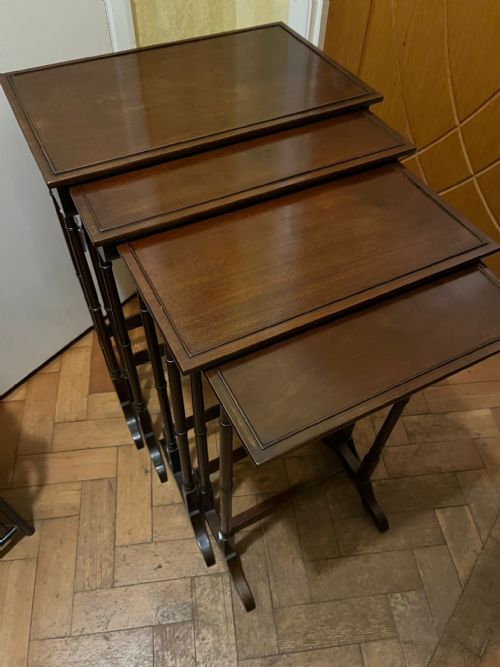


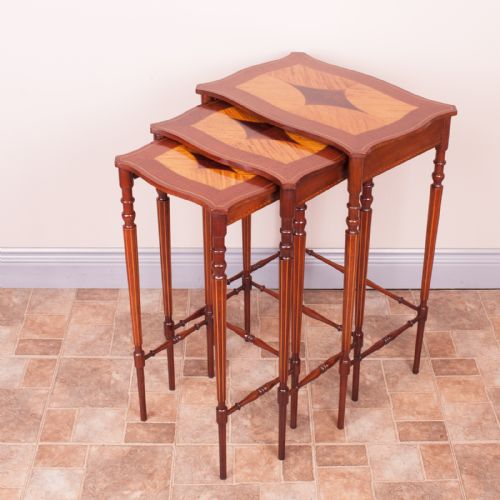

Traditional Brown Nest Tables
Traditional brown nest tables offer practical tiered surfaces for living spaces, appearing here in mahogany, walnut, and oak from Victorian to 1930s periods.
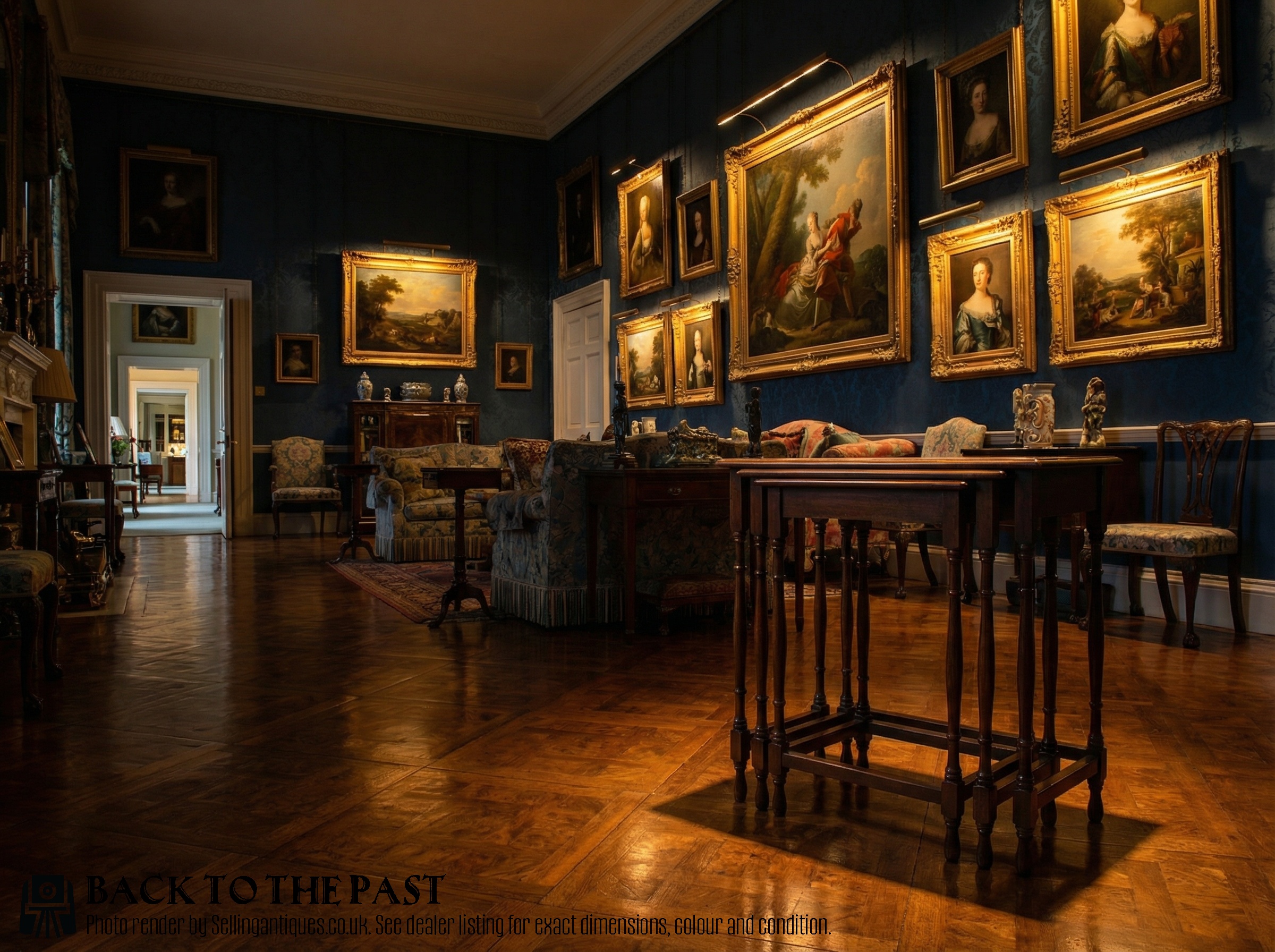
Traditional Brown Nest Tables
Traditional brown nest tables group multiple smaller surfaces that slide neatly beneath one another to save floor space when not in use. These sets span from the nineteenth century through the Edwardian era into the 1930s, reflecting changing domestic needs.
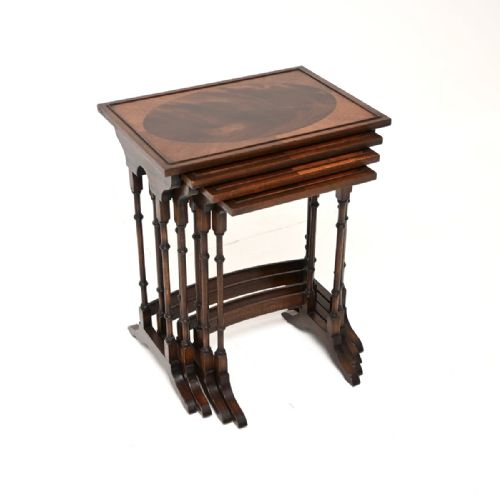
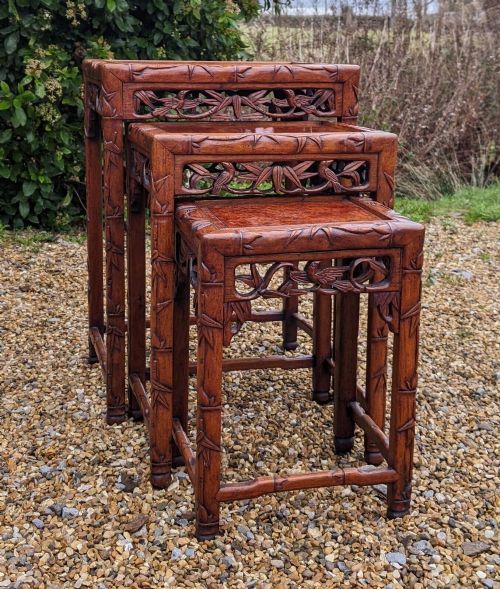
The versions most common on this page are mahogany sets of three or four tables, alongside examples in walnut, oak, and oriental hardwood. They take rectangular, oval, and shaped top forms designed for occasional living room use.
How traditional brown nest tables were made
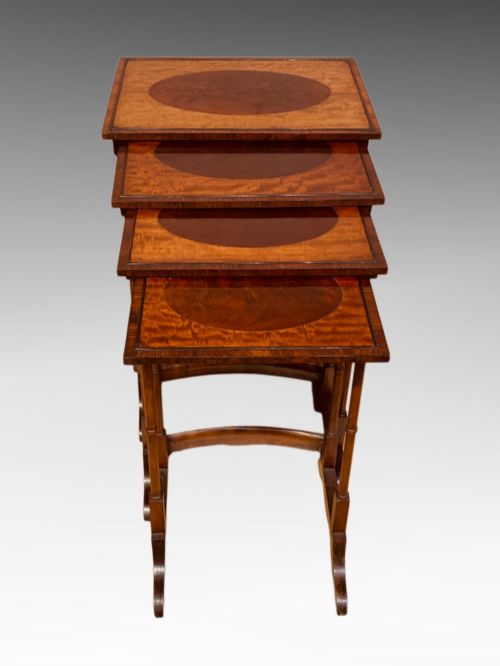
Cabinet makers utilised solid timbers alongside veneers, applying mahogany, walnut, oak, and satinwood over supportive frames. Selected pieces incorporate decorative inlay work and parquetry patterns across the top surfaces.
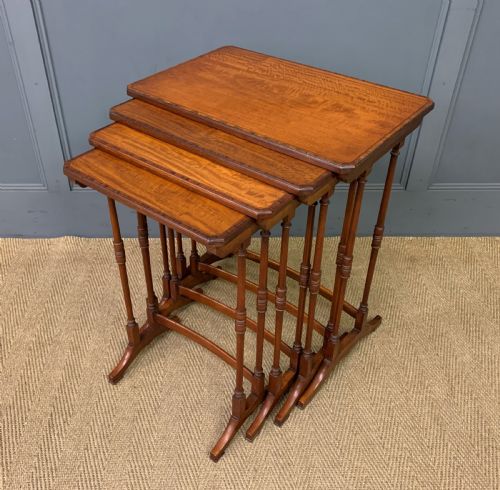
Construction methods range from turned legs and barley twist supports to graduated frames built to slide sequentially into the largest outer table. Finish relies on polished wood surfaces that highlight natural grain patterns.
Listings span from the 1880s through Victorian and Edwardian periods up to the 1930s, featuring mahogany, walnut, oak, and hardwood.
What varies in quality in traditional brown nest tables
Quality rests upon timber selection and the precision of the sliding fit, where superior examples exhibit closely matched wood grain across all graduated tiers. Finer pieces demonstrate careful attention to inlaid details and sturdy leg construction.
Simpler sets prioritise utility with plain timber tops and straightforward turned supports, whereas high quality production shows refined shaping to the edges and superior finishing to the hidden underframes.
The Traditional Brown Nest Tables Glossary
- Quartetto
- A matched set of four small tables designed to nest together. This term appears frequently in Edwardian and nineteenth-century descriptions.
- Graduated
- Describing tables made in diminishing sizes so each smaller tier slides smoothly beneath the preceding one. This construction defines the functional nature of the form.
- Inlay
- Decorative pieces of contrasting wood or satinwood fitted flush into the primary timber surface. This technique adorns many Edwardian and nineteenth-century table tops.
- Barley twist
- A spiral turning carved into the vertical legs of a table. This detail occurs on oak and hardwood examples from the early twentieth century.
- Parquetry
- Geometric patterns formed by small pieces of wood veneer arranged across a surface. It adds visual texture to select tabletops in the collection.
Traditional Brown Nest Tables: Frequently Asked Questions
How were traditional brown nest tables used?
These tables served primarily as occasional surfaces for tea, drinks, or books in Victorian and Edwardian sitting rooms. Homeowners kept them tucked together against a wall and pulled the tiers out individually as visitors arrived.
Their modular design made them adaptable for smaller interior spaces where permanent large tables would obstruct movement. The graduated sizing allowed households to deploy one, two, or four surfaces simultaneously depending on immediate needs.
How do I identify an Edwardian nest of tables?
Edwardian examples often feature light mahogany frames combined with delicate satinwood inlay work across the top surfaces. They typically comprise sets of three or four tables with slender tapered or turned legs reflecting the lighter aesthetic of the period.
Construction from this era frequently pairs traditional cabinet-making methods with balanced proportions suited to polite drawing rooms. Comparing the leg turnings and wood types helps distinguish them from heavier nineteenth-century or later 1930s variants.
What woods were used for these tables?
Makers relied heavily on mahogany, walnut, and oak, supplemented by satinwood, teak, and oriental hardwoods such as huanghuali. Timber choice often correlates with the period, from rich nineteenth-century mahogany to early twentieth-century oak and walnut.
Veneers and burr walnut also appear on select table tops to create decorative grain patterns. Each timber responds differently to polishing, yielding either deep red-brown tones or lighter golden hues.
How do I arrange nest tables in a modern room?
Nest tables fit well beside sofas or armchairs where the smaller tiers can be separated to hold cups or reading materials. Keeping the set nested creates a compact accent table when floor space is required for other activities.
Distributing the individual tables around a seating area provides functional surfaces while maintaining visual balance. The consistent brown timber tones allow them to anchor easily alongside various seating styles.