

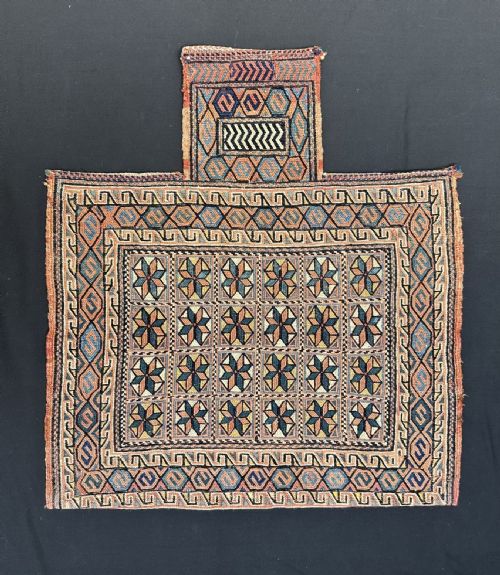
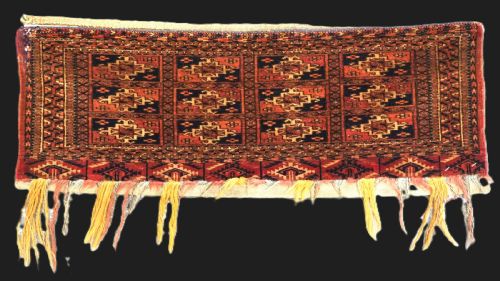


Terracotta Wool Woven Bag
When you trace a terracotta wool woven bag, you step directly into the nomadic weaving traditions of Central Asia, Persia, and the Caucasus.
Terracotta Wool Woven Bag
A terracotta wool woven bag represents functional nomadic art created by tribal groups for storage, transport, and dowry purposes. These pieces encompass utilitarian forms such as saddle-bags, salt-bags, tent-pole bags, and storage torbas.
The selections encountered here span from the mid-nineteenth century into the early decades of the twentieth century, originating from Turkmen tribes, Persian confederations, and Caucasian groups. You will find complete pieces retaining their original backs alongside bag faces that now function as decorative textiles.
Nomadic weavers structured these textiles to endure the rigours of camp life while displaying tribal identity through distinct secondary motifs and field patterns. The recurring terracotta ground tones anchor designs dominated by traditional guls, medallions, and banded flatweaves.
Factors of distinction
Quality rests upon the fineness of the weave, the clarity of the tribal motifs, and the depth achieved by natural dye palettes. Pieces demonstrating exceptionally tight knotting or precise structural execution command greater attention from collectors.
The survival of original components, including complete backs, tassels, and closure systems, elevates an example. Condition and integrity separate standard bag faces from fully preserved utilitarian storage containers.
Some tent-pole bags served to secure the nomadic dwelling while doubling as portable household art.
The Terracotta Wool Woven Bag Glossary
- Torba
- A small storage bag produced by Turkmen tribes, traditionally utilised inside the yurt for household possessions. These items often feature characteristic primary guls across the face.
- Mafrash
- A large rectangular storage bag or bedding chest panel associated with nomadic transport and tent organisation. They typically display horizontal banded designs or soumac weave.
- Chuval
- A large Turkmen storage sack intended for bedding and heavy goods. Examples frequently exhibit multiple rows of major tribal guls.
- Gul
- A medallion or repeated octagonal motif central to Turkmen and tribal textile design. Each pattern traditionally identifies a specific clan or tribal grouping.
- Khorjin
- The traditional Persian term for a double saddle-bag designed for animal transport. These pieces join two storage compartments with a central slit web.
Terracotta Wool Woven Bag: Frequently Asked Questions
What were these bags used for?
Nomadic groups utilised these containers for storing salt, household goods, bedding, and personal belongings inside tents or during seasonal migrations.
Double saddle-bags served practical transport needs across pack animals, while smaller pouches held specific domestic items.
How do I distinguish between tribal groups?
Distinctive design elements such as specific gul patterns, border arrangements, and structural weaves help identify particular tribes like the Yomut, Tekke, or Shahsevan.
Colour palettes and flatweave techniques also point directly to the specific region of origin, from the Caucasus to South Persia.
Can I hang a bag face on the wall?
Many collectors display bag faces as flat textile art to appreciate the intricate wool work and natural dye variations without structural strain.
Mounting methods should distribute the weight evenly across the upper edge to preserve the integrity of the antique fabric.
Why do some pieces retain their backs?
Complete examples kept their original plain-weave wool or goat hair backs because they remained intact within nomadic households rather than being divided into decorative fragments.
Surviving backs provide complete structural context for how the storage containers functioned in daily camp life.