
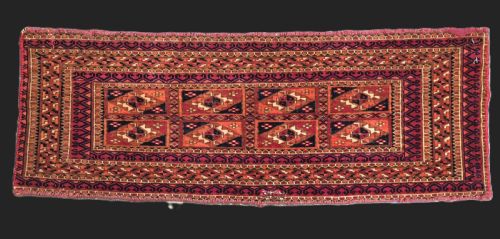
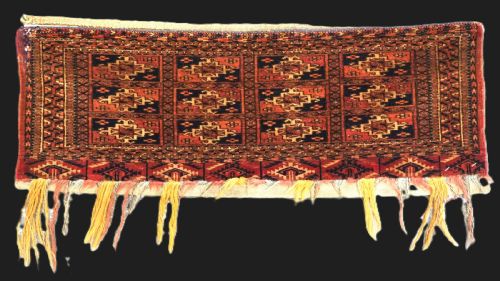


Tekke Turkmen Torba
These tekke turkmen torba examples are tribal bag faces and complete storage sacks woven in Central Asia during the nineteenth century.
Tekke Turkmen Torba
A tekke turkmen torba is a traditional tribal storage bag or face originating from Central Asian nomadic weavers. These nomadic weavings served functional purposes within the tent household, often created as dowry weaving or utility sacks.
Most pieces seen here date from the nineteenth century, specifically spanning the period from eighteen fifty through to eighteen eighty. They appear as complete pieces with plain weave backs or as individual bag faces.
Forms include examples featuring nine gul, six gul, fifteen gul layouts, or specific arrangements like chuval guls and kedjebe designs. Some pieces arrive as fragments or in pairs, reflecting their long history in tribal use.
Evaluating Quality
Quality in a tekke turkmen torba rests on the density and fineness of the weave alongside the complexity of the gul arrangement. Examples displaying scarce designs or unusual medallion counts command attention from serious textile enthusiasts.
The presence of original backs and structural completeness significantly alters the character of a piece compared to isolated faces or fragments. Fineness of knotting and the skillful deployment of natural dyes distinguish the upper tier of tribal output.
Tekke Turkmen Torba Retail Price Guide 2026
Typical asking prices for tekke turkmen torba among the pieces listed under this phrase on Sellingantiques today, from the lower quarter to the upper quarter. They describe what is for sale here now, not the wider market.
These nomadic storage bags once doubled as dowry items, carefully woven to impress prospective in-laws with knotting skill.
The Tekke Turkmen Torba Glossary
- Torba
- A small tent storage bag produced by Turkmen nomadic groups. These utility sacks hung inside the dwelling to store personal possessions or household goods.
- Gul
- The primary repeating medallion motif found on Turkmen carpets and bags. Each tribal group utilised distinct gul patterns to signal lineage and identity.
- Chuval
- A large tent bag used for household storage within the nomadic camp. The motifs found on chuval pieces occasionally appear in torba designs.
- Plain weave
- A simple unpiled structural weave used for the backs of bags and utility sacks. This technique provides lightweight strength behind the denser pile face.
- Kedjebe
- A specific camel trapping or wedding procession design adapted for use on tribal textiles. This pattern adds intricate geometric detail to the textile surface.
Tekke Turkmen Torba: Frequently Asked Questions
What is a torba used for?
A tekke turkmen torba functioned as a practical storage bag inside the nomadic tent. Families utilised these sacks to hold small possessions, utensils, or personal belongings.
Over time, many of these bags lost their original utility context and survive today as collected tribal textile art.
How do I identify a torba?
You identify a tekke turkmen torba by its characteristic format as a rectangular bag or bag face featuring repeating tribal guls. These pieces generally display distinctive Central Asian colour palettes derived from natural dyes.
Proportions are typically wider than they are tall, designed to hang securely against the lattice walls of a yurt.
Are these pieces complete?
Some examples survive as complete sacks featuring their original plain weave wool backs and closure systems. Others appear simply as decorative bag faces or surviving fragments from the nineteenth century.
Each listing specifies whether the textile retains its original back or presents as a face alone.
How should I display a textile?
Tribal bag faces and complete torbas mount successfully on stretched fabric panels or hang safely from non-damaging wooden suspension rods. Keeping textiles away from direct sunlight protects the natural dyes from fading over time.
Gentle vacuuming through a protective mesh screen helps maintain the wool pile without stressing the historic structure.