
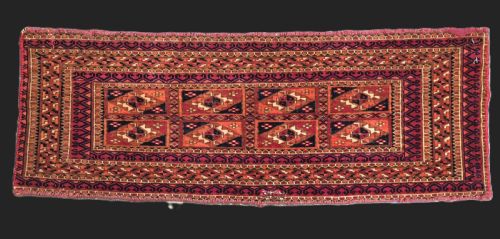
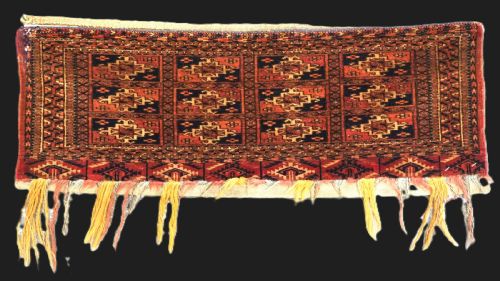


Tekke Gul Textile
When you search for tekke gul textile, you encounter tribal weaving rooted in Central Asian nomadic traditions.
Tekke Gul Textile
A tekke gul textile represents the utilitarian and decorative output of Turkmen tribal groups from the nineteenth century. Buyers on this page will primarily encounter torba faces, chuval faces, and complete tent bags originating between eighteen-fifty and nineteen hundred.
These items served functional roles in nomadic domestic life, functioning as storage sacks for household possessions and dowry belongings. Many examples survive as individual faces detached from their original plain weave backs, though complete bags with backs also appear.
The visual vocabulary relies heavily on repeated primary motifs known as guls, alongside secondary ornaments and border systems. Pieces range from smaller torbas designed for wall placement or smaller storage to larger chuvals utilised for bedding and blankets.
How they were made
The makers utilised wool spun by hand, building the textile structure through dense knotting paired with flat woven details. Natural dyes provide the palette, creating soft hues alongside vibrant cochineal highlights.
Weavers constructed these pieces with varying knot density, ranging from standard structural counts to exceptionally fine weaves found in dowry pieces. Plain weave backs, where present, were executed in simple utility weaves to balance the heavy pile face.
Listings span the nineteenth century, covering years from eighteen-fifty to nineteen hundred with a heavy concentration in eighteen-eighty.
What varies in quality
Quality rests upon the precision of the drawing and the complexity of the gul arrangement within the field. Tighter knot density and finer weaves distinguish superior dowry pieces and special commissions from standard utility sacks.
The handling of natural dyes dictates visual depth, where skilled dye work produces rich colour variations across the pile. Condition also plays a role, separating heavily worn fragments from complete examples retaining original hanging loops or full plain weave backs.
The Tekke Gul Textile Glossary
- Gul
- A primary medallion motif repeated across tribal rugs and textiles. These octagonal or polygonal designs identify the specific tribal group responsible for the weaving.
- Torba
- A small horizontal storage bag produced by Turkmen nomads. They were typically hung inside the tent to store personal items and small household possessions.
- Chuval
- A large tent bag used for storing bedding, clothing, and household goods. These pieces feature prominent gul designs arranged in structured rows across the face.
- Mafrash
- A rectangular storage container or face used for bedding and baggage. They share structural similarities with torbas but often serve distinct placement roles in the tent.
- Cochineal
- A natural red dye derived from scale insects, utilised to produce brilliant pinkish-red highlights in the wool. Its presence often indicates careful dye work and superior material sourcing.
Tekke Gul Textile: Frequently Asked Questions
What is a tekke gul textile?
These items are traditional woven bags and bag faces created by Turkmen nomadic weavers during the nineteenth century. They function as both utilitarian storage containers and expressions of tribal identity.
Each piece incorporates distinctive geometric medallion motifs known as guls, worked in wool using natural dyes. They survive today as important examples of Central Asian textile art.
How were these bags used?
Nomadic families utilised these woven sacks inside their tents for organising clothing, bedding, and dowry possessions. Smaller torbas hung against the lattice walls, while larger chuvals held bulkier household goods.
The inclusion of hanging loops on certain examples demonstrates their practical suspension within the domestic interior space.
How do I care for a textile?
Protect antique wool textiles from direct sunlight to prevent natural dye fading over time. Gentle vacuuming through a mesh screen helps remove dust without disturbing the pile.
Avoid hanging heavy pieces by single points to prevent structural strain along the upper edge. Professional textile conservators should handle any necessary cleaning or mounting.
How do I date these pieces?
Dating relies on examining material characteristics, natural dye usage, and structural refinement within the weave. Mid nineteenth-century examples often display exceptionally fine knotting and distinct drawing styles.
Changes in palette and structure toward the end of the century help separate earlier tribal work from later nineteenth-century production.