



Staffordshire Spill Holder
These Staffordshire spill holder figures combine practical mantelpiece spill storage with popular ceramic animal and human subjects.
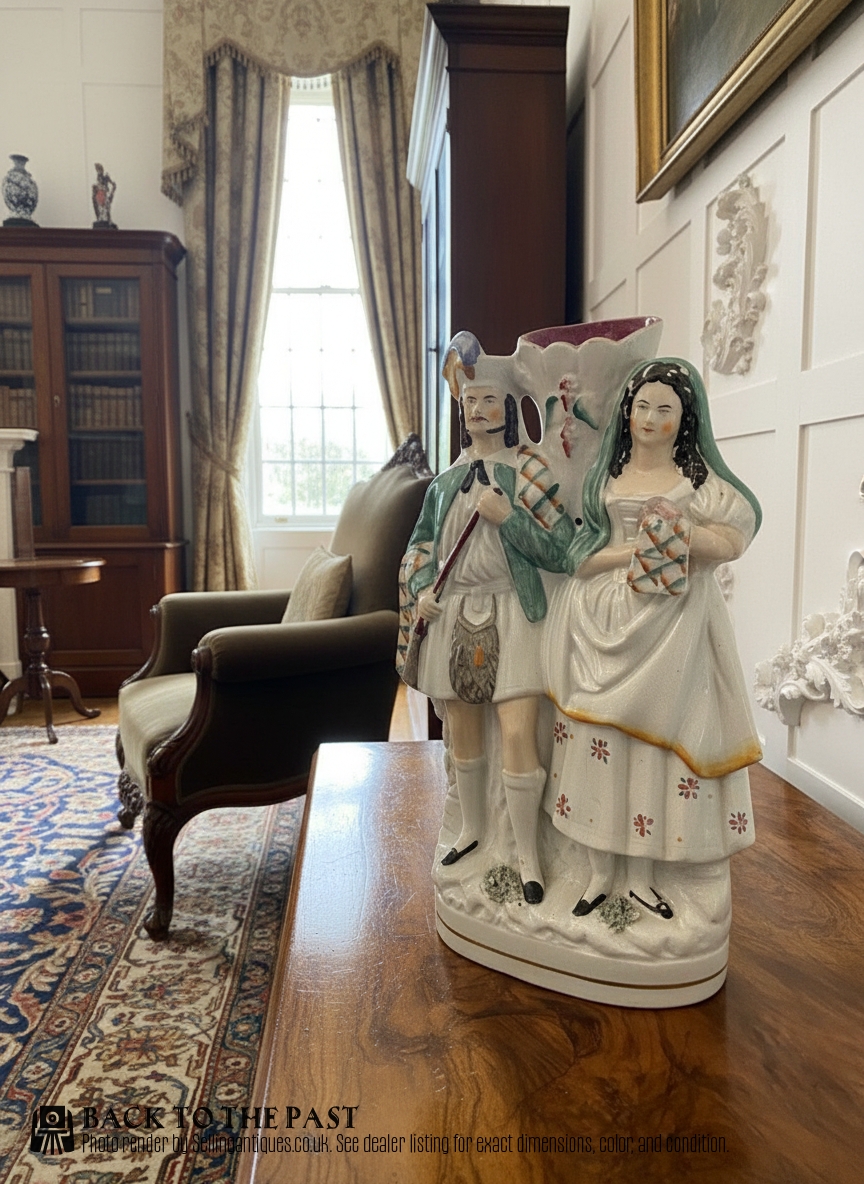
Staffordshire Spill Holder
A Staffordshire spill holder serves as a decorative mantelpiece vessel designed to hold thin wooden spills for lighting fires and candles. The pieces seen here span the Georgian, Regency, and Victorian eras, taking the form of earthenware figures and animals paired with hollow cylindrical tubes.
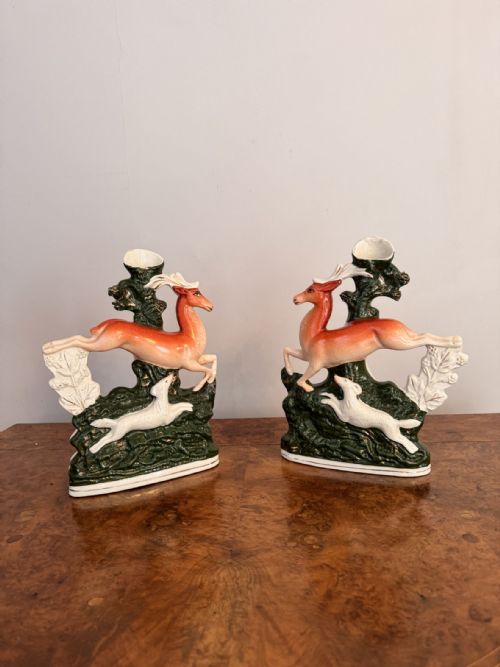
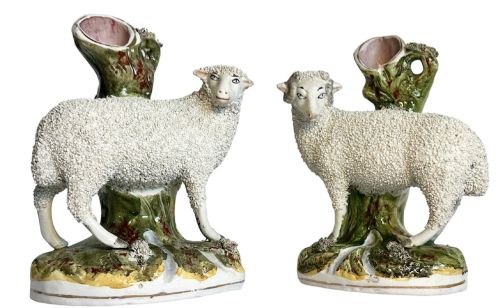
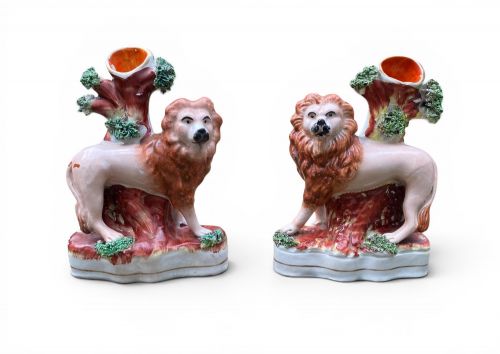
Animal groups dominate the selection, with pairs of sheep, deer, lions, swans, and dogs appearing frequently alongside human subjects such as Scots harvesters and literary scenes. These figures generally stand as flatbacks or freestanding models intended for display against a wall.
Most examples date from the nineteenth century, particularly around eighteen sixty, utilising traditional potting methods. Buyers will find both single figures and symmetrical pairs designed to anchor either end of a fireplace mantel.
How they were made
Potters shaped these objects using earthenware clay, frequently finished with a lead glaze or a pearlware glaze to give the surfaces a smooth, reflective sheen. The bodies were formed in moulds before receiving hand-applied details.
Makers applied enamel paints over the glaze to colour the animals, human figures, and foliage details before a final firing fixed the pigments. This combination of moulded earthenware and painted decoration defined the Staffordshire output of the period.
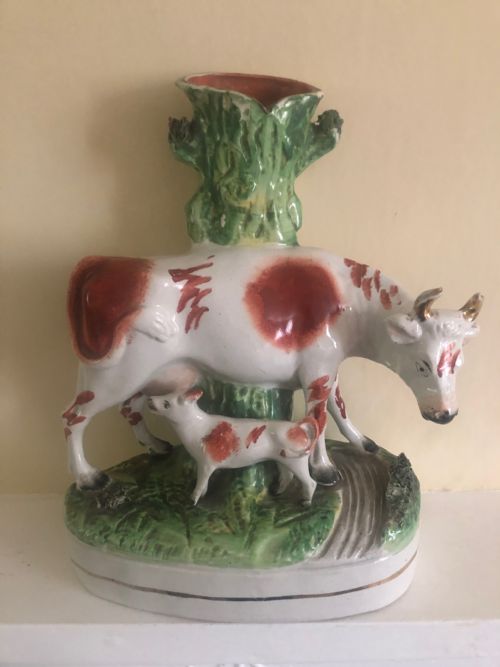
Animal subjects include sheep, deer, lions, swans, dogs, cows, and stags, frequently presented in matched pairs.
What varies in quality
The survival of matched pairs and the original glaze condition heavily influence the character of each piece. Superior examples retain bright, unblemished enamel colours and clean glaze surfaces without extensive crazing or later restoration.
Walton
The Staffordshire Spill Holder Glossary
- Spill
- A thin wooden slip or rolled paper used for transferring a flame from a fire to a candle or pipe. These vessels were made specifically to hold a cluster of them.
- Flatback
- A figure moulded with a finished front and sides while the rear remains largely unadorned and flat. This construction allowed the piece to sit flush against a wall or mantelpiece.
- Pearlware
- A fine earthenware developed in the late eighteenth century featuring a subtle bluish tint in the glaze. It was designed to mimic the appearance of Chinese porcelain.
- Lead glaze
- A glossy coating containing lead oxide applied to earthenware to seal the porous clay body. It gives the ceramic surface a characteristic bright lustre.
- Earthenware
- Porous pottery fired at lower temperatures than stoneware or porcelain. It forms the structural base for the vast majority of nineteenth century Staffordshire figures.
Staffordshire Spill Holder: Frequently Asked Questions
What is a Staffordshire spill holder?
A Staffordshire spill holder is a nineteenth century earthenware figure combined with a hollow vase designed to hold wooden fire lighting spills. They were produced primarily in Staffordshire potteries for domestic use on mantelpieces.
These pieces combined ornamental sculpture with a practical household function, depicting animals, figures, and architectural scenes.
How were spill holders used?
Households kept them filled with thin wooden splints near the fireplace to easily transfer a flame to candles, lamps, or tobacco pipes. The cylindrical holder kept the spills upright and ready for daily service.
When not in use, the vibrant enamel colours and sculptural subjects served as decorative mantel ornaments.
How do I date a Staffordshire figure?
Dating relies on stylistic clues, glaze characteristics, and potting methods associated with periods like the Regency and Victorian eras. Pearlware glazes generally point towards earlier nineteenth century production, while mid-Victorian pieces often feature flatback construction.
Comparing the modelling style and enamel palette to documented factory examples helps narrow the production window.
Are pairs more desirable than singles?
Matched pairs command greater interest because they were originally modelled and sold to sit symmetrically on either side of a fireplace. Finding a surviving pair of deer, sheep, or lions intact is less common than finding isolated single figures.
Single figures remain popular for shelf or cabinet display where symmetrical mantel placement is not required.
How should I clean my spill holder?
Dust the ceramic surface gently with a soft, dry brush to prevent accumulation in the crevices of the moulded details. Avoid using water, liquid cleaners, or abrasive cloths which can damage the delicate enamel paints applied over the glaze.
Keep the piece away from direct sunlight and damp environments to preserve the earthenware body and surface pigments.