


Staffordshire Meat Dish
A Staffordshire meat dish brings grand nineteenth-century dining to the table, offering generous proportions and bold transfer-printed scenes for everyday use.

Staffordshire Meat Dish
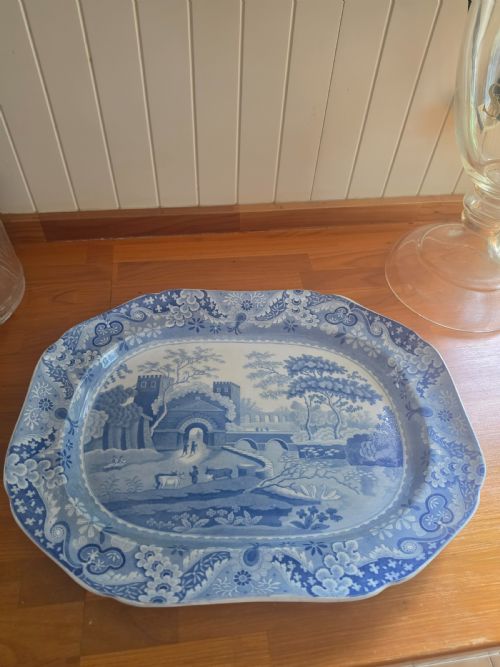
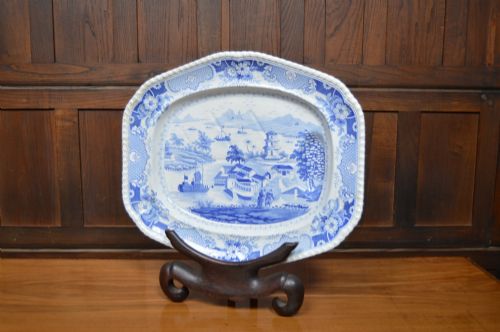
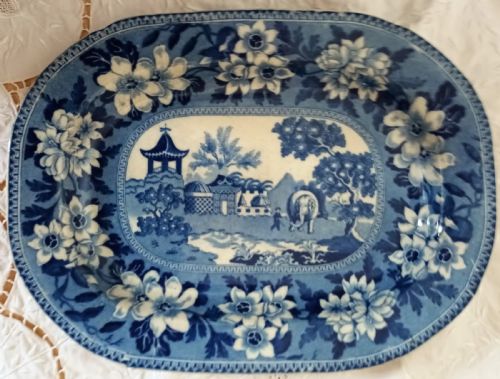
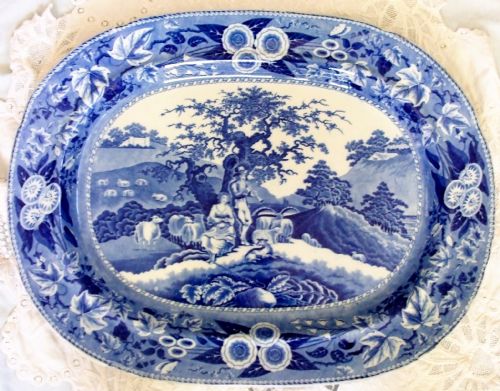
The pieces seen here span the Georgian, Regency and Victorian periods, reflecting shifting tastes from classical topographical views to exotic oriental patterns. Collectors encounter these serving vessels in earthenware, pearlware and robust ironstone, each material offering distinct weight and durability.
Blue and white transfer printing dominates the selection, bringing crisp pictorial detail to the surface through cobalt pigment under a clear glaze. Large serving platters range from simple domesticware to ambitious decorative items meant for display on a sideboard or dresser.
Materials and technique
Potters shaped these large serving dishes from earthenware, pearlware or dense ironstone, firing the clay bodies to create a sturdy foundation for heavy joints of meat. Ironstone provided exceptional strength, allowing makers to cast exceptionally large platters and integrated strainers without warping.
Makers applied intricate patterns using copperplate transfer printing, transferring engraved designs in cobalt pigment onto the biscuit ceramic before glazing and firing. This technique allowed potteries to produce complex scenes, from pastoral landscapes to architectural views, with remarkable speed and precision.
Dating spans from the Georgian era through the Victorian period, encompassing Regency refinements and mid-century industrial output.
Judging quality and craft
Quality in a transfer-printed platter rests upon the crispness of the cobalt impression and the stability of the glaze during firing. Superior examples show deep, even blue tones without blurring or smudging in the intricate borders and central scenes.
The presence of functional additions, such as a matching strainer or a well-formed gravy reservoir, elevates the practical and visual interest of a piece. Ironstone plates with sharp relief moulding and unblemished surfaces demonstrate superior kiln control and robust manufacturing standards.
John Rogers & Son·Elkin Knight & Bridgwood·Mason's Ironstone China·Spode
The Staffordshire Meat Dish Glossary
- Transferware
- Pottery decorated by pressing a paper sheet engraved with a copperplate design onto the ceramic surface, leaving a monochrome ink pattern ready for glazing.
- Pearlware
- A refined earthenware developed in the late eighteenth century featuring a subtle bluish glaze that pooled pleasingly in crevices and whuied the body.
- Ironstone
- A heavy, durable ceramic patented in the early nineteenth century that combined earthenware clay with slag of iron to resist chipping and cracking.
- Gravy well
- A recessed channel or depression at one end of a platter designed to collect meat juices during carving for easy spooning.
- Strainer
- A perforated ceramic insert that drops into the well of a meat dish to keep joints elevated above accumulated pan juices.
Staffordshire Meat Dish: Frequently Asked Questions
What were Staffordshire meat dishes used for?
These large ceramic platters served as the centrepiece for presenting roasted joints of meat and fowl at nineteenth-century dining tables. Their generous surface area accommodated carving at the table, while specialised versions handled the resulting pan juices.
Today, modern collectors utilise these historic dishes for large-scale serving during family gatherings or mount them securely as decorative wall plates in kitchens and dining rooms.
How do I tell Georgian meat dishes from Victorian ones?
Georgian and Regency platters often feature lighter earthenware bodies with delicate botanical borders or classical topographical scenes, reflecting neoclassical tastes. They tend to feel slightly lighter in the hand than later wares.
Victorian examples frequently utilise heavier ironstone bodies and feature denser, more complex transfer prints, including orientalist Chinoiserie subjects or elaborate industrial townscapes.
Why do some platters have holes in them?
Platters featuring pierced ceramic surfaces originally held a matching strainer insert designed to keep roasted meat elevated above its own juices. This prevented the meat from sitting in liquid while being carved at the table.
When a dish includes both a strainer and a gravy well at one end, it represents a complete functional set engineered for the formal nineteenth-century dining room.