

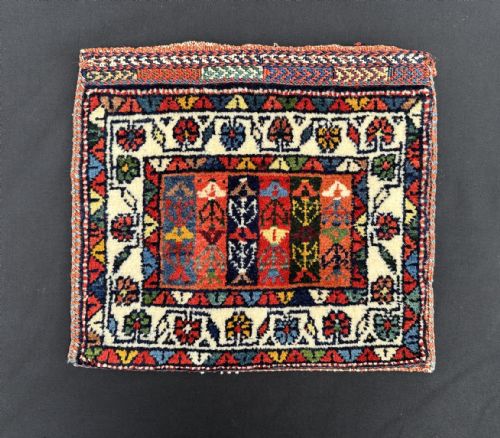


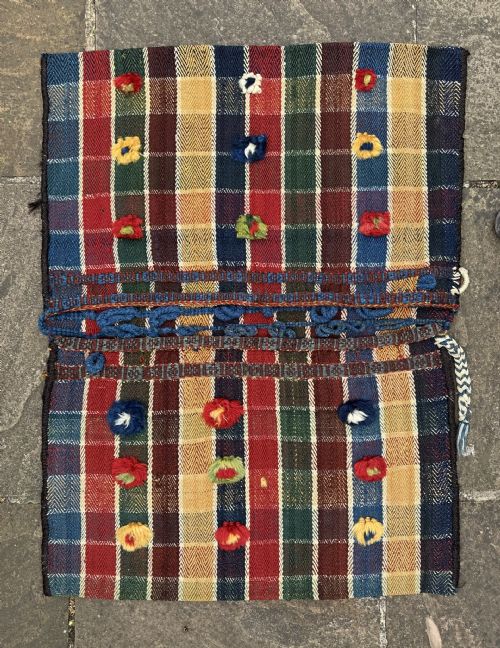


South Persian Khorjin
These south persian khorjin are woven tribal saddlebags and bag faces carrying generations of nomadic history in every knot.
South Persian Khorjin
A south persian khorjin is a traditional woven saddlebag or bag face produced by nomadic confederations such as the Qashqai, Afshar, and Khamseh. Collectors seek these pieces for their authentic tribal utility and dynamic geometric patterns originating from the Fars and Kerman provinces.
The selections available here span from the mid nineteenth century through the early twentieth century, showing periods like eighteen eighty, eighteen ninety, and nineteen hundred. You will frequently encounter surviving bag faces, personal chantehs, and occasionally complete double bags retained with their original backs.
Judging quality in tribal weaving
Quality rests upon the fineness of the knotting and the brilliance of the wool supply. Lustrous, luminous wool demonstrates superior material selection by the weaver, enhancing the visual impact of central medallions and boteh motifs.
Condition and completeness also distinguish pieces, as surviving complete double bags with backs remain scarcer than detached bag faces. The precision of tribal geometric drawing and the richness of the natural dye palette complete the evaluation.
The South Persian Khorjin Glossary
- Khorjin
- The Persian term for a traditional woven saddlebag used by nomadic tribes for transport and storage. These pieces often survive as single bag faces after the back sections were separated through decades of use.
- Chanteh
- A small personal bag or vanity bag woven by tribal women for carrying small possessions. These compact items display the same intricate knotting and design vocabulary as larger saddlebags.
- Boteh
- A recurring paisley or almond-shaped motif symbolizing life and eternity in Persian textiles. It appears frequently across Afshar and Khamseh tribal bag faces.
- Tayefeh
- A specific clan, tribe, or subtribe within a larger Persian nomadic confederation such as the Qashqai. Identifying the tayefeh helps pinpoint the geographic origin and specific weaving traditions of a piece.
- Pile
- The cut woolen surface of a rug or bag that forms the decorative design. Hand-spun wool provides the foundation for this raised texture.
South Persian Khorjin: Frequently Asked Questions
What is a khorjin?
A khorjin is a traditional double saddlebag woven by nomadic groups in Persia for carrying belongings during migration. They were constructed to hang across the backs of pack animals.
Over time, many of these utilitarian items were separated into individual bag faces to be used as small rugs or wall hangings.
How were these bags used?
Nomadic families utilised these bags for storing household goods, clothing, and personal items inside their tents and during seasonal migrations. Different sizes served different purposes, from large storage containers to small vanity bags.
Their sturdy construction was intended to withstand the harsh conditions of desert and mountain travel.
How do I care for a tribal bag face?
Protect antique wool textiles by keeping them out of direct sunlight to prevent natural dye fading. Gentle vacuuming without a beater bar removes dust safely from the pile.
Consult a professional rug conservator experienced in antique oriental textiles for any washing or repair needs.
How do I identify the tribe?
Tribal attribution relies on specific design vocabulary, colour palettes, and structural characteristics associated with groups like the Qashqai, Afshar, and Khamseh. Motifs such as botehs, central medallions, and specific border arrangements offer key clues.
Geographic origins often trace back to the Fars and Kerman provinces of south-west Persia.