
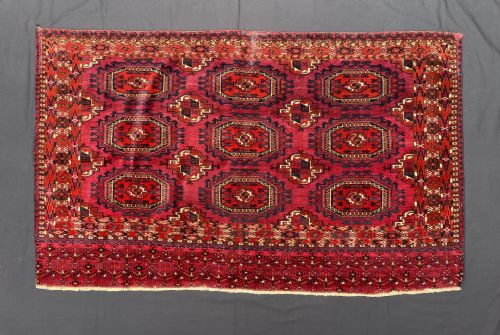


Small Turkmen Wall Hanging
These small turkmen wall hanging examples are tribal bag faces and fragments, offering rich nomadic artistry for modern interiors.
Small Turkmen Wall Hanging
When searching for a small turkmen wall hanging, collectors encounter genuine tribal bag faces, torbas, and mafrash panels originating from Central Asia. These items date from the mid-nineteenth century through the early twentieth century, spanning periods such as 1850, 1880, 1890, and 1900.
The pieces on this page mostly comprise utilitarian nomadic objects repurposed for display, including chuval faces, torba faces, and small storage bag fragments. Specific tribal attributions include Tekke, Saryk, Yomut, and Ersari groups, showcasing traditional formats designed for nomadic life.
Forms range from square torba faces to rectangular chuval fronts and bag fragments, often featuring classical tribal motifs like guls, tree designs, and hooked patterns. Their compact scale makes them well suited for mounting as textile art on interior walls.
How they were made
Nomadic weavers utilised hand-spun wool foundations paired with natural dyes to create durable pile textiles. Cotton and silk elements occasionally appear as accents, particularly in finer tribal bag faces and highlights.
Weaving techniques rely on dense knotting methods that produce tight structures, especially visible in fine dowry pieces and nineteenth-century fragments. Vegetable and insect dyes provide the deep crimson, madder, and earthy tones characteristic of Central Asian tribal rugs.
Many of these miniature masterpieces began life simply holding an ancient nomad's spare socks and spoons.
What varies in quality
The fineness of the knotting and the density of the weave set superior examples apart from standard tribal bag faces. Pieces produced for dowry purposes often display tighter foundations and greater precision in executing complex motifs.
Colour saturation and the variety of natural dyes significantly influence the visual depth of a piece. Well-preserved wool and silk highlights alongside clear, crisp tribal guls indicate higher standards of tribal weaving.
The Small Turkmen Wall Hanging Glossary
- Torba
- A small Turkmen storage bag used traditionally inside a yurt for household items. These bag faces are frequently displayed today as wall hangings.
- Chuval
- A large tent bag used for nomadic storage, whose face is often preserved and mounted as a textile panel. They display repeating primary guls.
- Gul
- A primary medallion or octagonal motif repeated across Turkmen carpets and bag faces to identify specific tribal groups. Each tribe utilised distinct stylistic variations.
- Mafrash
- A rectangular tribal storage container or bedding bag, often encountered as individual panels or flat-woven fragments. They share construction methods with other nomadic bags.
- Elem
- The decorative lower border panel of a Turkmen rug or bag face, often filled with floral or tree motifs. It provides a distinct framing device for the central field.
Small Turkmen Wall Hanging: Frequently Asked Questions
What is a Turkmen torba?
A torba is a small utility bag traditionally woven by Central Asian nomads for storing domestic possessions inside a tent.
Today, the decorative face of the bag is commonly mounted and displayed on walls as a textile artwork.
How old are these wall hangings?
The pieces listed date primarily from the mid-nineteenth century up to the early twentieth century, spanning the 1850s to the 1920s.
Weavers created them during the height of traditional nomadic tribal production in Central Asia.
Which tribes made these textiles?
Nomadic groups such as the Tekke, Saryk, Yomut, and Ersari produced these distinctive bags and decorative panels.
Each tribe developed recognizable gul patterns and colour palettes that help identify their origin.
How do I hang a textile safely?
Mounting ancient textiles requires non-damaging methods such as hand-sewing the piece onto a fabric-covered support board or using a padded Velcro suspension system.
Avoid direct weight or clamping pressure that might stress the fragile wool foundation.