
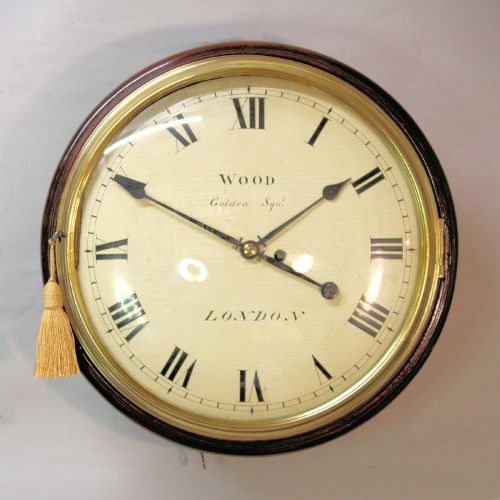


Single Fusee Timepiece
A single fusee timepiece is a reliable clock driven by a spring and a cone-shaped pulley, prized for its steady timekeeping and clean dial.
Single Fusee Timepiece
A single fusee timepiece is a clock designed solely to tell the time without striking the hours or quarters, keeping the mechanism straightforward and focused entirely on precision. The selection spans robust wall clocks, refined library pieces, and decorative mantel clocks suited for domestic settings.
Most examples date from the nineteenth century, including the Regency, Victorian, and Edwardian periods, reflecting the height of British horological skill. Buyers encounter wall-mounted dial clocks alongside table versions housed in architectural cases of marble, wood, or gilt bronze.
The core mechanical feature is the fusee itself, a spirally grooved pulley that equalises the diminishing pull of the mainspring as it unwinds. This clever device ensures steady force reaches the escapement throughout the running cycle, resulting in accurate daily performance.
Materials and construction
Cases utilise dense timbers like mahogany and oak, alongside luxurious ornamental metals such as ormolu, gilt bronze, and brass. Marble also appears in Regency mantel designs, providing substantial weight and a striking visual contrast to metal mounts.
Dial construction varies from traditional painted wooden convex faces on wall clocks to intricate metal chapters protected behind bevelled glass panes. Movement plates and gear trains are fashioned from brass, assembled by hand to ensure smooth interaction between the wheels and the escapement.
Several Victorian clock faces feature cherubs reaching eagerly for birds perched in trees.
Assessing quality and craftsmanship
Quality rests in the crispness of the movement engraving, the finish of the gilded mounts, and the integrity of the case joinery. Finer makers invested heavily in precise wheel cutting and hand-finished components that endure centuries of daily winding.
Proportion and material choice dictate the visual standing of each piece, distinguishing modest utility clocks from elaborate salon timepieces created by renowned London makers.
Phillips Brothers·Thomas Cole and James Cole·William Hardy London·Henry Berkeley Square London·John Massey·Baetens London·Richard Webster
The Single Fusee Timepiece Glossary
- Fusee
- A conical pulley with a spiral groove that regulates the pull of the mainspring. It compensates for the loss of power as the spring unwinds, ensuring constant force.
- Timepiece
- A clock that indicates the time without any striking mechanism. This simpler design allows for slimmer cases and quieter operation.
- Ormolu
- Finely ground high-carat gold applied to a bronze base using a mercury amalgamation process. This technique creates a rich, durable golden finish popular in Regency and Victorian decorative pieces.
- Escapement
- The mechanism that controls the release of power from the gear train to the pendulum or balance wheel. It gives the clock its characteristic ticking sound.
Single Fusee Timepiece: Frequently Asked Questions
Why does a timepiece not strike?
A timepiece is engineered strictly to show the hours and minutes without an audible chime or strike train.
This deliberate omission reduces mechanical wear and allows for more compact case designs.
Where should I place a wall clock?
Mount the clock securely on a solid interior wall away from draughts and direct sunlight.
Stable placement ensures the pendulum or balance remains plumb for accurate operation.
How do I identify the period?
Examine the case style, wood selection, and dial typography against documented design traits of the nineteenth century.
Signature engravings on the movement backplate often provide direct clues to the maker and decade.