





Sheraton Style Side Cabinet
These sheraton style side cabinet examples bring refined neoclassical elegance to a room, offering sophisticated storage through expert marquetry and fine timbers.
Sheraton Style Side Cabinet
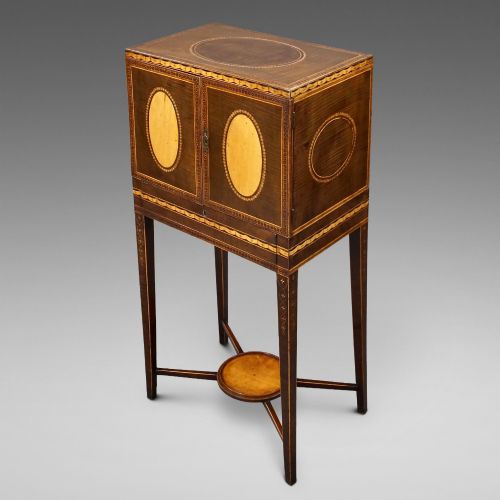
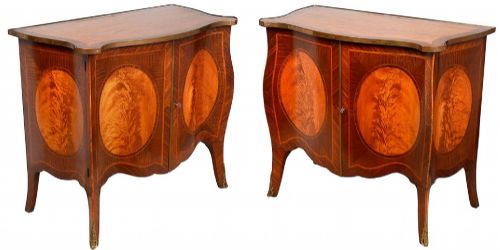
A sheraton style side cabinet encompasses graceful furniture forms designed for storage and display, drawing heavily on eighteenth-century classicism. Pieces on this page span several eras, originating predominantly from the Georgian period through to the Edwardian and Sheraton Revival phases of the late nineteenth and early twentieth centuries.
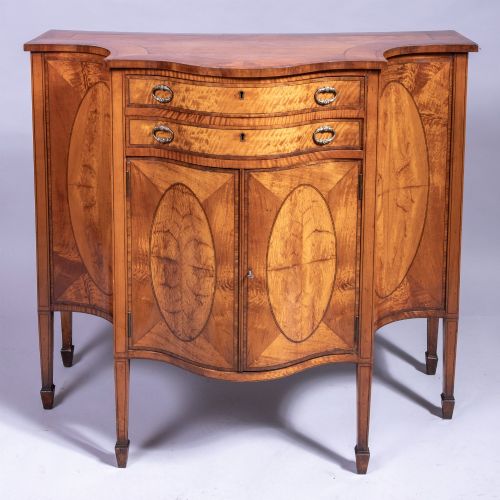
Buyers will encounter various formats ranging from demi-lune commodes and serpentine fronted cabinets to bedside companions and compact side cupboards. Satinwood and mahogany dominate the selection, frequently enhanced by contrasting crossbanding and classical marquetry panels.
How they were made
Cabinet makers built these pieces using solid mahogany or framing carcasses in pine or oak before applying veneers of satinwood, harewood and rosewood. Delicate stringing lines in boxwood and ebony define the structural geometry, while hand-painted neoclassical motifs and floral swags add surface decoration.
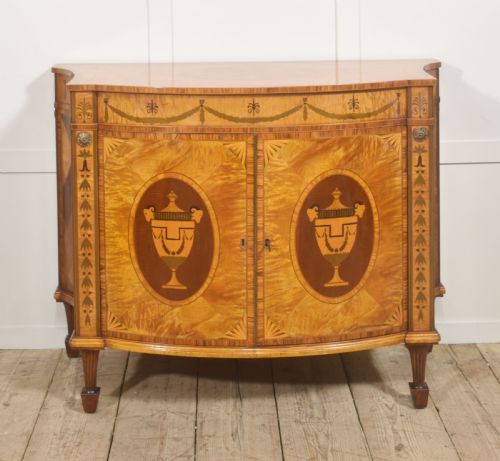
Marquetry panels utilise contrasting timbers cut with fine saws and fitted together by hand to create elaborate urns, ribbons and classical medallions. Brass hardware, including drop handles and key escutcheons, provides functional and visual accents to the polished timber surfaces.
Sheraton Style Side Cabinet Retail Price Guide 2026
Typical asking prices for sheraton style side cabinet among the pieces listed under this phrase on Sellingantiques today, from the lower quarter to the upper quarter. They describe what is for sale here now, not the wider market.
Makers hid secret compartments within work tables and cabinets for holding precious letters or sewing implements.
What varies in quality
The degree of refinement in the marquetry work and hand-painted detailing dictates the tier of craftsmanship, where master artisans achieved crisper lines and greater tonal depth using natural stained woods. Superior examples display tighter timber grain selection and perfectly matched veneer symmetries across curved serpentine and demi-lune facades.
Structural integrity relies on the precision of the cabinet joinery, particularly where curved doors meet the frame and where slender legs join the main body. Heavier proportioning in revival pieces contrasts with the lighter, more delicate framing found in genuine Georgian originals.
The Sheraton Style Side Cabinet Glossary
- Demi-lune
- Having a half-moon shape with a flat back and a curved front, frequently seen on commodes and side cabinets designed to sit flush against a wall.
- Crossbanding
- A narrow strip of veneer laid around the border of a panel so that the grain runs at right angles to the main surface, providing a neat visual frame.
- Marquetry
- Decorative patterns formed by the insertion of small pieces of tinted or textured wood into a veneered surface to picture urns, flowers, or classical scenes.
- Serpentine
- A curved shape consisting of a convex centre flanked by two concave curves, creating a flowing wave effect across the front of a cabinet.
- Satinwood
- A lustrous, yellow-toned timber imported from the tropics, prized by cabinet makers for its reflective sheen and smooth surface texture.
Sheraton Style Side Cabinet: Frequently Asked Questions
What is a sheraton style side cabinet?
A sheraton style side cabinet is a refined storage piece inspired by late eighteenth-century classical design principles, featuring straight tapering legs and symmetrical geometric or curved fronts.
These pieces use fine veneers and subtle inlay work rather than heavy carving to create an elegant silhouette suitable for principal rooms.
How do I tell original Georgian from revival pieces?
Original Georgian pieces display construction methods, timber ageing and tool marks characteristic of eighteenth-century workshop practices. Revival pieces from the Victorian and Edwardian eras often use machine-cut veneers and internal secondary timbers typical of later manufacturing.
Examining the drawer linings, backboards and interior construction usually reveals the true period of manufacture.
Where should I place a demi-lune cabinet?
A demi-lune cabinet suits hallways, living rooms and dining areas where its flat back allows it to stand securely against a wall without protruding too far into the floor space. The curved front softens the geometry of a room while providing a useful surface for lamps or decorative objects.
These pieces also function effectively as bedside cabinets in larger bedrooms.
How do I care for satinwood veneer?
Satinwood veneer requires gentle cleaning with a soft, dry cloth to remove dust and protection from direct sunlight to prevent the timber from darkening or fading unevenly. Natural wax applied sparingly helps maintain the lustre of the polished surface without building up residue.
Keeping the room at a stable humidity prevents the fine inlays and veneers from lifting or cracking.