


Satinwood Server Table
These satinwood server table pieces are timber serving furniture for dining spaces, offering refined inlay work and polished surfaces.
Satinwood Server Table
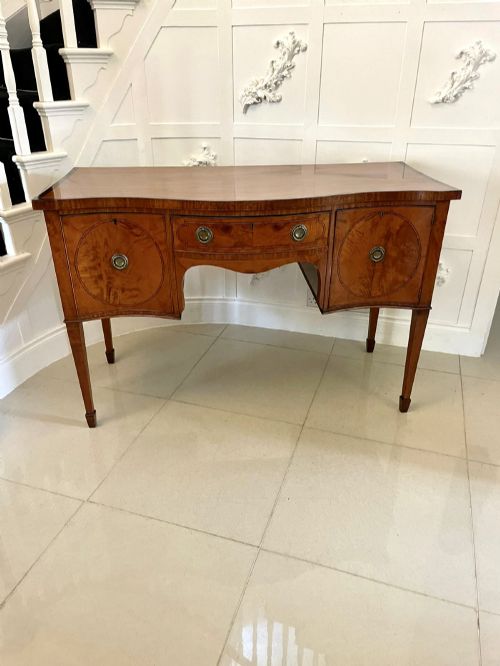
A satinwood server table takes the form of dining furniture designed for serving food and displaying silver in a dining room. The pieces matching this search phrase encompass sideboards, serving tables, and side tables.
The version most commonly met on this page is the Edwardian or Sheraton Revival incarnation, often pairing mahogany carcases with satinwood veneer. Examples range from serpentine and bowfront shapes to more restrained side tables.
Origins stretch across the nineteenth century into the Edwardian period, alongside Georgian and Regency influences. Makers utilised different regional timber selections while keeping to the traditional serving table format.
What Varies in Quality
The standard of craftsmanship shows in the precision of the wood inlay and the alignment of the crossbanding. Superior examples display crisp lines and well-matched grain panels across serpentine or bowfront surfaces.
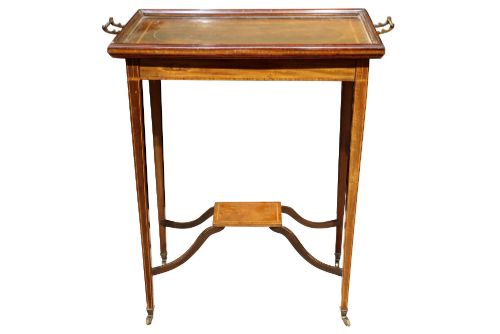
Structural integrity of the timber carcase and the stability of the drawers dictate the grade of the piece. Subtle details such as original brass galleries and intact boxwood stringing elevate certain items above simpler variants.
Listings feature periods ranging from the Georgian era through Victorian times to the Edwardian period.
The Satinwood Server Table Glossary
- Satinwood
- A light-coloured, lustrous timber native to tropical regions, prized for its golden sheen and smooth finish. Cabinet makers used it extensively as a veneer on high-status dining furniture.
- Crossbanding
- A decorative border technique where veneer strips are laid perpendicular to the grain of the main panel. This frames the top or drawer fronts with a contrasting direction of timber.
- Serpentine
- A curved shape featuring a convex centre flanked by concave curves, creating a fluid serpentine outline. It requires advanced woodworking skill to veneer and fit accurately.
- Bowfront
- A convex, outward-curving front profile typical of many dining sideboards and serving tables. This shape maximises internal storage while softening the room profile.
- Inlay
- The technique of embedding pieces of contrasting timber or boxwood into a recessed surface to form patterns. It defines the Sheraton Revival aesthetic seen on many of these pieces.
Satinwood Server Table: Frequently Asked Questions
What is a satinwood server table used for?
These pieces functioned historically as dining room furniture for holding dishes, serving food, and displaying silverware.
Today, they serve similar practical purposes in modern dining spaces or act as decorative console tables in hallways.
How do I date an Edwardian server table?
Dating relies on examining the timber construction, hardware styles, and the specific revival characteristics present in the design.
Edwardian pieces often combine Sheraton revival motifs with lighter framing and machine-sawn internal components distinct from earlier eras.
What is the difference between a sideboard and a serving table?
Sideboards generally incorporate enclosed cupboard storage and multiple drawers beneath a broad top surface for heavy service.
Serving tables often present a more open profile with fewer drawers, sometimes featuring brass gallery rails along the back edge.
How do I care for antique satinwood furniture?
Maintenance requires keeping the timber away from direct sunlight and maintaining stable humidity levels to protect the delicate veneer.
Regular dusting with a soft cloth and occasional application of appropriate furniture wax preserves the polished finish.