
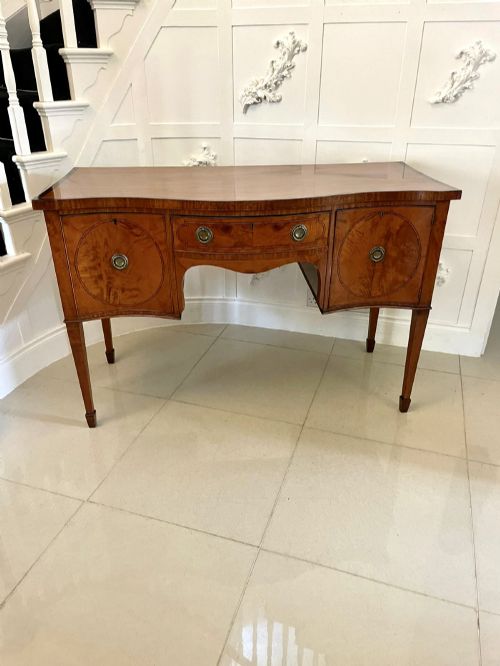


Satinwood Buffet Table
A satinwood buffet table offers a refined focal point for a dining room, combining figured timber with classic proportions.
Satinwood Buffet Table
A satinwood buffet table or sideboard serves as an elegant dining room piece for storage and display, appearing in forms such as bow fronts, serpentine shapes, and breakfronts. These items emerge from periods spanning the Georgian era through the Victorian, Edwardian, and Sheraton Revival styles.
Buyers encounter variations ranging from compact pieces to large serving tables, frequently constructed with mahogany bodies and highlighted by satinwood veneers or cross-banding. The selection spans the eighteenth, nineteenth, and early twentieth centuries, capturing shifts in British cabinet making.
How they were made
Cabinet makers utilised dense timber foundations like mahogany, applying smooth satinwood veneers to create contrasting grain patterns across the main surfaces. Wood inlay, boxwood lines, and intricate marquetry added decorative detail to drawer fronts and top edges.
Metal components such as brass galleries appeared on specific serving tables, combining utility with decorative metalwork. Joinery techniques relied on traditional framing to support the weight of the timber and the inlaid panels.
What varies in quality
The sophistication of the timber figure and the precision of the inlay dictate the distinction between standard and superior pieces. Finer examples display meticulous cross-banding and balanced wood selection that enhances the visual depth of the facade.
Proportion and execution of form, from gentle bow fronts to sharp serpentine curves, reflect the skill of the original workshop. Clean lines and harmonious integration of contrasting woods separate basic utility items from ambitious revival pieces.
The Satinwood Buffet Table Glossary
- Satinwood
- A hard, yellow-tinted timber prized for its lustrous grain and used extensively for decorative veneers. It provides a bright contrast against darker woods like mahogany.
- Cross-banding
- A border technique where veneer strips are laid perpendicular to the main grain direction. This frames the top or drawer fronts with a neat geometric boundary.
- Bow front
- A convex curved cabinet front popular in Georgian and later furniture design. It softens the room profile while offering interior storage depth.
- Marquetry
- The art of applying decorative pieces of veneer to a structure to form intricate pictorial designs. Workshops utilised varied timber species to achieve natural colour shading.
- Serpentine
- A shape featuring a concave central section flanked by two convex curves. This undulating outline demands advanced woodworking precision.
Satinwood Buffet Table: Frequently Asked Questions
Where should I put a buffet table?
These pieces suit dining rooms or large hallways where they provide surface space for serving food or displaying decorative objects. Their finished backs and refined facades allow them to anchor a room as a central focal point.
Ensure there is enough clearance for doors and drawers to open fully without obstruction from nearby dining furniture or walls.
How do I identify a Sheraton Revival piece?
Sheraton Revival furniture draws inspiration from late eighteenth-century neoclassical designs, typically featuring light wood inlay, tapered legs, and symmetrical proportions. These items often date from the late nineteenth or early twentieth centuries rather than the original Georgian period.
Look for refined stringing, satinwood cross-banding, and classical urn or floral motifs integrated into the mahogany framework.
What is the difference between a sideboard and a buffet?
Sideboards and buffets both serve dining room storage and serving functions, though terminology varies by period and regional preference. Serving tables often feature open lower structures or lighter frames compared to enclosed cabinet sideboards.
Both forms accommodate dining accessories, with some variations including brass galleries for holding items securely during service.
How do I care for satinwood veneer?
Protect the timber by keeping the piece away from direct sunlight and sudden temperature shifts that can dry out old veneers. Dust gently with a dry, soft cloth and avoid chemical polishes that damage aged finishes.
Maintaining stable room humidity helps preserve the integrity of the wood inlay and prevents the veneer from lifting over time.