

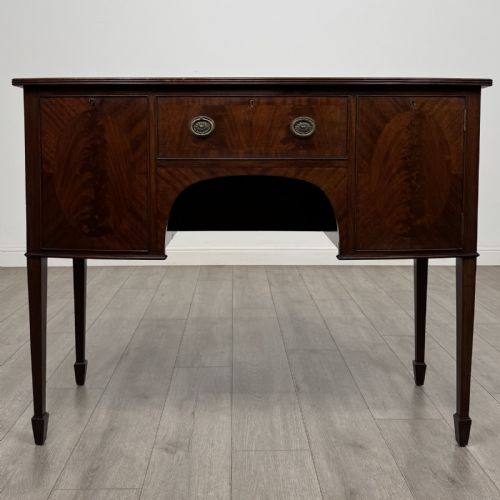
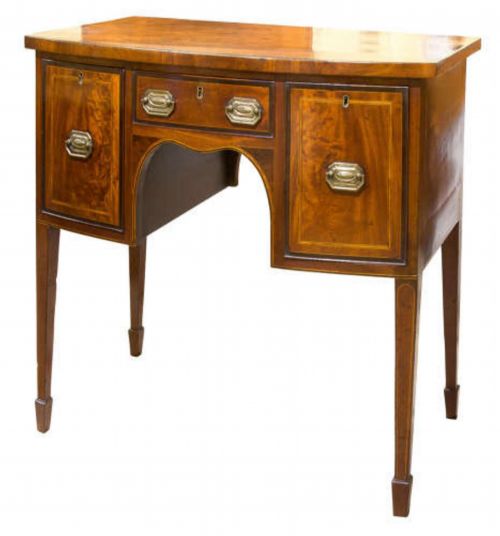


Small Bow Front Sideboard
A small bow front sideboard offers curved elegance and practical storage, making it a clever choice for compact dining rooms and hallways.
Small Bow Front Sideboard
A small bow front sideboard is a compact serving piece designed with a gently curving convex front that softens the lines of a room. These items appear most frequently in Georgian, Regency and Edwardian forms, spanning periods from the eighteenth century to the early twentieth century.
Makers designed these smaller sideboards to fit into modest spaces while retaining the storage capacity of larger dining room furniture. The selection ranges from narrow side tables and cupboards to miniature chests and dwarf linen presses.
Georgian and Regency examples dominate the available selection, often featuring inlaid details and figured timbers. Edwardian interpretations also emerge regularly, reflecting a lasting appreciation for the curved silhouette.
Materials and Construction
Cabinet makers relied heavily on mahogany as the primary timber, frequently selecting figured varieties to accentuate the curved facade. Artisans applied contrasting veneers such as satinwood and purpleheart to create delicate banding and decorative borders along the edges.
Secondary timbers like oak appear in drawer linings, demonstrating traditional joinery methods used to ensure stability. Brass handles and fittings complete the construction, matching the warm tones of the polished wood.
Small Bow Front Sideboard Retail Price Guide 2026
Typical asking prices for small bow front sideboard among the pieces listed under this phrase on Sellingantiques today, from the lower quarter to the upper quarter. They describe what is for sale here now, not the wider market.
Judging Quality
Quality rests upon the selection of timber and the precision of the curved drawer fronts. Superior pieces display continuous grain patterns across the bow and meticulous inlay work that remains intact over centuries.
The choice of secondary woods and the neatness of internal linings reveal the standard of workshop execution. Pieces bearing thoughtful proportions and restrained brass hardware represent the higher end of cabinet making.
The Small Bow Front Sideboard Glossary
- Bow front
- A convex curved cabinet front that projects outward in an arc. This shape gained popularity during the Georgian period to soften room angles.
- Banding
- A narrow strip of contrasting veneer inlaid around the perimeter of a drawer or top. Cabinet makers used this technique to frame the primary timber.
- Figured mahogany
- Wood grain containing distinctive patterns such as flames or curls. Artisans reserved these choice sections for prominent surfaces like drawer fronts.
- Dwarf linen press
- A short storage cabinet originally intended for household textiles. These pieces share similar proportions with compact sideboards.
Small Bow Front Sideboard: Frequently Asked Questions
Where do I place a small bow front sideboard?
These compact pieces suit narrow hallways, dining rooms, or living spaces where standard furniture proves too deep. Their curved fronts allow for easier movement around tight corners.
Positioning them against a flat wall highlights the convex sweep of the timber without obstructing household traffic.
How do I date a bow front sideboard?
Examine the secondary timbers inside the drawers, the style of the brass handles, and the framing around the drawers. Georgian and Regency pieces often feature hand-cut dovetails and subtle mahogany inlay.
Later Edwardian reproductions or adaptations typically display machine-sawn elements and different interior construction methods.
What is the difference between Georgian and Regency styles?
Georgian furniture from the eighteenth century tends to emphasise refined proportions, understated stringing, and classical symmetry. Regency pieces from the early nineteenth century often incorporate bolder contrasts, painted finishes, or more pronounced brass ornaments.
Both periods embrace the curved bow front format but handle the decorative details differently.
Can I use a small sideboard as a dressing table?
Historical records show that these versatile pieces served multiple functions in domestic spaces, including serving halls and dressing areas. Their surface area accommodates daily essentials while the drawers provide discreet storage.
Adding a mirror transforms the top surface into a functional dressing space without altering the antique furniture.