
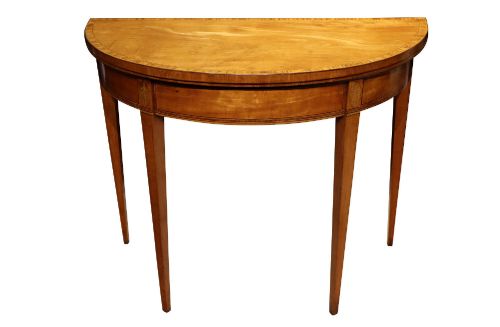
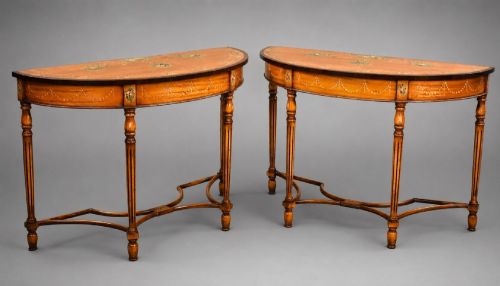
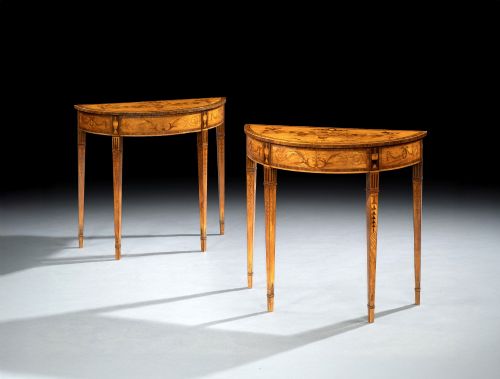
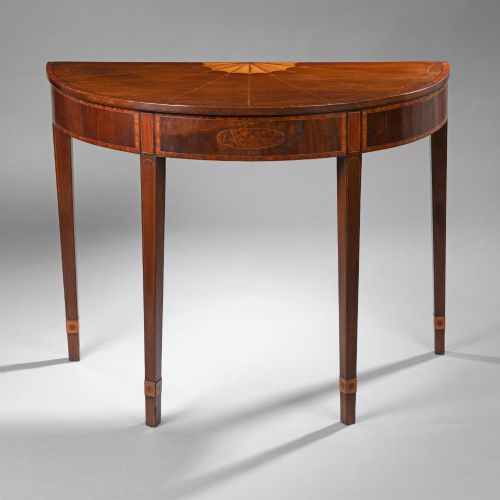
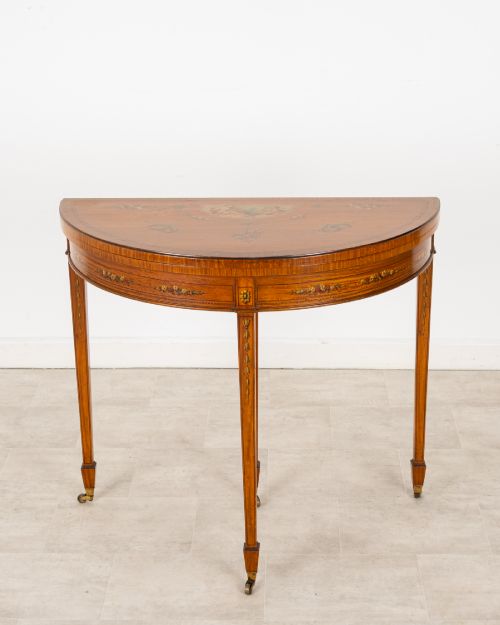
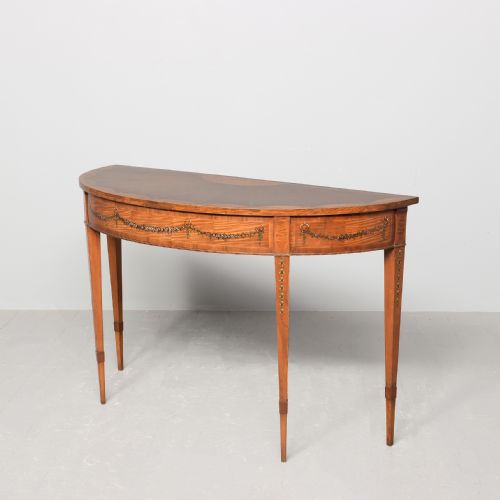


Satinwood Demi Lune Table
A satinwood demi lune table offers a semicircular footprint and light timber figuring, making it a compact choice for hallways and drawing rooms.
Satinwood Demi Lune Table
A satinwood demi lune table is defined by its half-moon shape, designed to stand flush against a wall while occupying minimal floor space.
The selections span from eighteenth-century George III originals to nineteenth-century Sheraton Revival interpretations and Edwardian pieces.
Card tables, games tables, and console tables dominate the available forms, often featuring fold-over tops supported by pivoting rear legs.
Materials and Construction
Craftsmen built these tables using solid and veneered timbers, pairing a primary body of satinwood or mahogany with contrasting crossbanding in rosewood, kingwood, or boxwood.
Marquetry inlay and hand-painted decorative motifs frequently adorn the flat surfaces, showcasing neoclassical urns, swags, and floral borders.
Structural elements rely on traditional joinery, with tapered legs often following the curved apron of the frame.
Some card tables conceal secret compartments beneath their folding tops for storing counters during evening games.
Distinguishing Factors
The distinction between tiers rests upon the crispness of the hand-painted detailing and the precision of the marquetry and crossbanding.
Timbers with rich natural figure and warm grain contrast command attention, reflecting superior selection by the original cabinetmaker.
The integrity of the folding mechanisms on card tables and the original patination of the timber surface determine the desirability of surviving examples.
Filmer And Son
The Satinwood Demi Lune Table Glossary
- Demi-lune
- A half-moon shape used for console and card tables designed to stand flat against a wall.
- Satinwood
- A lustrous, yellow-toned hardwood native to Ceylon and the West Indies, prized for decorative veneer.
- Crossbanding
- A narrow strip of veneer laid around the border of a tabletop with the grain running perpendicular to the central panel.
- Marquetry
- Elaborate decorative patterns formed by the insertion of pieces of wood, shell, or ivory into a veneered surface.
- Console table
- A side table designed to stand against a wall, frequently secured to the masonry with brackets in more elaborate forms.
Satinwood Demi Lune Table: Frequently Asked Questions
What is a demi lune table used for?
These half-moon tables served historically as console pieces against drawing room walls or as folding card and games tables for evening entertainment.
Their compact semicircular design allowed them to sit unobtrusively in hallways before being pulled out into the room when guests arrived.
How do I identify an 18th century piece?
Eighteenth-century examples typically display hand-cut dovetails, older timber shrinkage patterns, and genuine George III or Hepplewhite proportions.
Later nineteenth-century Sheraton Revival copies often use machine-cut elements and brighter, more uniform satinwood veneers.
Are painted satinwood tables original?
Many tables from the late eighteenth century and the subsequent Sheraton Revival period featured delicate hand-painted floral motifs and neoclassical medallions.
Checking the pigment integration into the grain helps distinguish period painted work from later decorative additions.
How do I care for antique satinwood?
Satinwood requires protection from direct sunlight to prevent the characteristic golden-yellow timber from darkening or bleaching unevenly over time.
Applying microcrystalline wax periodically preserves the polished surface without building up heavy residues that obscure the fine wood grain.