

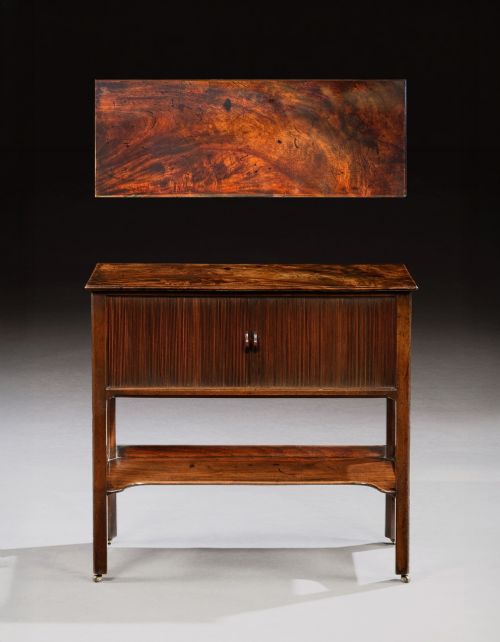


Tambour Door Side Table
These tambour door side table pieces offer sliding enclosures and compact proportions, uniting practical bedside storage with refined period craftsmanship.
Tambour Door Side Table
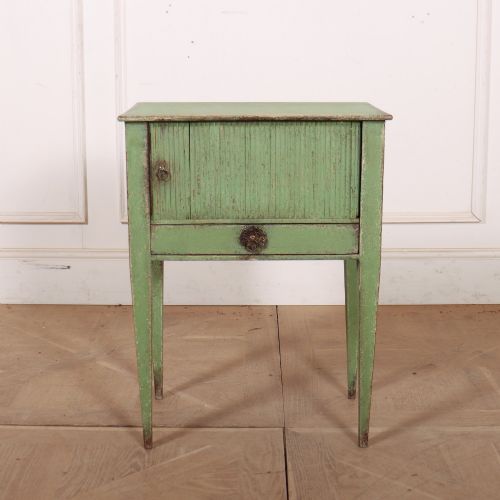
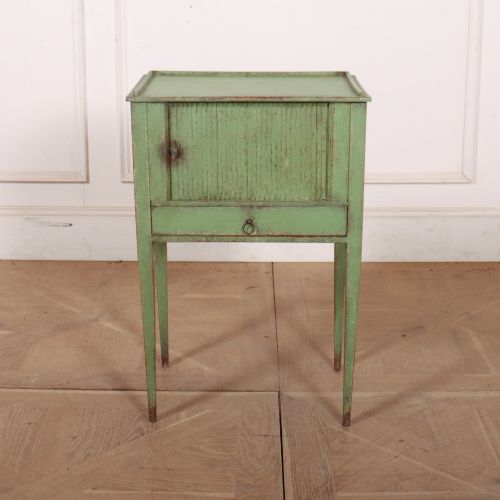
A tambour door side table is a compact item designed for bedside or occasional use, utilising slatted sliding shutters to conceal interior storage without swinging doors.
The examples gathered here span the eighteenth century, the nineteenth century, and the early twentieth century, including Georgian, Victorian, and provincial styles.
Most pieces take the form of bedside cabinets, cupboards, or nightstands, frequently executed in regional European traditions such as Dutch provincial and French provincial workshops.
Materials and construction
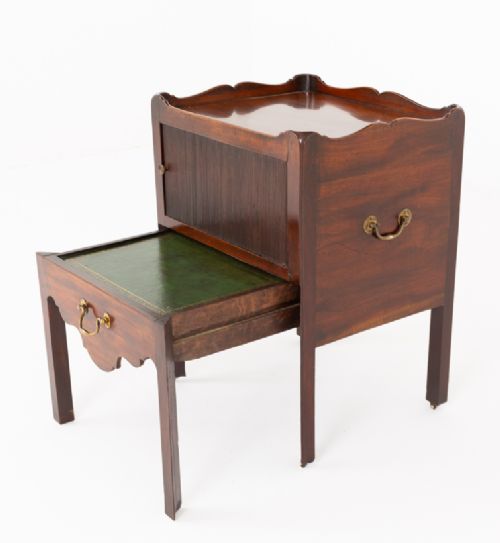
Cabinetmakers constructed these pieces primarily in mahogany and walnut, often employing fruitwood or softwood for secondary framing and interior elements.
The signature tambour shutter consists of narrow wooden strips glued to a canvas or linen backing, allowing the door to curve smoothly around a track.
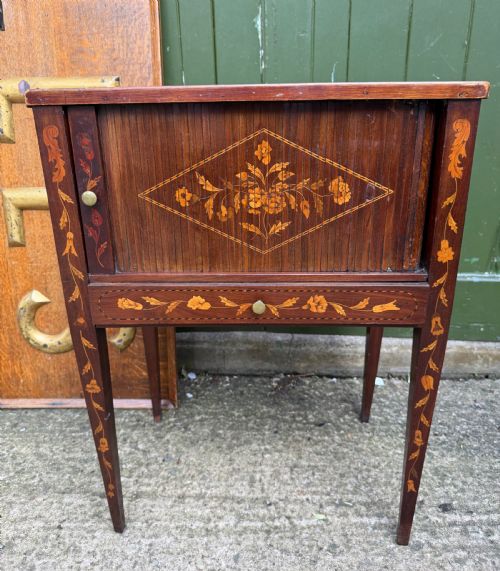
Surface decoration ranges from floral marquetry inlays to painted finishes, complemented occasionally by brass feet or leather accents.
Tambour Door Side Table Retail Price Guide 2026
Typical asking prices for tambour door side table among the pieces listed under this phrase on Sellingantiques today, from the lower quarter to the upper quarter. They describe what is for sale here now, not the wider market.
Judging the work
Quality rests upon the smooth operation of the slatted shutter and the precision with which the individual wooden strips track within their grooves.
Finer examples display careful timber selection, such as figured mahogany or intricate marquetry patterns that align seamlessly across the curves of the cabinet.
Structural integrity in the joints and the crispness of carved or inlaid details distinguish standard utility pieces from high-status furniture.
The Tambour Door Side Table Glossary
- Tambour
- A flexible door formed of narrow wooden slats glued to a fabric backing, which slides horizontally or vertically within grooved tracks. This clever mechanism allows access to restricted spaces where traditional hinged doors would prove impractical.
- Marquetry
- The art of applying decorative veneer pieces to a structure to form intricate pictorial or floral designs. Artisans cut various coloured woods to create contrasting patterns on the exterior surfaces.
- Demi-lune
- A half-moon shape used for the footprint of console tables and cabinets, placing a flat back against the wall with a curved front. This profile softens room circulation while maintaining compact dimensions.
- Tray top
- A raised rim encircling the upper surface of a small table or cabinet to prevent items from rolling off. It is frequently moulded directly from the solid timber or assembled from separate shaped rails.
Tambour Door Side Table: Frequently Asked Questions
What is a tambour door side table?
A tambour door side table is a compact cabinet featuring a sliding slatted shutter that conceals the interior compartment. These pieces typically function as bedside storage or small occasional cupboards.
Craftsmen built them across various historical periods, incorporating sliding mechanisms to save space while keeping bedside items neatly out of sight.
How do tambour doors work?
Tambour doors operate by fixing thin wooden slats onto a flexible textile backing, allowing the entire panel to curve smoothly along a recessed track. This design lets the door slide around corners or into the cabinet body.
Smooth movement depends on clean tracks and well-maintained wooden slats that do not bind or catch during operation.
Which woods are most common?
Mahogany and walnut form the primary timber choices for these pieces, offering rich grain patterns and durable structural support. Secondary woods like softwood and fruitwood appear in internal framing.
Regional workshops often applied painted finishes or delicate floral marquetry over the primary carcase timbers.
How do I date these tables?
Dating relies on stylistic markers, construction methods, and materials, ranging from eighteenth-century Georgian and Dutch pieces to nineteenth-century walnut variants. Georgian examples often display disciplined classical proportions, while provincial pieces feature marquetry or painted details.
Examining the internal fixings and secondary timbers helps establish the likely period of manufacture.