


Ruby Cut to Clear
Ruby cut to clear glassware offers a brilliant contrast of deep red colour and transparent glass that transforms any room.
Ruby Cut to Clear
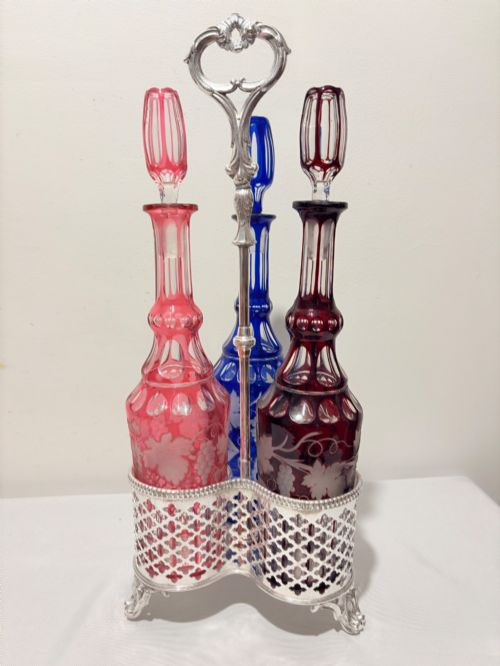
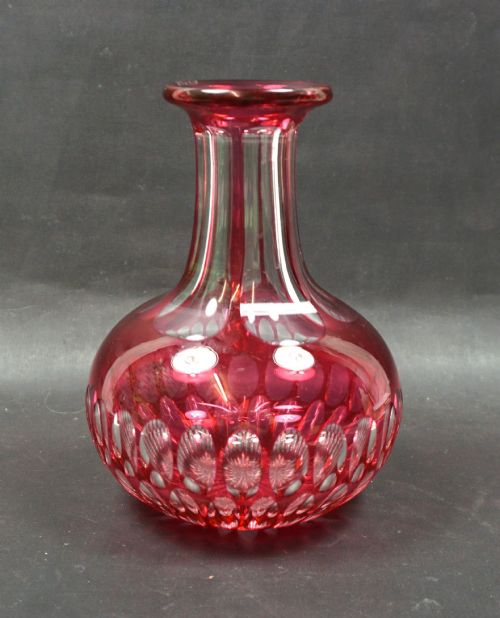
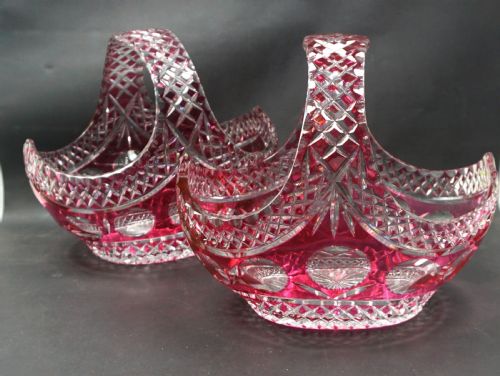
When you search for ruby cut to clear, you are looking at decorative items formed by layering a vibrant red glass over a colourless base before cutting through the outer layer. The pieces on this page span the Victorian and Art Deco periods, ranging from Victorian beakers and scent bottles to Art Deco vases and decanter stands. You will frequently encounter Bohemian and Victorian Bohemian origins alongside English and Belgian examples.
The forms vary from practical items like carafes, tumblers and decanters to purely decorative baskets, bowls and vases. Many examples display panelled ovoid shapes or detailed wheel engraving that cuts deep enough to reveal the clear crystal underneath. This dual-layer construction creates the distinct flashing effect that collectors prize in nineteenth and twentieth-century glassware.
Materials and technique
The makers formed these objects using lead crystal, cut glass or ruby flash glass, applying a coloured casing over a clear core while hot. Artisans then ground and polished the surface on a wheel to cut away portions of the red layer, leaving crisp geometric or floral patterns in clear relief.
Engraving often added further detail to the panels, requiring steady handwork to ensure the cuts remained sharp and uniform across the vessel. This combination of glass-blowing, cased overlay and cold-wheel cutting produced the intense saturation and refractive depth characteristic of the medium.
Some Victorian decanter stands even managed to incorporate miniature silver collars, just in case the glass alone wasn't posh enough for the dining table.
Assessing quality
Quality rests in the precision of the cutting and the depth of the red layer. Superior pieces show crisp, clean edges where the wheel met the glass, without chipping along the facets, and possess a resonant weight from lead crystal contents.
The richness of the ruby colour and the clarity of the underlying glass dictate the visual impact. Stronger pieces balance the thickness of the overlay so that the cut panels catch the light evenly from every angle.
Val St Lambert·Charles Graffart
The Ruby Cut to Clear Glossary
- Ruby Flash Glass
- A thin layer of red glass applied over a colourless glass body before cutting. This technique allowed makers to achieve deep colour without making the entire vessel from solid ruby metal.
- Cut Crystal
- High-clarity glass containing lead oxide that has been shaped by grinding and polishing. The lead content increases the refractive index, making the cut facets sparkle more brightly.
- Cased Glass
- Glass made from two or more distinct layers of different colours fused together while molten. The outer layer is typically carved away to reveal the contrasting colour underneath.
- Ovoid
- An egg-shaped form frequently used for vases and decanters in nineteenth-century glass production. This rounded profile provided a generous surface area for panel cutting and engraving.
Ruby Cut to Clear: Frequently Asked Questions
What is ruby cut to clear glass?
Ruby cut to clear glass consists of a colourless crystal body encased in a layer of deep red glass. Artisans cut through this outer ruby layer on a wheel to reveal the clear glass beneath, forming sharp patterns.
This cased construction creates a strong visual contrast between the saturated red exterior and the transparent facets. You will find this technique used on Victorian decanters, Bohemian vases, and twentieth-century tableware.
How do I date a piece?
Dating relies on stylistic clues, form, and cutting techniques. Victorian pieces often feature heavy floral engraving or panelled ovoid shapes, while later Art Deco examples show sleeker, geometric profiles.
Material descriptions also help, as nineteenth-century pieces frequently originate from Bohemian workshops, whereas later twentieth-century items include work from Belgian makers like Val St Lambert.
Can I use these for drinks?
Many items, such as tumblers, carafes, decanters, and hook wine glasses, were originally designed for serving beverages. You can continue to use them for dining, provided you wash them by hand.
Avoid putting antique glass in a dishwasher or using harsh abrasive cleaners. Hand washing preserves the polished facets and protects any delicate wheel engraving.
Where were these items made?
The listings on this page include significant production from Bohemia, which was a major European centre for decorative glass during the Victorian era. Other pieces originate from English and Belgian glassworks.
Bohemian makers excelled in heavy overlay techniques and detailed wheel cutting. Belgian production later introduced streamlined designs suited to twentieth-century interiors.