


Rosewood Reading Table
A rosewood reading table offers adjustable surfaces and rich grain, bringing functional elegance to period interiors.
Rosewood Reading Table
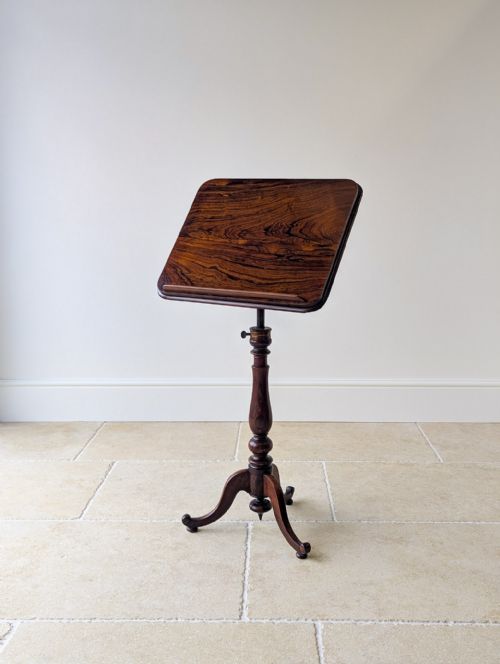
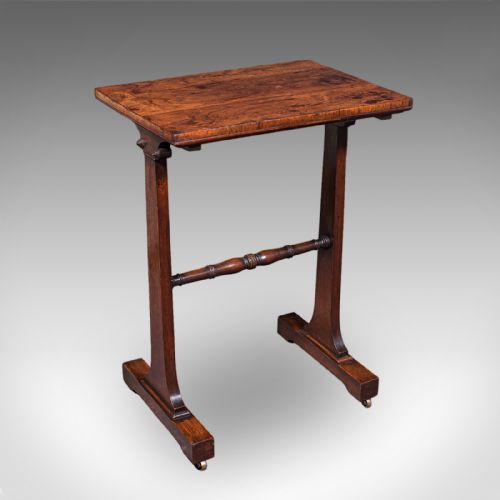
A rosewood reading table combines a book rest or sloping surface with a sturdy pedestal or leg support, designed for study and correspondence in the principal rooms of a house. You will encounter forms spanning the Regency, William IV, and Victorian eras, often serving dual purposes as writing or sewing tables.
The construction typically incorporates adjustable mechanisms for height or inclination, allowing the surface to adapt to the user. Many examples integrate side compartments, drawers, or folio stands within their compact footprints.
Originating largely from the nineteenth century, these pieces reflect the changing domestic habits of the period, moving from formal libraries into morning rooms and boudoirs.
Materials and construction methods
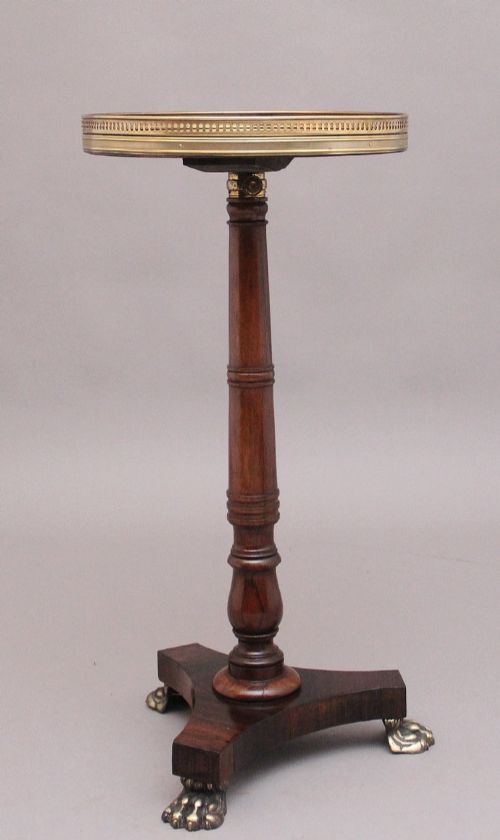
Makers utilised dense, dark rosewood timbers, often applied as veneers over secondary woods to display striking grain figures across the top surfaces. Brass fittings, including adjustable ratchets, hinges, and casters, provide the mechanical support necessary for moving and altering the stands.
Inlay work in satinwood or mother-of-pearl appears on select surfaces, alongside tooled leather inserts on writing flaps. Ormolu mounts and fine turned pillars add structural definition and decorative contrast to the polished timber.
Some nineteenth-century readers clearly suffered from indecision, resulting in tables that doubled as sewing boxes, clocks, and music stands all at once.
Distinctions in standard and execution
The sophistication of the mechanical action separates standard utilitarian pieces from workshop masterworks, particularly in how smoothly the telescopic column or adjustable ratchets operate. Superior examples exhibit precise brass engineering that holds heavy volumes securely without slipping.
The selection of the rosewood timber dictates visual appeal, with richly figured grain and well-matched veneers indicating higher workshop standards. Finer pieces incorporate secondary woods of matching quality and restrained brass or inlaid ornamentation rather than excessive embellishment.
Gillow of Lancaster·Miles and Edwards·Seller of Reading
The Rosewood Reading Table Glossary
- Rosewood
- A dense, dark tropical timber valued for its heavy weight and dramatic grain patterns, frequently used in high-status nineteenth-century cabinetmaking.
- Telescopic
- A vertical sliding mechanism allowing the table height to be raised or lowered to suit the user.
- Metamorphic
- Describing furniture designed to transform from one form or function to another, such as a writing table converting into a reading stand.
- Folio stand
- An upright frame attached to a table for holding large books, prints, or unbound papers.
- Ormolu
- Gilt-bronze mounts applied to furniture for decorative enrichment.
Rosewood Reading Table: Frequently Asked Questions
How do I adjust the reading surface?
Most period examples use a brass ratchet mechanism beneath the slope or a telescopic pillar secured by a thumb screw. Lifting the rest engages the internal teeth to lock the board at the desired angle.
Care should be taken when altering older mechanisms to support the weight of the board rather than relying solely on the brass stop.
Were these used in bedrooms or libraries?
While the primary forms were designed for libraries and morning rooms, specific metamorphic versions functioned as adjustable bed tables. These versatile pieces moved easily between private quarters and communal reception spaces.
Their mobility made them practical additions for writing and reading in various parts of the residence throughout the nineteenth century.
How do I date a rosewood reading table?
Stylistic indicators such as heavy turned pillars point toward the William IV era, while crisp brass inlay and elegant proportions often suggest the earlier Regency period. Victorian examples frequently incorporate carved pedestal bases or fitted sewing compartments.
Examining the construction methods of the drawer linings and mechanical fixings helps confirm the period of manufacture.
How do I care for rosewood surfaces?
Maintain the timber by keeping the table away from direct sunlight and heat sources that can dry out the polished finish and veneers. Gentle dusting with a dry cloth preserves the natural lustre of the rosewood.
Applying appropriate wax sparingly helps protect the wood without building up a heavy residue.