
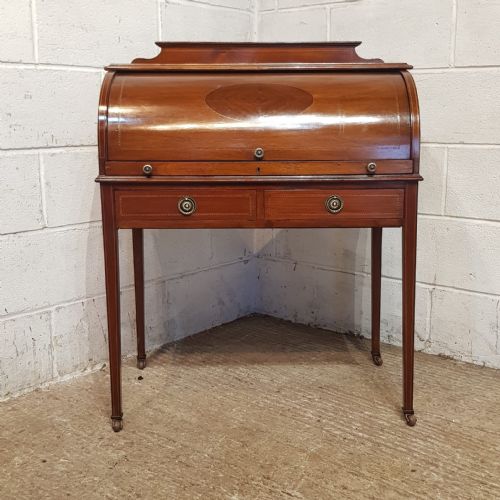
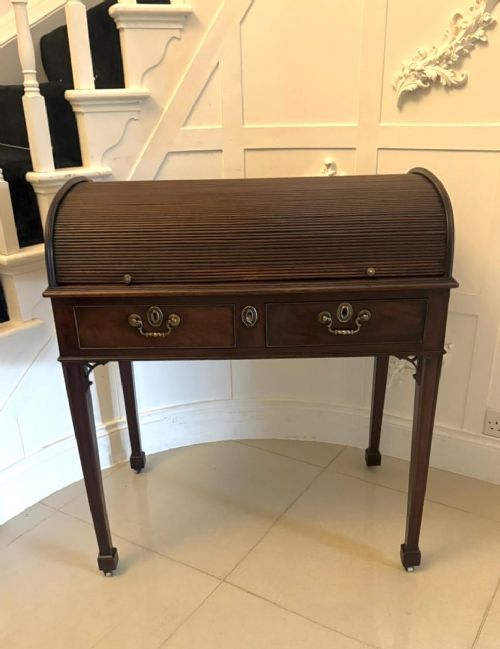
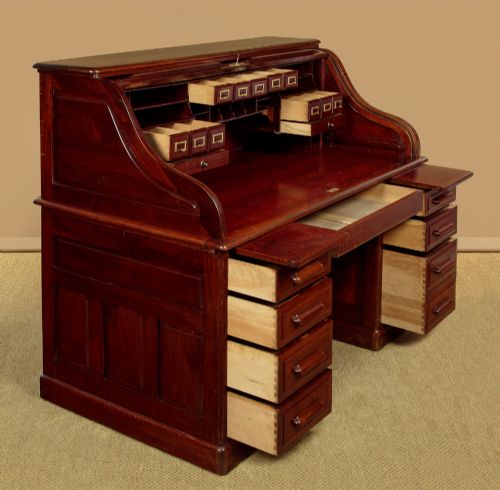


Roll Front Secretary Desk
A roll front secretary desk brings together hidden workspaces and rich timbers, offering a practical cabinet for writing while keeping papers out of sight.
Roll Front Secretary Desk
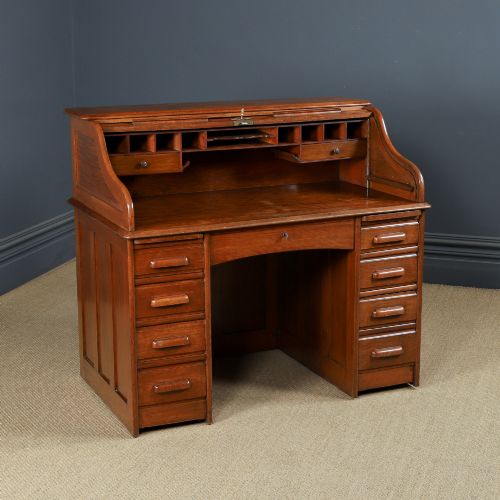
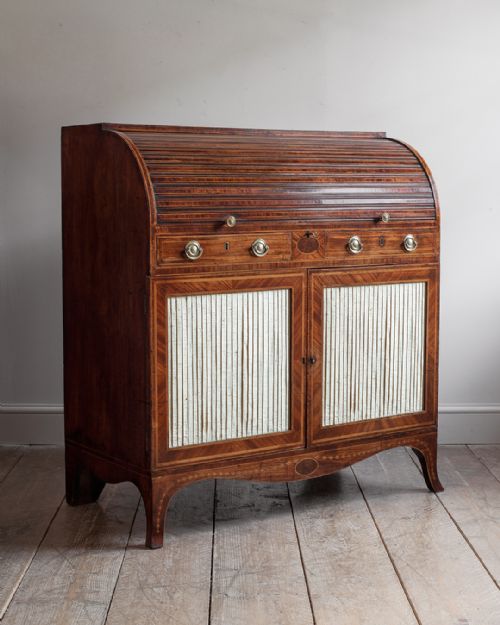
When you search for a roll front secretary desk, you encounter pieces designed to conceal a writing surface and pigeonholes beneath a curved tambour shutter or solid cylinder. These writing pieces span the Georgian, Regency, and Victorian eras, carrying through into Edwardian office furniture.
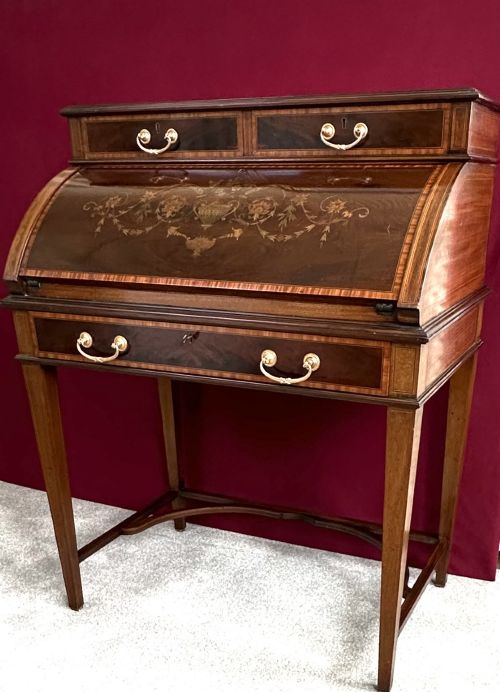
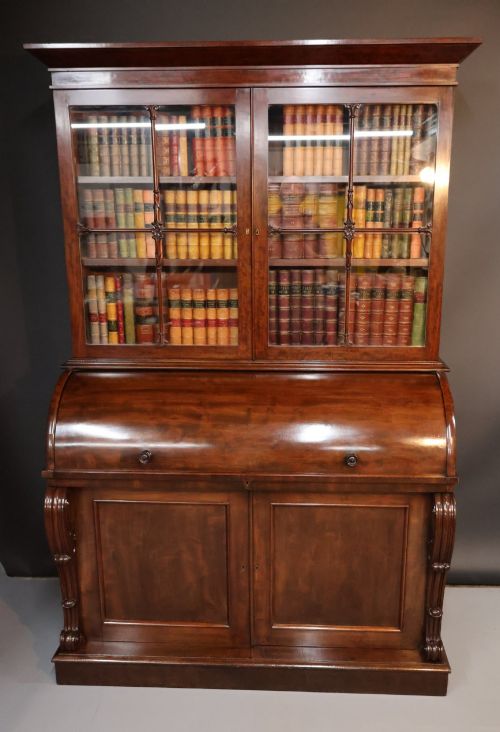
The versions most commonly met on this page range from compact satinwood ladies' desks and bureau bookcases to large oak and walnut pedestals or tambour cylinder desks. Woods like mahogany and satinwood dominate the earlier centuries, while later examples often utilise oak and walnut.
Makers and cabinetmakers produced these desks to serve as private stations for correspondence and estate management. The integration of pull-out writing slides and tiered pigeonholes defines the internal arrangement across almost every period represented here.
How they were made
Construction relies heavily on solid timber framing faced with finely figured veneers of mahogany, satinwood, walnut, or rosewood. Cabinetmakers applied intricate inlay work and brass mounts to elevate the visual weight of the exterior.
The defining mechanical feature, the tambour shutter or cylinder, requires precise woodworking where individual wooden slats are glued to a flexible canvas backing. This allows the curved front to slide smoothly within concealed vertical tracks.
Listings feature pieces spanning from the late 18th century through the Edwardian period, utilising mahogany, satinwood, oak, walnut, and rosewood.
What varies in quality
Quality rests upon the selection of timber veneers and the precision of the tambour mechanism. Finer pieces display continuous grain matching across the front and superior execution of inlaid stringing or crossbanding.
The complexity of the interior fitments, including secret compartments, satinwood drawer linings, and original brass hardware, separates standard workshop production from exceptional cabinet work.
Edwards & Roberts·Hepplewhite
The Roll Front Secretary Desk Glossary
- Tambour
- A flexible shutter formed of narrow strips of wood glued to a fabric backing, allowing it to slide around a curved track. This mechanism conceals the desk interior when closed.
- Cylinder desk
- A writing table featuring a solid quarter-circle wooden cylinder that rolls backward into the desk body to reveal the writing surface. It differs from the slatted tambour construction.
- Bureau bookcase
- A combination piece comprising a writing desk base with a fitted interior, surmounted by a glazed or panelled shelving cabinet. These stand tall and serve storage functions.
- Bonheur du jour
- A light lady's writing desk originating in the eighteenth century, typically featuring a small cabinet or tiered shelving upon the desktop. Satinwood examples are particularly noted.
- Pedestal desk
- A heavy office form supported by two banks of drawers with a central opening for the user. These often incorporate heavy oak or walnut roll-top mechanisms.
Roll Front Secretary Desk: Frequently Asked Questions
How do tambour desks work?
A series of narrow wooden slats are joined to a flexible canvas backing, enabling the entire shutter to glide along recessed tracks in the desk frame. This conceals the pigeonholes and writing slide when pushed down.
The mechanism requires precise carpentry so the wood moves without binding in its curve. When opened, the tambour retracts completely out of sight into the body of the desk.
Are these desks suitable for modern laptops?
Many examples provide sufficient depth on the pull-out writing slides or main surfaces to accommodate a laptop or writing materials. The internal pigeonholes are tailored for paper and letters rather than modern electronics.
Care must be taken with the antique mechanisms and antique leather writing surfaces during daily use. Using a protective blotter helps preserve the original leather or wood finish.
What is the difference between a bureau and a cylinder desk?
A bureau typically uses a sloping fall-front flap hinged at the bottom to cover the writing area. A cylinder desk employs a rolling curved wooden barrel or tambour shutter that retracts upwards.
Cylinder desks and tambour pieces often conceal more complex internal fittings and pull-out desk surfaces. Bureaux rely on simple hinged supports attached to the fold-down writing flap.
How do I date an antique secretary desk?
Stylistic cues such as Sheraton Revival satinwood inlay, Georgian proportions, or Edwardian oak construction provide the primary indicators of age. Timber choice, secondary woods used in drawer linings, and brass hardware styles also point to specific periods.
Construction methods, including hand-cut dovetails and the wear patterns on sliding mechanisms, help confirm whether a piece belongs to the eighteenth or nineteenth century.