
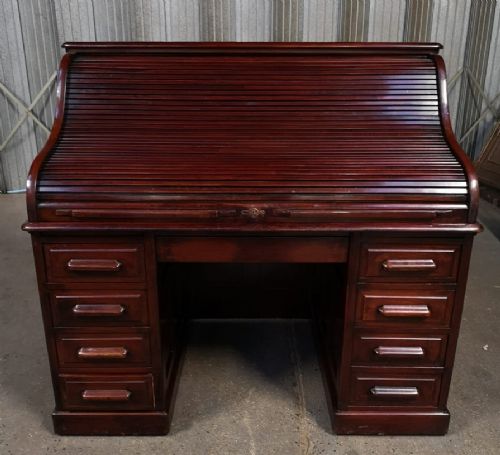
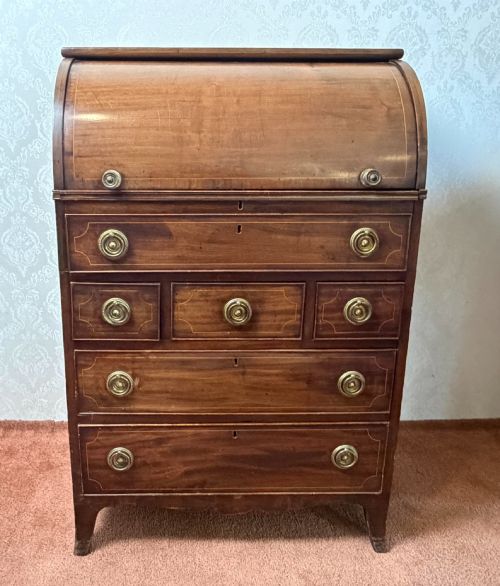
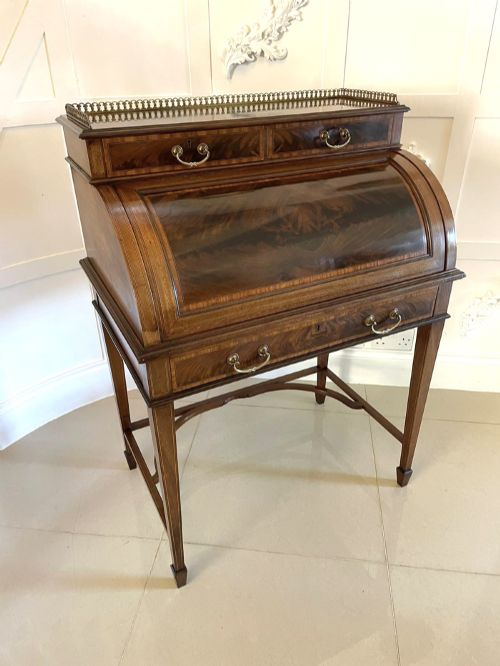
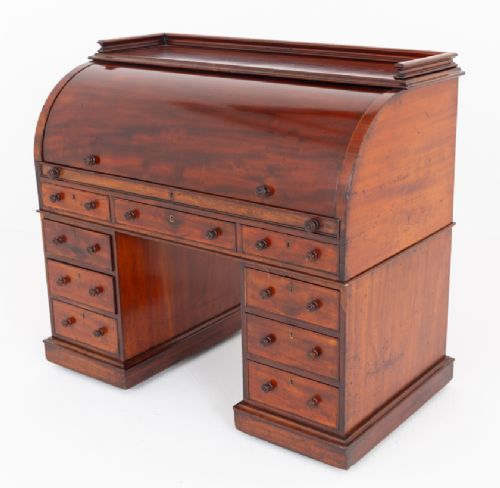

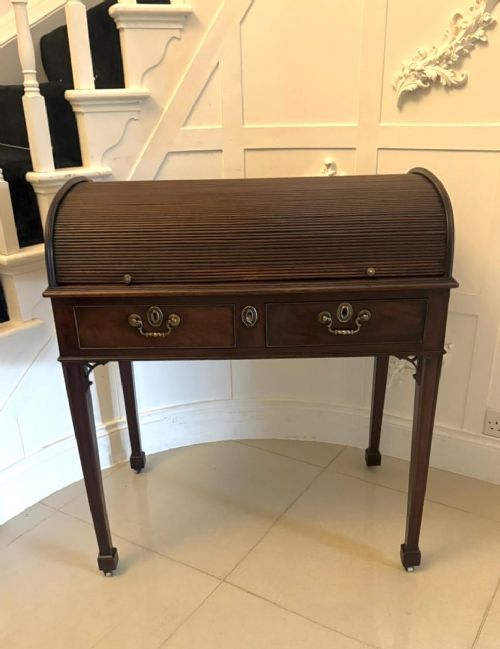
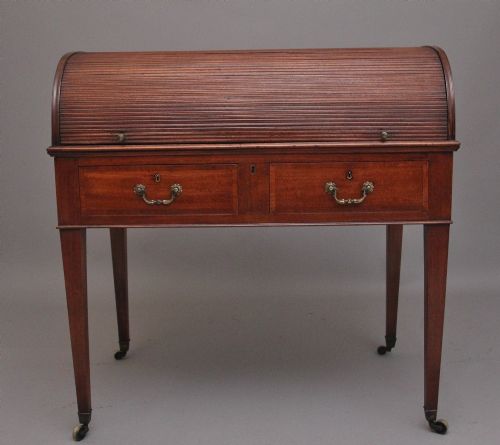

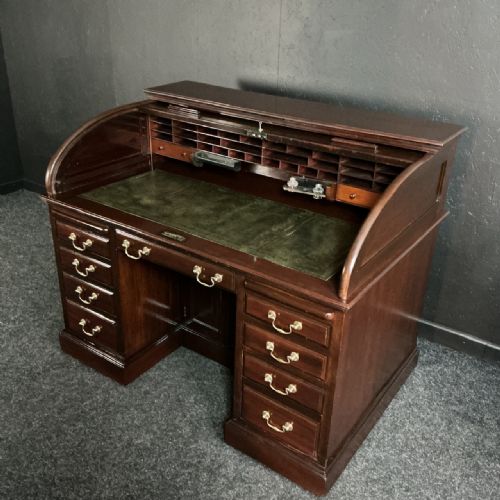


Mahogany Rolltop Desk
A mahogany rolltop desk combines tactile warmth with practical utility, offering private workspace through a sliding tambour lid.
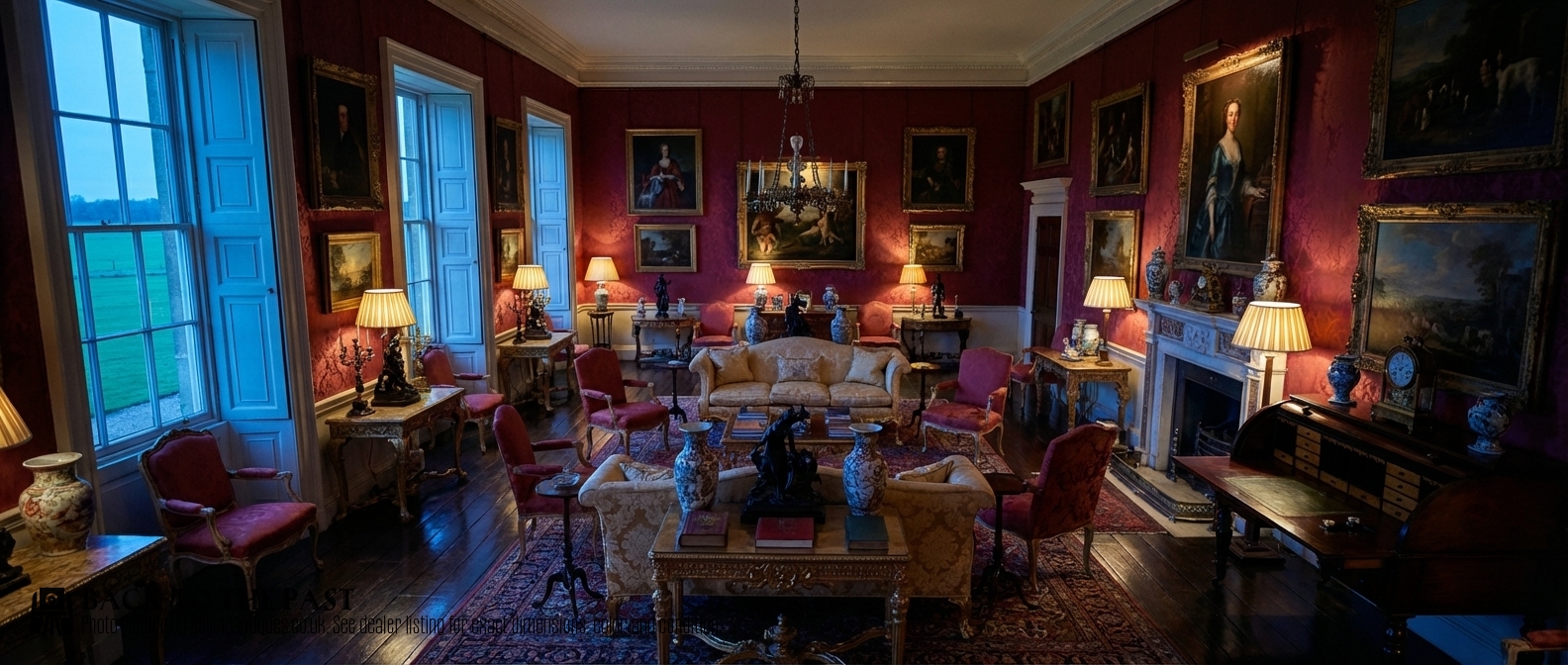
Identifying your mahogany rolltop desk
When you search for a mahogany rolltop desk, you encounter substantial writing furniture designed to conceal working papers behind a slatted or cylindrical cover. These pieces span several distinct historical eras, appearing in forms ranging from compact Edwardian examples to grand Victorian models and earlier Georgian or William IV creations.
The selection includes cylinder desks and tambour desks, drawing on styles such as French Empire, Sheraton Revival, and Victorian production. You will find both large pedestals and smaller standalone writing desks represented across the inventory.
Construction and materials
These items rely fundamentally on solid and veneered mahogany, often enhanced by striking flame mahogany figuring across the main surfaces. Workshops integrated secondary timbers and decorative elements including satinwood, boxwood inlay, and brass hardware to elevate the visual detail.
Writing surfaces frequently incorporate fitted leather panels, whilst specific architectural interpretations feature marble tops or ormolu mounts. The sliding mechanisms require precise joinery to ensure the tambour or cylinder glides smoothly within its curved tracks.
Retail Price Guide 2026
Typical UK retail prices for mahogany rolltop desk, calculated from the Sellingantiques database of over a million retail prices indexed since 2003. This retail price guide relies exclusively on Sellingantiques data; no external sources or auction records are used, so the figures do not describe the wider market.
Listings feature mahogany rolltop and cylinder desks spanning the Georgian, Victorian, and Edwardian eras, incorporating satinwood and brass details.
Assessing craftsmanship and finish
Superior examples demonstrate careful selection of timber, matching flame mahogany grains symmetrically across drawers and cylinder fronts. The intricacy of inlaid stringing in boxwood and satinwood indicates the level of artisan time invested in the piece.
Construction integrity governs the longevity of the sliding mechanism, distinguishing robust framework from pieces showing wear in the tracks. Interior configuration, such as tidy pigeonholes and secret compartments, reflects the original commission's ambition.
The Mahogany Rolltop Desk Glossary
- Rolltop desk
- A writing desk featuring a flexible slatted lid that pulls down to cover the work surface and pigeonholes. This design became popular for keeping correspondence secure and out of sight.
- Cylinder desk
- A desk with a solid curved wooden drum that rotates backward to open the writing area. Unlike the slatted rolltop, this uses a single curved panel.
- Tambour
- A flexible shutter made of narrow vertical strips of wood glued to canvas or leather backing. It allows the cover to follow a curved track.
- Flame mahogany
- A highly figured veneer cut from the fork of a mahogany tree where the branch meets the trunk. It creates a distinctive, flickering flame pattern.
- Sheraton Revival
- A late 19th-century design movement inspired by late 18th-century neoclassical furniture. It often utilises lighter timbers and delicate inlay work.
Frequently Asked Questions
What is a rolltop desk?
A rolltop desk is a form of writing furniture characterised by a sliding slatted or solid cylinder lid that covers the desk's pigeonholes and working surface.
This mechanism allows the user to secure their correspondence and paperwork quickly without needing to clear the entire desktop.
How do I date a mahogany desk?
Dating relies on observing stylistic markers, construction methods, and secondary timbers used within the drawers and frame. Pieces span from the 18th century through to the Edwardian period, each showing distinct decorative preferences.
For instance, Sheraton Revival examples echo 18th-century neoclassicism during the Victorian era, whereas Georgian models display simpler, sturdier proportions.
What is the difference between a cylinder and tambour desk?
A cylinder desk uses a solid, rigid curved panel of wood that rotates on a pivot to open and close. A tambour desk employs multiple narrow slats joined to a flexible backing fabric.
Both serve the same purpose of concealing the desk interior, but their internal tracks and mechanical actions differ significantly.
How do I care for mahogany furniture?
Maintenance involves keeping the timber away from direct sunlight and extreme temperature fluctuations to prevent the mahogany and its veneers from drying out. Regular dusting with a soft, dry cloth preserves the polished surface.
Leather writing inserts benefit from occasional specialised conditioning to keep the material supple and prevent cracking over time.