




Renaissance Revival Pottery
These pieces of renaissance revival pottery capture the bold colour and classical ornamentation of earlier centuries through nineteenth-century ceramic art.
Renaissance Revival Pottery
When you search for renaissance revival pottery, you are looking at nineteenth-century European ceramics that consciously imitate the classical forms, grotesque decoration, and vibrant palettes of the Italian and French Renaissance. These items span various forms including vases, ewers, wall brackets, plaques, and table lamps originating from Italian, French, and English factories during the Victorian era. The most common examples meeting your search are tin-glazed earthenware and majolica vessels produced in Italian and French workshops.
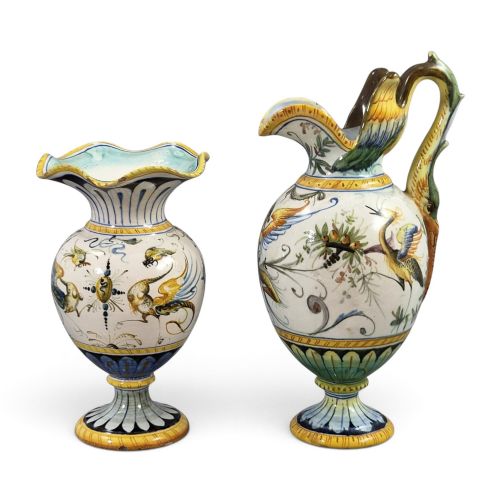
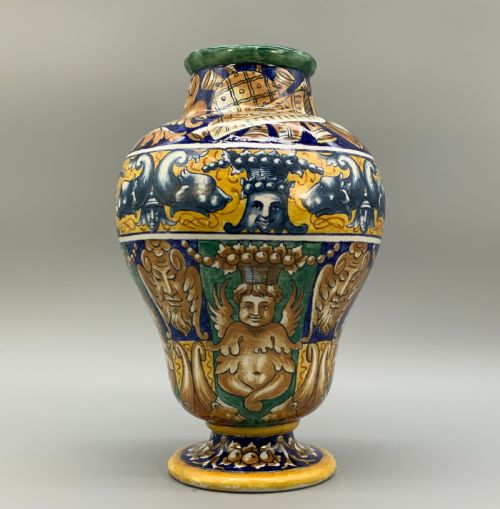
The style draws heavily upon sixteenth-century prototypes, reinterpreted by nineteenth-century ceramists working in periods such as the 1870s, 1890s, and around 1900. Pieces range from large decorative urns and chargers to functional table lamps mounted with brass or bronze hardware. Italian production, particularly from centres like Florence, frequently employs polychrome painted decoration featuring mythological figures, cherubs, and armorial motifs.
How They Were Made
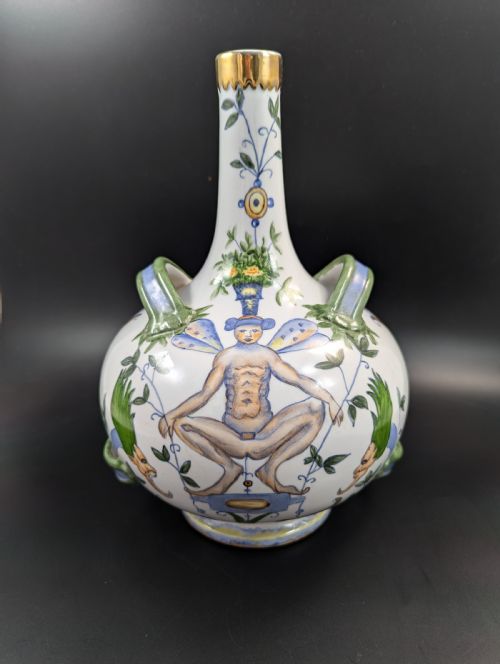
Makers utilised earthenware, ceramic, and faience bodies, applying tin glazes or opaque enamel to create smooth white surfaces suitable for detailed brushwork. Polychrome pigments were hand-painted over the glaze before firing, capturing the rich palette typical of historical majolica production.
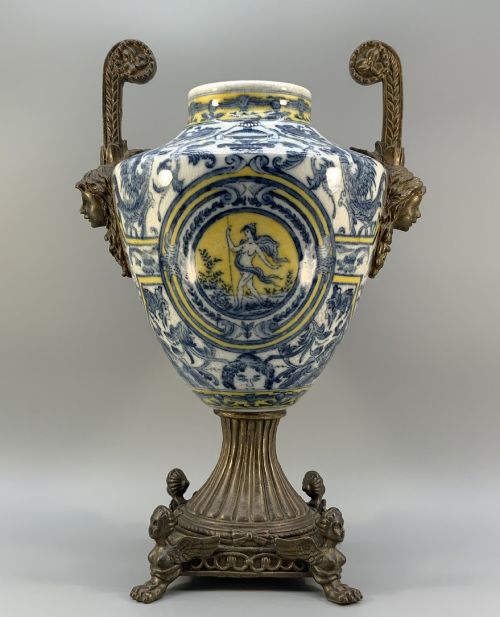
Many ornamental vessels incorporate secondary materials such as brass and bronze mounts, which were fitted to handles, bases, or rims to accentuate the classical architectural quality of the ceramic body.
Several vessels feature industrious cherubs seemingly struggling under the weight of oversized mythological handles.
What Varies in Quality
The distinction between standard commercial output and superior examples lies in the execution of the hand-painted decoration and the crispness of the moulded relief. Finer pieces display confident brushwork with intricate mythological scenes or armorial details, whereas lesser examples rely on repetitive stencilled patterns and simpler glazes.
Quality is also evident in the integration of metalwork mounts and the overall sculptural balance of the ceramic form, where heavier bronze mountings and well-proportioned pedestals elevate the piece.
Cantagalli Florence·Ulisse Cantagalli·Gien Faience·Minton·C. Ravier
The Renaissance Revival Pottery Glossary
- Majolica
- A type of earthenware decorated with opaque tin glazes and painted with colourful metal oxides. This technique allows for vibrant polychrome illustrations across vases, ewers, and chargers.
- Faience
- Tin-glazed earthenware originating from European traditions, particularly associated with French and Italian workshops. It provides a dense white ground for detailed historical narratives.
- Ewer
- A large jug with a wide spout and arched handle, historically used for pouring water. In revival ceramics, it serves primarily as a decorative vessel.
- Charger
- A large ornamental plate designed to be displayed on a wall or mounted on a stand. These items frequently feature elaborate painted scenes covering the entire surface.
- Polychrome
- Decoration utilising multiple distinct colours in the painted design. This multi-coloured approach defines the visual impact of nineteenth-century revival ceramics.
Renaissance Revival Pottery: Frequently Asked Questions
What is renaissance revival pottery?
These are nineteenth-century ceramic items modelled on the artistic styles of the sixteenth-century European Renaissance.
They emulate historical majolica and faience through classical motifs and painted decoration.
Where were these ceramics made?
Production was centred primarily in Italy, France, and England during the Victorian period.
Prominent workshops in Florence and French faienceries produced the majority of these revival pieces.
How do I use them in a room?
Larger vessels and chargers function as striking focal points on sideboards, pedestals, or mounted to walls.
Some items, such as table lamps, combine historical ceramic bodies with functional electrical fittings for domestic lighting.
What materials are used?
The core structures are formed from earthenware, ceramic, and tin-glazed bodies.
Many examples incorporate brass and bronze mounts to accent handles, rims, and bases.
How do I date these pieces?
Dating relies on identifying factory marks, stylistic traits, and associated mountings typical of the nineteenth century.
Most surviving examples date from the 1870s through to the early 1900s.