
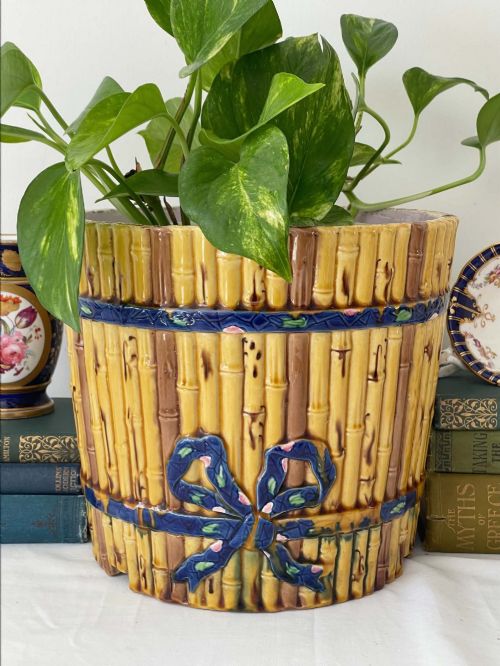


Victorian Majolica Pot
These Victorian majolica pots bring vivid colour and rich, tactile glazes to interior spaces.
Victorian Majolica Pot
A victorian majolica pot encompasses moulded earthenware and porcelain vessels glazed with intensely coloured metallic oxides, originating primarily from the nineteenth century. These pieces function predominantly as jardinieres, planters, pedestals, vases, and teapots, capturing the Victorians' fascination with decorative horticulture and domestic display.
The versions most commonly met on this page take the form of large jardinieres and planters, often shaped with naturalistic motifs such as bamboo, swans, or flora. Makers adopted both British and continental styles, moving from high Victorian naturalism and Renaissance revival towards early twentieth-century expressions.
Examples span the period from the 1870s through to the Edwardian era, reflecting both English potteries and Italian workshops. Buyers encounter everything from substantial floor-standing jardiniere and pedestal combinations to smaller decorative teapots featuring figural subjects.
Materials and glazing techniques
Potters shaped these vessels using earthenware and ceramic bodies, building up complex three-dimensional forms through moulding and casting. The clay provided a stable, absorbent base suited to receiving heavy layers of decoration.
Coloured metallic oxide glazes were applied directly to the porous body or over an opaque white tin enamel, a method defining the majolica technique. Firing at high temperatures caused these glazes to pool and run, creating deep colour saturation across naturalistic and revival surfaces.
Victorian potters delighted in whimsy, transforming everyday tea breaks into theatrical adventures by placing Chinese boys upon melons and fish leaping from the sea.
Distinguishing quality in majolica
Quality rests upon the crispness of the moulding and the depth of the glaze application. Superior examples retain sharp relief work where every leaf, feather, or figural detail remains distinct beneath the glossy surface.
The handling of the colour palette distinguishes finer studio production from standard commercial output. Skilled glazing creates subtle tonal shading and pooling within the recesses of the ceramic, whereas lesser pieces display flat, uniform colour washes.
Minton·Burmantofts·Royal Worcester·George Jones·Joseph Holdcroft·Brownfield
The Victorian Majolica Pot Glossary
- Majolica glaze
- A colourful lead-glazed earthenware technique utilising metallic oxides over a tin enamel or directly on the clay body. It produces a rich, glossy finish characteristic of nineteenth-century decorative wares.
- Jardiniere
- A large ornamental pot or receptacle designed to hold growing plants or flowers. These vessels often sit upon matching ceramic pedestals in interior settings.
- Naturalism
- An artistic style mimicking organic forms found in nature, such as bamboo, animals, and foliage. Victorian potters utilised this approach to celebrate the natural world.
- Earthenware
- Porous pottery fired at lower temperatures than stoneware or porcelain. It forms the standard ceramic body for the majority of these glazed vessels.
- Renaissance Revival
- A nineteenth-century design movement drawing inspiration from sixteenth-century classical motifs, strapwork, and architectural ornament. This style appears frequently on formal vases and jardiniere bodies.
Victorian Majolica Pot: Frequently Asked Questions
How were majolica pots used?
These vessels served primarily as indoor planters and ornamental centerpieces for nineteenth-century reception rooms and conservatories. Jardinieres housed potted palms and ferns, while smaller figural teapots functioned during formal tea services.
Owners placed them on tables, windowsills, or dedicated ceramic pedestals to showcase exotic plants against domestic interiors.
How do I clean a majolica pot?
Maintenance requires only gentle dusting with a soft, dry cloth to protect the glossy metallic oxide glazes. Avoid chemical cleaners and prolonged immersion in water, which can penetrate porous earthenware bodies through hairline crazing.
Careful handling ensures the fragile moulded details and surface brilliance remain undamaged over time.
How can I tell Minton majolica apart?
Minton pieces frequently display precise registration diamond marks or impressed factory ciphers indicating specific production years in the 1870s. The modelling exhibits exceptional refinement, particularly in naturalistic plant and animal forms.
Their glaze application achieves a luminous depth that sets standard benchmarks for nineteenth-century English ceramics.