
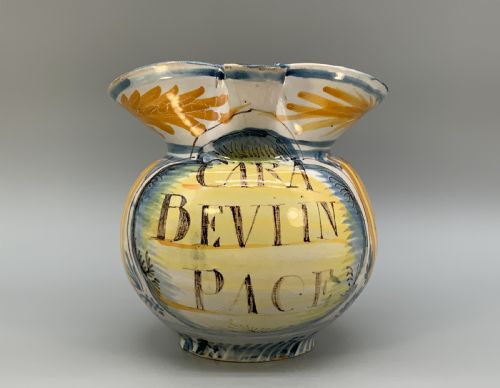
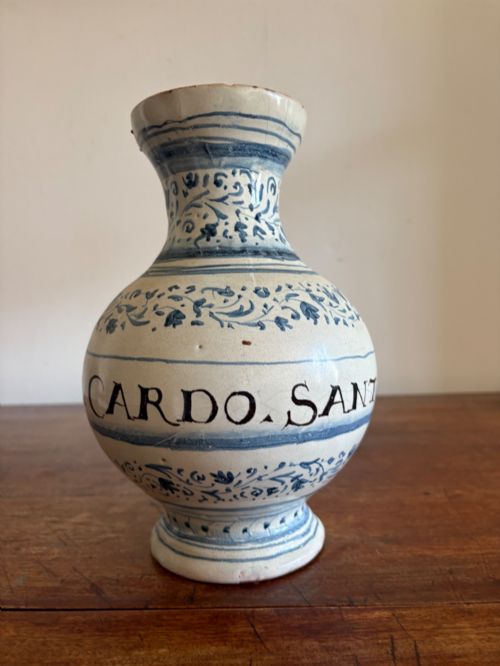


Albarello Pharmacy Jar
An albarello pharmacy jar is a cylindrical ceramic drug vessel designed for apothecary storage, prized for its painted decoration and historic utility.
Albarello Pharmacy Jar
An albarello pharmacy jar is a distinctive cylindrical vessel created to hold dry drugs, ointments, and syrups in historic apothecaries. When you search for this phrase, you find earthenware and ceramic pieces originating from Italian and French traditions, often grouped under majolica, faience, and delft faience.
The pieces on this page span several centuries, reaching from the seventeenth century through the eighteenth and nineteenth centuries up to nineteen hundred. Forms vary from waisted drug jars to wet drug jars with handles and spouts, alongside broader water vessels and apothecary jugs.
Italian styles dominate the selection, including Italian Baroque, Italian Renaissance, and regional variants from Savona, Naples, and Nove. Buyers encounter both blue and white colour schemes and richer polychrome palettes featuring manganese and yellow.
How these pieces were made
The construction of an albarello pharmacy jar relies on earthenware clay shaped into a distinct waist for ease of handling. Potters applied an opaque tin glaze over the ceramic body to create a smooth white surface suitable for painting.
Decoration was hand-painted directly onto the unfired tin glaze using mineral pigments such as cobalt blue, manganese, and yellow. Subsequent firing fused the pigments into the glaze, producing the durable finish seen on Italian majolica and French faience.
What varies in quality
Quality in an albarello pharmacy jar rests upon the crispness of the hand-painted decoration and the harmony of the palette. Pieces decorated with expressive blue and white or detailed polychrome brushwork display superior artistic control.
The refinement of the ceramic body and the consistency of the tin glaze also determine the grade of the vessel. Well-potted shapes with balanced proportions and even glaze coverage distinguish finer workshop production from simpler output.
The Albarello Pharmacy Jar Glossary
- Albarello
- A cylindrical earthenware jar used by apothecaries for storing dry drugs and spices. The shape evolved in the Near East before becoming a staple of Italian and European ceramic production.
- Majolica
- Tin-glazed earthenware decorated with colourful metal oxide paints on an opaque white ground. This technique flourished across Italy during the Renaissance and subsequent centuries.
- Faience
- European tin-glazed pottery, particularly associated with French and Dutch traditions. It shares technical similarities with Italian majolica.
- Tin Glaze
- A ceramic glaze made opaque by the addition of tin oxide. It provides the white background essential for painted earthenware decoration.
- Wet Drug Jar
- A specialised apothecary vessel featuring a spout and handle designed for liquid syrups and oils rather than dry powders.
Albarello Pharmacy Jar: Frequently Asked Questions
What were albarello pharmacy jars used for?
These cylindrical ceramic vessels stored dry herbs, ointments, and medicines in historic apothecaries and dispensaries.
Their shape allowed pharmacists to grip them easily while lined up on pharmacy shelves.
How do I date an albarello?
Dating relies on stylistic clues such as Renaissance, Baroque, or nineteenth-century decorative motifs and colour palettes.
Changes in tin glaze composition and potting technique also help place a jar within the seventeenth to twentieth-century span.
Are all these jars Italian?
The majority of pieces stem from Italian kilns, including regional centres like Savona, Naples, and Nove.
Some examples reflect French faience and delft traditions influenced by Italian styles.
How do I display an albarello at home?
Place jars on open shelving or mantels where their painted tin-glazed surfaces catch the light.
Keep them away from damp areas to protect the historic ceramic body.