
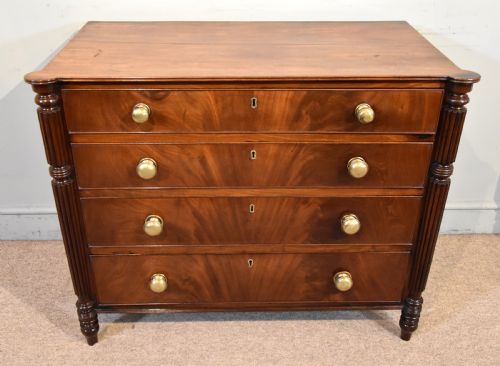


Reeded Mahogany Chest
A reeded mahogany chest brings warmth and architectural precision to a room through dense tropical timber and fine linear carving.
Reeded Mahogany Chest
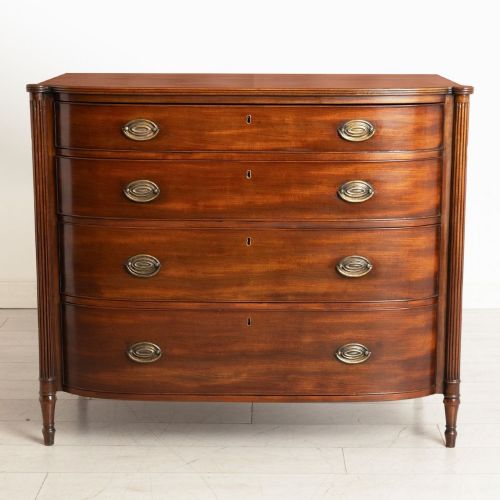
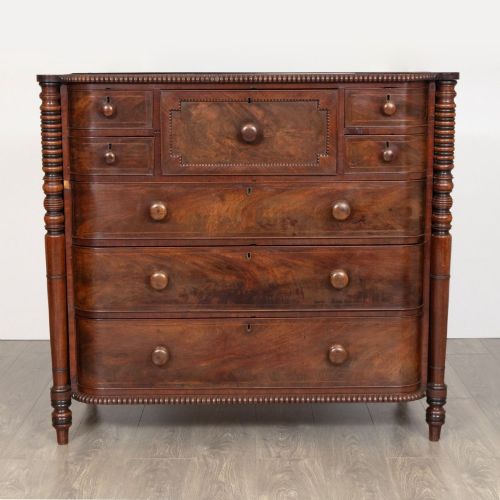
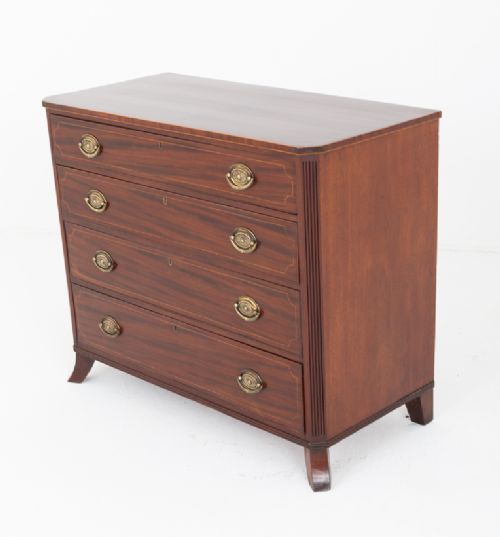
A reeded mahogany chest is primarily encountered as a chest of drawers spanning the Regency, Georgian, and Edwardian periods. These practical storage pieces take forms such as bow-fronted, concave, and straight fronts.
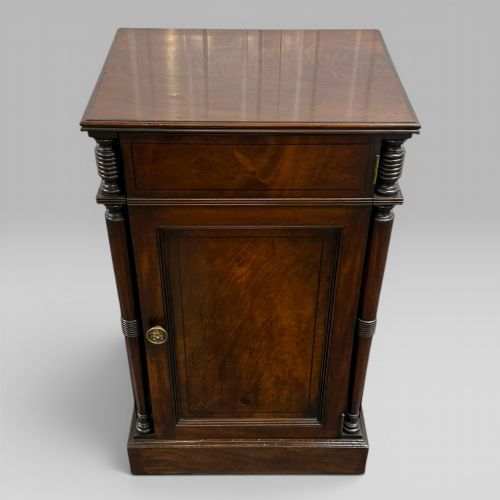
The inventory also includes related cellar pieces like wine coolers and cellarettes alongside pedestals. Originating largely from British cabinet-making traditions, these items range from Scottish regional interpretations to grand Regency designs.
How they were made
Makers utilised solid mahogany and flame mahogany veneer applied over secondary woods like oak. Cabinet-makers shaped the timber with linear reeding carved directly into the solid wood or structural pilasters.
Details were completed using brass for handles and hardware, alongside contrasting ebony line inlay to accentuate the drawer fronts and borders. Construction methods relied on traditional joinery to support heavy timber and veneered surfaces.
Listings feature mahogany, flame mahogany veneer, oak, brass, and ebony across pieces dating from the 18th century to the Edwardian period.
What varies in quality
The upper tier of pieces exhibits superior figure in the flame mahogany veneer and crisply executed reeding along the columns or edges. Lesser examples rely on plainer timber boards and softer, less defined carving.
Proportion and the integration of secondary elements like brass mounts and ebony stringing dictate the distinction between standard workshop production and exceptional cabinet-making.
Gillows·Morison and Co
The Reeded Mahogany Chest Glossary
- Reeding
- Parallel convex mouldings carved closely together to resemble a bundle of reeds. This decorative technique is frequently applied to the vertical corners or legs of case furniture.
- Flame mahogany
- A highly figured veneer cut from the fork of the mahogany tree where the branch meets the trunk. It creates a distinctive rippling flame pattern across drawer fronts.
- Bow-fronted
- A convex curved front cabinet shape that projects outward in the centre. This form softens the profile of storage chests.
- Cellarette
- A lockable container used for storing wine and bottles before serving. They appear in period dining spaces alongside standard drawer chests.
Reeded Mahogany Chest: Frequently Asked Questions
What periods do these pieces date from?
The pieces span the 18th century, the Regency era, the William IV period, and the Edwardian era. Cabinet makers worked within these prevailing British design movements.
Stylistic shifts can be observed across these dates, moving from Georgian proportions to bolder Regency forms and later Edwardian revivals.
How do bow-front and straight chests differ?
Bow-front chests feature a rounded, projecting front profile that softens the visual weight of the timber. Straight chests maintain a flat, rectangular facade.
Both shapes utilise mahogany construction and linear reeding, but the curved front requires more complex joinery from the maker.
What woods are used besides mahogany?
Oak frequently appears as a secondary timber for drawer linings and internal framing. Ebony is utilised for fine line inlay and contrasting details.
Flame mahogany veneer is also applied over core timber bases to create decorative surface patterns.
Where were these pieces made?
Production is rooted in British cabinet-making workshops, including notable regional centres in Scotland and workshops in London and Lancaster. Makers such as Gillows produced items in these locations.
Local timber availability and regional style preferences influenced the distinct character of Scottish and English pieces.