


Post Impressionist Still Life
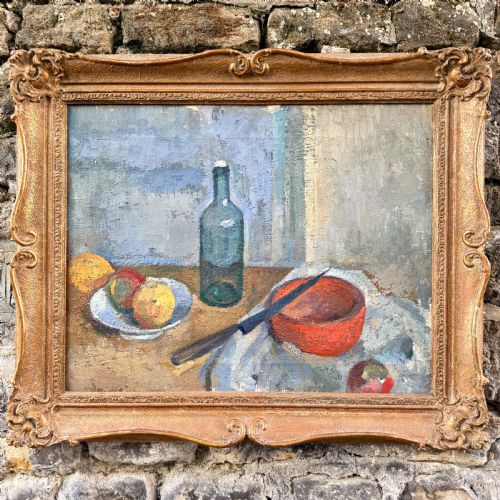
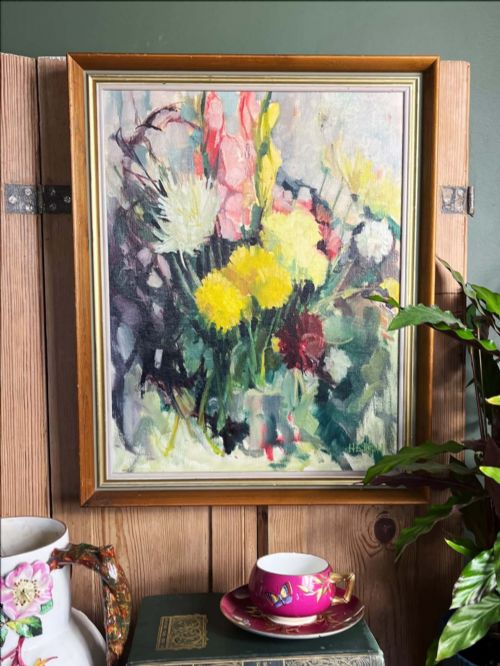
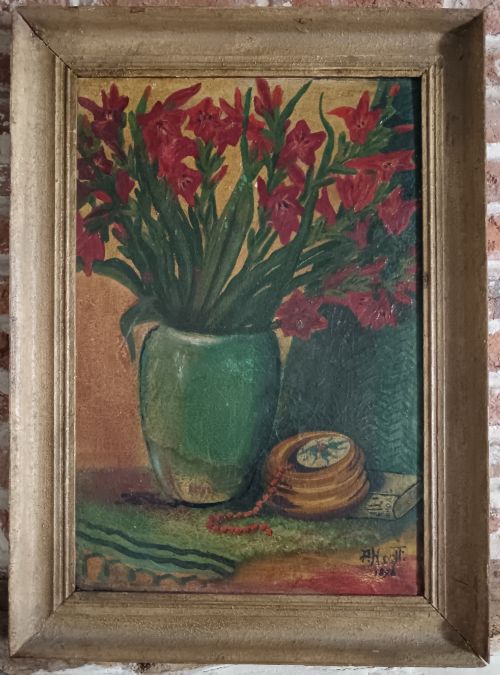
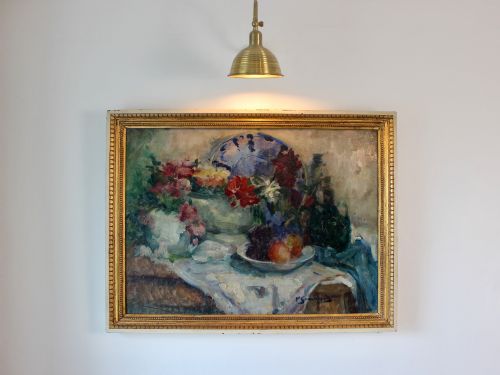
A post impressionist still life brings together bold brushwork and everyday domestic objects, capturing domestic arrangements through spirited colour and expressive form.
Post Impressionist Still Life
A post impressionist still life focuses on familiar domestic arrangements like bowls of fruit, vases of flowers, and everyday interiors painted with expressive freedom. These works capture the arrangement of objects through non-naturalistic colour and visible brushstrokes rather than strict academic precision.
The pieces on this page span from the late nineteenth century through the mid twentieth century, reflecting stylistic shifts from early pointillist experiments to mid-century modernist abstraction. You will frequently encounter oils on canvas and board depicting floral subjects, interiors, and tabletop scenes.
British Impressionism, Modern British, and French colourist traditions inform many of the compositions available here. Painters working in these modes prioritised atmospheric light and surface texture over photographic likeness.
Materials and construction
Artists painted these works primarily in oil paint applied to woven canvas, wooden board, or wood panels. Some pieces utilise watercolour on paper, capturing lighter washes for botanical and landscape studies.
Support frames often incorporate gold leaf or gilt wood moulding, complementing the vibrant pigments of the composition. These physical foundations provide the durable ground necessary for thick, impasto brushwork and layered glazing techniques.
Floral subjects and tabletop fruit arrangements dominate the visual record, executed in both British and French modernist styles.
Distinctions in quality and execution
Quality in these paintings rests upon the confidence of the brushwork and the deliberate harmony of the colour palette. Stronger works demonstrate a sure command of tone and spatial arrangement, even when the subject is abstracted.
The integrity of the canvas and the preservation of the original paint layer significantly influence the standing of a piece. Works retaining their initial wooden stretchers and untouched surfaces command greater regard among collectors.
Victor Simonin·Sir Matthew Smith·Rowland Henry Hill·John Gilbey Bowles·Maud Frances Eyston Sumner·Ernest Higgins Rigg·Markey Robinson·Henry D'Arcy Hart·Herbert Davis Richter·Owen Bowen·John M. Green
The Post Impressionist Still Life Glossary
- Impasto
- Paint applied thickly to a canvas or board, standing out in relief from the surface. This technique emphasises the tactile quality of the medium and the movement of the artist's brush.
- Pointillism
- A technique of painting involving small, distinct dots of colour applied in patterns to form an image. Luminist pointillist works use these optical mixtures to enhance the brilliance of light.
- Canvas
- A heavy woven fabric stretched across a wooden frame to serve as a painting surface. It provides a resilient and textured ground for oil pigments.
- Gilt wood
- Wood coated with a thin layer of gold leaf or metallic paint. Frames treated in this manner add warmth and formal definition to the finished artwork.
- Board
- A rigid wooden or composite sheet used as a flat painting support instead of fabric. Many early twentieth-century painters favoured this stable medium for smaller studies.
Post Impressionist Still Life: Frequently Asked Questions
What defines a post impressionist still life?
These works break away from strict academic realism by prioritising expressive colour, flattened perspective, and visible brushstrokes. Artists focused on domestic subjects like flowers or fruit to explore form and light in innovative ways.
Such paintings rely on personal interpretation rather than optical accuracy, making the arrangement of objects a vehicle for mood and decorative harmony.
How should I display an oil painting?
Keep the artwork away from direct sunlight and fluctuating humidity to protect the canvas and paint layers. Proper wall placement ensures the surface remains stable over decades.
Allow natural ambient light to illuminate the canvas without placing it in harsh glare, which can obscure the subtle textures of the brushwork.
Are watercolours different from oils?
Watercolour paintings utilise pigments suspended in a water-based solution on paper, creating a translucent and luminous effect. Oil paintings use slow-drying paint on canvas or board, allowing for rich impasto and layered depth.
Both mediums appear across these twentieth-century works, offering distinct visual textures and handling methods.
How do I identify a modernist still life?
Modernist compositions often simplify shapes, experiment with cubist angles, and use non-naturalistic colour schemes. The focus shifts toward the structural relationship between objects on a table or within an interior.
These pieces frequently dispense with traditional perspective to emphasise the flat surface of the canvas itself.