
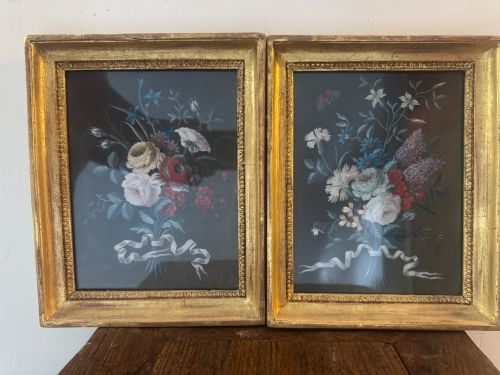
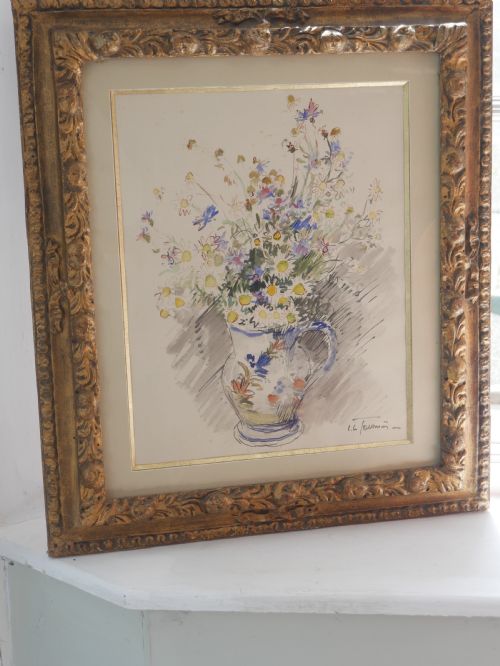


French Floral Still Life
When you search for french floral still life, you find centuries of painted bouquets capturing the changing light on garden blooms.
French Floral Still Life
A french floral still life presents arranged blooms, gathered garden stems, or potted plants captured in oils and gouache across various centuries. These works range from tightly rendered 19th-century academic studies to looser modernist interpretations from the mid-20th century.
The versions most commonly met on this page span the 19th century through the 1960s, executed on canvas, wood panels, board, and paper. Painters capture subjects as varied as humble field flowers, vibrant anemones, and structured arrangements in vases or baskets.
Compositions bridge traditional realism, Impressionism, post-impressionism, and mid-century abstraction. Many pieces reflect regional schools, including the distinct artistic traditions associated with Lyon and Provence.
Materials and Technique
Artists built these images using oil paint or gouache applied to various supports, including woven canvas, prepared wood panels, paper, and metal. The choice of ground alters how light interacts with the pigment, allowing for smooth gradients or heavy, textured brushwork.
Many works incorporate layered brushstrokes that build up the depth and form of petals and leaves. Selected pieces feature highlights of gold leaf or gilt framing that enhance the warmth of the palette.
The archive includes works associated with regional centres such as Lyon and Provence.
Assessing Quality
Quality rests in the surety of the hand and the handling of light across the arrangement, where confident brushwork brings vitality to stems and petals. Weaker pieces can feel stiff or flat, lacking the atmosphere and tonal depth found in superior examples.
The strength of the composition and the integrity of the original support dictate the lasting presence of the work. Skilled artists capture the transient nature of flowers through nuanced colour harmony rather than mere botanical recording.
Paul Lelong·Bertoldo Taubert·Pierre-Laurent Baeschlin·Nessi Valtat·Rémy Hétreau·Alfred Lesbros·Emile Compard·Marthe Barbaud Koch·Pierre-Louis Cadre·Sylvain Vigny
The French Floral Still Life Glossary
- Gouache
- An opaque water-based paint that dries to a matte finish. It allows for sharp details and flat areas of vibrant colour.
- Support
- The physical base upon which the artist paints, such as canvas, panel, board, or paper. Each material absorbs and holds pigment differently.
- Pointillism
- A technique of painting where small, distinct dots of pure colour are applied in patterns to form an image. Optical mixing occurs in the viewer's eye.
- Toleware
- Enamelled or lacquered metalware, sometimes found painted with floral motifs. It represents the decorative arts aspect of domestic floral design.
French Floral Still Life: Frequently Asked Questions
What periods do these paintings cover?
The selections span from the early 19th century through the mid-20th century. Works demonstrate the evolution of floral painting from classical realism into modernist abstraction.
Dates are assigned based on stylistic evidence, signatures, and historical records tied to the individual artists.
How were these artworks traditionally displayed?
These pieces were created to bring natural colour and light into domestic interiors, often hung in parlours, dining rooms, or studios. Their scale generally suits intimate residential spaces rather than grand halls.
Frames often reflect the period of creation, ranging from simple mouldings to gilt surrounds.
How do I care for an antique oil painting?
Keep paintings away from direct sunlight and dramatic fluctuations in temperature or humidity. Avoid using chemical cleaners on the canvas or paint surface.
Dust gently with a soft, dry brush when necessary, and consult a professional conservator for deeper cleaning.
How do I tell different painting styles apart?
Earlier 19th-century works typically focus on botanical accuracy and smooth blending, while Impressionist and post-impressionist pieces emphasise visible brushwork and light effects. Mid-century examples often incorporate flattened perspectives and bolder, abstracted palettes.
Examining the handling of the background and vase helps distinguish academic realism from avant-garde expression.