
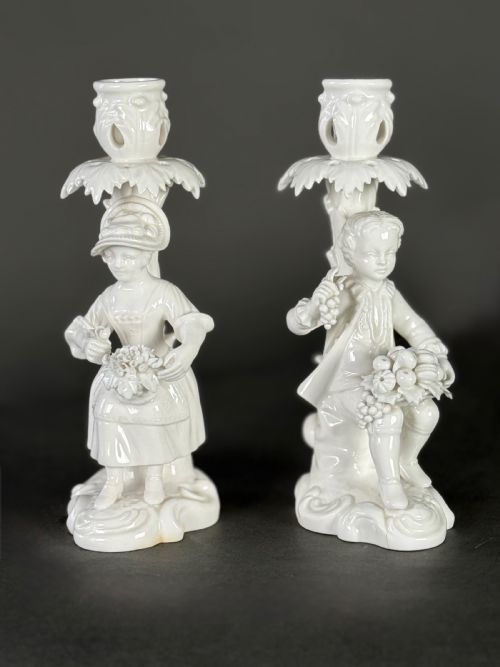
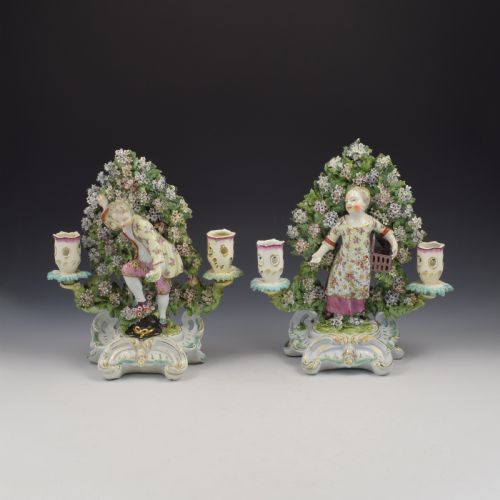
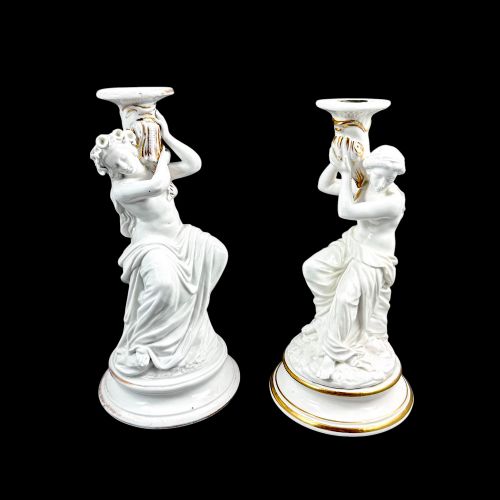


Porcelain Figural Candlesticks
Porcelain figural candlesticks combine illumination with sculpted human or allegorical figures, offering a decorative centrepiece for a table or mantel.
Porcelain Figural Candlesticks
When searching for porcelain figural candlesticks, a buyer examines sculpted ceramic lighting pieces populated by human figures, children, dancers, musicians, gardeners, or allegorical representations of seasons like summer and autumn. These items function simultaneously as functional candleholders and ornamental figures.
The inventory on this page contains nineteenth-century German and English production, alongside eighteenth-century Georgian examples from factories such as Derby and Chelsea. Pairs dominate the selection, frequently featuring sconces attached to floral or bocage backdrops.
Forms extend from single-light candlesticks to multi-arm candelabras. Figures range from classical dancers and children to shepherdesses and musicians set upon shaped bases.
How they were made
Manufacturers utilised hard-paste porcelain, soft-paste porcelain, and blanc de chine, shaping the clay through moulding and hand-modelling. Artisans applied fine details such as applied floral encrustations and bocage elements by hand before the initial firing.
Glazing and enamelling followed, with colour applied alongside gold leaf, gilding, and gilt highlights. Pieces underwent multiple kiln firings to set the enamel colours and the surface glaze.
Porcelain Figural Candlesticks Retail Price Guide 2026
Typical asking prices for porcelain figural candlesticks among the pieces listed under this phrase on Sellingantiques today, from the lower quarter to the upper quarter. They describe what is for sale here now, not the wider market.
Listings span the eighteenth century, the Georgian period, the Victorian era, and the years 1880, 1890, 1900, and 1920.
What varies in quality
The application of gilding and the complexity of the figural composition distinguish standard production from superior work. Fully preserved bocage elements and original sconces elevate a pair's desirability.
Derby·Sitzendorf·Royal Worcester·James Hadley·Volkstedt·Chelsea·Helena Wolfsohn·Minton·Meissen·Samson·Triebner ENS & Eckert
The Porcelain Figural Candlesticks Glossary
- Bocage
- Background foliage made of applied porcelain leaves and flowers that frames the central figure. This delicate technique is prone to loss over time.
- Hard-Paste Porcelain
- A dense ceramic compound composed of kaolin and petuntse, fired at very high temperatures. It produces a hard, bright white body.
- Soft-Paste Porcelain
- An artificial porcelain mixture fired at lower temperatures than hard-paste bodies. It possesses a warmer tone and a softer glaze.
- Blanc de Chine
- White porcelain originating from China and later emulated by European factories. It relies entirely on the purity of the white glaze rather than enamel colours.
- Sconce
- The metal or porcelain cup at the top of a candlestick that catches dripping wax and holds the candle in place.
Porcelain Figural Candlesticks: Frequently Asked Questions
How do I tell eighteenth-century pieces from nineteenth-century ones?
Eighteenth-century examples, such as those from Derby or Chelsea, display softer paste bodies, patch marks, and hand-modelled details characteristic of early English production. Their painting styles reflect Georgian palettes.
Nineteenth-century pieces from factories like Sitzendorf or Meissen often utilise harder porcelain bodies, brighter enamels, and machine-pressed elements alongside hand-finishing.
What are allegorical figures on candlesticks?
Allegorical figures represent abstract concepts or periods of the year through human form, such as children symbolising summer or autumn. Musicians, dancers, and gardeners also serve as common symbolic or pastoral subjects.
These themes allowed makers to create matched sets representing the four seasons or various arts and trades.
How do I care for antique porcelain candlesticks?
Keep them away from direct sunlight and dust them gently with a soft brush to protect fragile elements like bocage leaves. Avoid harsh cleaning agents that can damage enamel colours and gilding.
When burning candles, ensure wax does not drip directly onto vulnerable painted or gilded surfaces.