
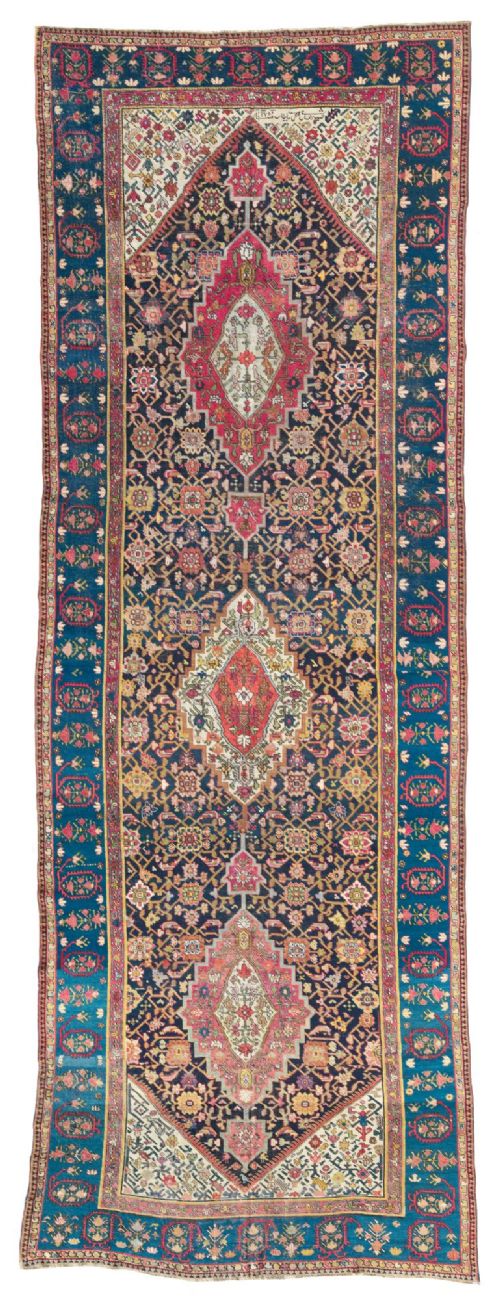


Persian Kelleh Carpet
A Persian kelleh carpet is an elongated room-sized rug offering dense tribal or regional designs.
Persian Kelleh Carpet
A Persian kelleh carpet is a distinctively elongated floor covering traditionally woven in specific proportions for room settings. The pieces seen here span from the mid nineteenth century to the early twentieth century, originating from various tribal and regional weaving centres.
The format is narrower and significantly longer than a standard carpet, functioning as a grand runner or a central room rug. Most examples emerge from Kurdish, Bidjar, Malayer, and wider North West Persian traditions.
Buyers look for these pieces to anchor long rooms, hallways, or spacious galleries where standard proportions fail. The surviving examples demonstrate how regional weavers adapted the format to local geometric and floral vocabularies.
Assessing Quality and Execution
Quality in a Persian kelleh carpet rests upon the crispness of the drawing and the density of the knotting. Finer weaves allow complex motifs like the harshang border, dragon patterns, or tree of life designs to render with sharp definition.
The choice and saturation of dye stuffs heavily influence the visual success of the piece. Hand-spun wool accepts colour unevenly in subtle, pleasing ways, creatingabrash that distinguishes superior traditional dyeing from flatter, uniform hues.
Some nineteenth-century weavers slipped tiny protective amulets directly into the wool knotting, hidden forever beneath the geometric patterns.
The Persian Kelleh Carpet Glossary
- Kelleh
- A format of Persian carpet characterised by an elongated rectangular shape, traditionally positioned on the floor alongside larger room carpets. It provides a grand runner aesthetic.
- Boteh
- A stylised floral or almond-shaped motif representing a bush, seed, or flame. It appears repeatedly across nineteenth-century runner and kelleh designs.
- Harshang
- A classic geometric crab pattern often found in the borders of North West Persian carpets. It frames the central field with repeating stylized floral elements.
- Abrash
- A natural variation in carpet pile colour caused by distinct dye batches or changes in hand-spun wool. This subtle shading marks authentic traditional production.
- Bidjar
- A town and weaving district in western Iran famous for heavy, densely knotted carpets built on stiff foundations. These pieces earn a reputation for iron-like durability.
Persian Kelleh Carpet: Frequently Asked Questions
What is a kelleh carpet?
A kelleh is a traditional Persian carpet woven in an elongated, narrow proportion rather than a standard square or rectangle. It functions as a room-sized runner.
Historically, weavers designed these formats to sit along the sides or centre of larger reception rooms in traditional Persian homes.
How do I place a kelleh in a room?
The elongated dimensions make these pieces ideal for narrow spaces, corridors, long galleries, or beneath large dining tables. Their length draws the eye down the room.
Ensure the surrounding floor space exposes the edges so the geometric or floral borders remain visible.
How do I identify a Kurdish kelleh?
Kurdish examples typically display robust wool foundations, bold geometric structures, and dense knotting derived from tribal weaving traditions. Look for sturdy construction and expressive borders.
Many feature distinct motifs such as tree of life designs, dragon borders, or repeating boteh patterns originating from the nineteenth century.
What distinguishes older Persian carpets?
Older pieces from the nineteenth and early twentieth centuries rely on hand-spun wool and natural dye stuffs that create soft tonal variations across the pile. The handle tends to be supple yet heavy.
Over time, wool fibres settle and soften, developing an organic patina that modern synthetic dyes cannot replicate.