

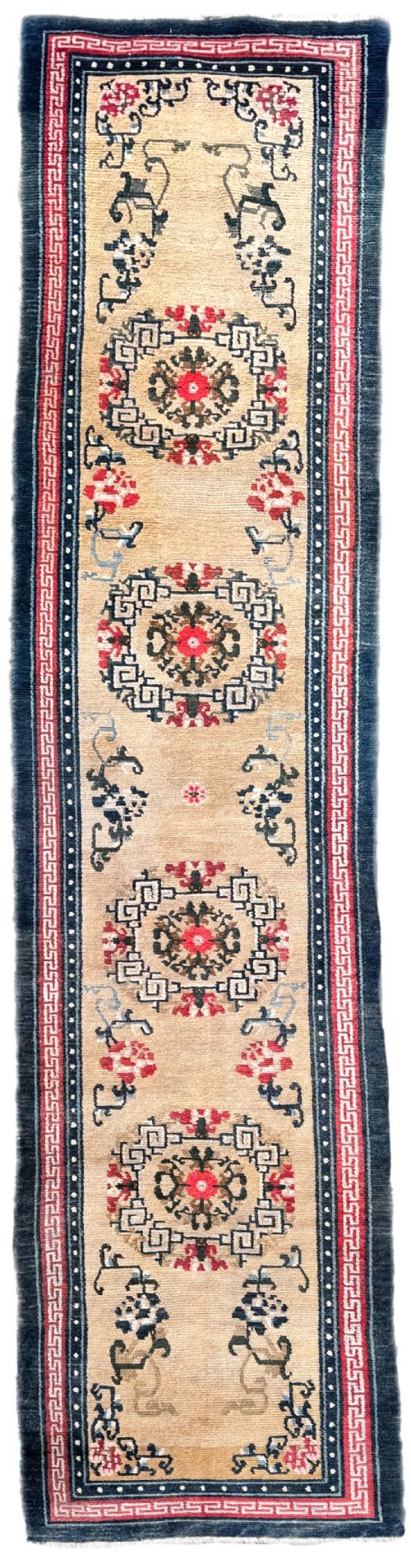

Antique Runner for Hallway
An antique runner for hallway spans eras from the nineteenth century into the twentieth, bringing patterned warmth and historical texture to narrow domestic spaces.
Antique Runner for Hallway
An antique runner for hallway usage typically measures significantly longer than it is wide, designed specifically to fit narrow corridors, landings and passageways. The selection spans origins from Persian tribal areas, Anatolia, the Caucasus and Tibet, reflecting diverse weaving traditions.
The pieces date predominantly from the late nineteenth century through to the early decades of the twentieth century. Forms range from village Kurdish and Shahsavan weaves to larger workshop pieces from Heriz and Ushak.
Makers utilised traditional formats suited to high-traffic domestic areas long before modern machine manufacture began. Buyers encounter narrow proportions paired with geometric medallions, lattice patterns and repeating tribal motifs.
Materials and Construction
The pieces rely primarily on wool piles knotted onto sturdy wool or cotton foundations. Natural dyeing methods created the underlying palette of olive greens, navy blues and earthy reds found across the inventory.
Weavers worked on vertical or horizontal looms, employing hand-spun wool that absorbed natural mordants unevenly, which produced subtle variations in tone over large surface areas. Dense knotting provided the durability necessary for functional floor coverings in heavy-use corridors.
Antique Runner for Hallway Retail Price Guide 2026
Typical asking prices for runner for hallway among the pieces listed under this phrase on Sellingantiques today, from the lower quarter to the upper quarter. They describe what is for sale here now, not the wider market.
Evaluating the Weaves
Quality rests upon the tightness of the knotting, the crispness of the drawn lines and the integrity of the wool foundation. Finer workshop pieces display intricate geometric or floral precision, whereas tribal examples lean toward expressive, irregular motifs.
The choice of natural dyestuffs dictates visual depth, separating pieces with rich, saturated hues from those with flat or uniform colour. Structural survival, including the retention of original selvedges and end finishes, determines the physical condition of each runner.
The Antique Runner for Hallway Glossary
- Runner
- A long, narrow carpet format specifically proportioned for corridors, hallways and stairs.
- Selvedge
- The bound or reinforced side edges of a rug that prevent the horizontal weft threads from unravelling.
- Medallion
- A large central ornamental design motif placed in the field of the rug.
- Pile
- The vertical or diagonal loops of yarn that form the usable upper surface of the textile.
- Lattice
- A symmetrical network pattern of intersecting diagonal lines forming repeated geometric compartments across the field.
Antique Runner for Hallway: Frequently Asked Questions
How long do these hallway runners typically measure?
Dimensions vary extensively across the inventory, ranging from compact lengths under two metres to expansive corridors stretching past five metres.
Narrow widths remain consistent to fit standard hallways, usually staying close to one metre across.
Where were these antique runners made?
Origin points span several traditional weaving regions including Persia, Anatolia, the Caucasus and Tibet.
Specific provenances often point to village workshops or tribal groups such as the Kurds, Shahsavan and Bakshaish.
What materials make up the pile and foundation?
The surface pile consists almost entirely of hand-spun wool, valued for its natural resilience in heavy foot traffic.
Foundations underneath use wool or cotton to support the dense knotting structure.
Which periods do these rugs date from?
The pieces span the late nineteenth century through the early decades of the twentieth century, including Victorian and Edwardian eras.
Datings draw from stylistic evidence and historical construction methods typical of those decades.