
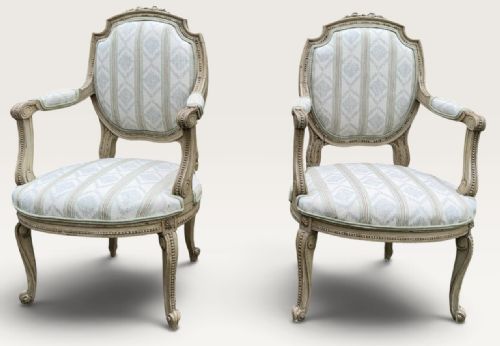
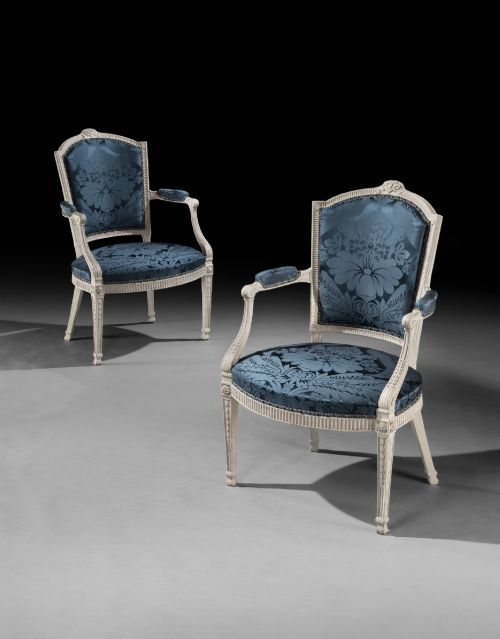


Painted Open Elbow Chair
A painted open elbow chair brings colour and lightness to a room, offering a seat with supportive arms crafted in wood and finished with decorative pigment.
Painted Open Elbow Chair
When you search for a painted open elbow chair, you are looking at seating designed with armrests and an open frame rather than a fully upholstered body. These pieces range from Georgian and Regency eras to later French and Victorian examples.
You are most likely to meet pairs or single armchairs featuring wooden frames treated with paint, often incorporating cane seats or fabric upholstery. The styles span from George III neoclassical to Sheraton and later decorative revivals.
How they were made
The construction of these chairs relies on timbers such as beech and walnut, shaped into open frames with elbow rests. Artisans applied paint directly to the wood surface, sometimes adding gold leaf or parcel gilt highlights to accentuate the carved details.
Surfaces frequently feature hand-painted floral decoration, polychrome finishes, or japanned lacquer work. Seats incorporate woven cane panels or textile pads covered in fabric to provide comfort within the open framework.
Some chairs come equipped with music-themed painted decoration, suggesting they spent their days holding notes rather than coats.
What varies in quality
The distinction between tiers of quality rests upon the preservation of original painted surfaces and the crispness of decorative detail. Pieces retaining their initial polychrome or gilt decoration display greater artistic merit than later overpainted layers.
Structural refinement in the turning of the woodwork and the delicacy of the painted motifs separate standard examples from finer works. The integration of cane work and the harmony of the proportion across pairs further define the grade of the piece.
John Gee·Gillows
The Painted Open Elbow Chair Glossary
- Elbow chair
- An armchair featuring wooden armrests designed to support the elbows. These chairs provide an open structure distinct from fully padded armchairs.
- Cane seat
- A seating surface woven from rattan strips. This technique creates a light, resilient mesh within the wooden frame.
- Japanned
- European furniture finished in imitation of East Asian lacquer work. The process involves layered varnishes and decorative painting.
- Parcel gilt
- A surface treatment where specific carved areas receive gold leaf decoration. This technique highlights particular details against a painted background.
- Polychrome
- Painted or decorated in multiple colours. This finish appears frequently on neoclassical and decorative chair frames.
Painted Open Elbow Chair: Frequently Asked Questions
What is a painted open elbow chair?
A painted open elbow chair is a wooden armchair featuring armrests and an exposed frame finished with painted decoration. These pieces lack full upholstery on the sides, maintaining an open profile.
They appear in various historic styles, incorporating materials like beech, cane, and textile seats across eighteenth and nineteenth-century periods.
Where were these chairs used?
These chairs served primarily in formal sitting rooms, parlours, and bedrooms of period homes where light and decorative furnishings were preferred. Their open frames and painted finishes suited drawing rooms.
They often formed part of larger sets used around dining tables or flanking fireplaces in prominent rooms.
How do I live with painted chairs?
Living with these chairs involves placing them away from direct sunlight and damp conditions to protect the delicate painted surfaces and wood. Regular dusting with a soft cloth maintains the finish.
Because many feature cane seats or antique fabric, gentle daily use helps preserve the structural integrity of the woven panels and upholstery.
How do I tell Regency from Georgian pieces?
Regency chairs often display bolder ebonised finishes, sabre legs, and classical revival motifs influenced by early nineteenth-century design. Their lines tend to follow distinct archaeological patterns.
Georgian examples, particularly from the George III period, frequently exhibit neoclassical details like shield backs, tapered legs, and delicate floral painted swags.