
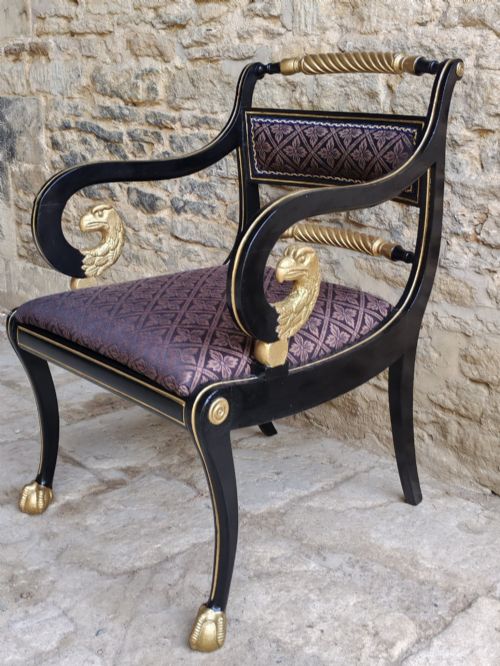


Ebonised Elbow Chair
An ebonised elbow chair offers a striking silhouette in black timber, bringing deep contrast and historical elegance to a room.
Ebonised Elbow Chair
An ebonised elbow chair is a seating piece finished to resemble ebony, spanning the eighteenth century, the Regency era, the nineteenth century, and later twentieth-century revivals. These armchairs and dining chairs appear in styles from George III and Hepplewhite Revival to Grand Regency and Anglo-Indian designs.
The version most commonly met on this page is the Regency model, often featuring open arms, caned seats, and decorative painted details or parcel gilt highlights. Makers utilised forms ranging from shield backs and faux bamboo to library armchairs and desk elbow chairs.
How they were made
The construction relies on hardwoods such as beech and mahogany, painted or chemically treated to achieve a dense black ebonised surface. Artisans enhanced these dark frames with gold leaf, paint, and parcel gilt to create sharp visual contrast.
Seating areas frequently incorporated woven cane or traditional fabric upholstery, occasionally supported by unusual block feet or turned supports as seen in colonial and Anglo-Indian workshops.
Listings feature periods spanning the eighteenth century, the Regency era, the nineteenth century, and the twentieth century.
What varies in quality
Quality rests in the crispness of the turning, the precision of the painted or gilded decoration, and the integrity of the ebonised finish over the timber base. Pieces retaining original cane work or sophisticated decorative motifs sit higher in the range than later, simpler revivals.
The refinement of the carving, such as shield backs or faux bamboo moulding, distinguishes standard utility seating from high-style Regency library and desk armchairs.
The Ebonised Elbow Chair Glossary
- Ebonised
- Timber treated with stain, paint, or chemical processes to imitate costly ebony wood. This finish became particularly fashionable during the Regency period.
- Parcel Gilt
- Partially gilded surfaces where gold leaf accents specific carved details against a contrasting background colour. It highlights architectural mouldings on the frame.
- Caned
- Woven rattan material forming a light, resilient seat or back panel. It appears frequently on Regency and nineteenth-century armchairs.
- Shield Back
- A chair back shaped like a heraldic shield, popular in late eighteenth-century designs. This contour often incorporates open-arm construction.
- Faux Bamboo
- Wood turned and painted to replicate natural bamboo stalks. This decorative technique reflects Regency tastes for exotic and botanical motifs.
Ebonised Elbow Chair: Frequently Asked Questions
What is an ebonised elbow chair?
An ebonised elbow chair is a seated furniture piece with arms, finished in a dark black coating designed to mimic ebony wood. These chairs range from late eighteenth-century painted designs to nineteenth-century Regency and later revival pieces.
They function primarily as occasional seating, desk chairs, or library armchairs, combining structural timber frames with materials like cane, fabric, and gold leaf decoration.
How do I date an ebonised elbow chair?
Dating relies on observing stylistic markers such as the geometry of the legs, the shape of the backrest, and the presence of Regency motifs. Pieces from the early nineteenth century often feature refined reeded legs, caned seats, and parcel gilt highlights.
Later nineteenth-century and 1920s revival pieces tend to replicate these earlier Regency or George III forms, though timber selection and decorative techniques help separate original period pieces from later interpretations.
Were these chairs used at dining tables?
Elbow chairs served multiple domestic functions, including use as desk chairs, library seating, and end chairs at formal dining tables. The inclusion of arms meant they occupied more space than standard side chairs.
In many historical settings, matching sets included a pair of armchairs to sit alongside numerous simpler dining chairs.
How do I care for ebonised wood?
Ebonised furniture requires gentle maintenance to protect the dark surface finish from moisture, direct sunlight, and abrasive cleaning products. Dusting with a soft, dry cloth preserves the lustre of the painted or stained timber.
Care should also be taken with integrated cane seats, which benefit from occasional light hydration to prevent brittleness.