


Oval Tea Caddy
An oval tea caddy is a refined wooden or silver canister designed to safeguard precious dry leaves, prized for its graceful curved silhouette.
Oval Tea Caddy
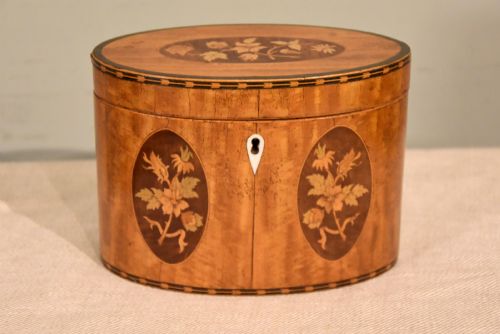
The oval tea caddy takes many forms across the Georgian and Edwardian eras, predominantly appearing as wooden veneered boxes or solid silver canisters. Buyers encounter satinwood, mahogany and harewood examples from the late eighteenth century alongside sterling silver pieces from later decades. These containers originally sat upon formal dining tables or tea tables, locking securely to protect expensive imported leaves from domestic theft.
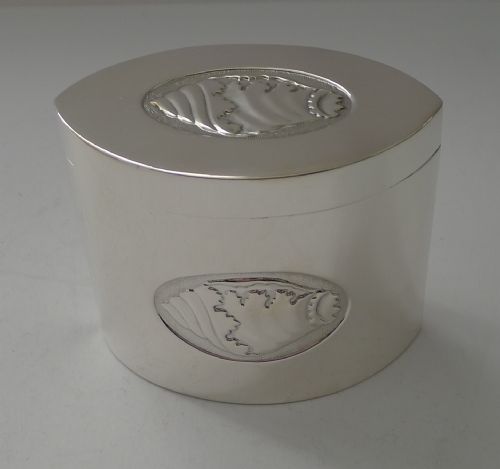
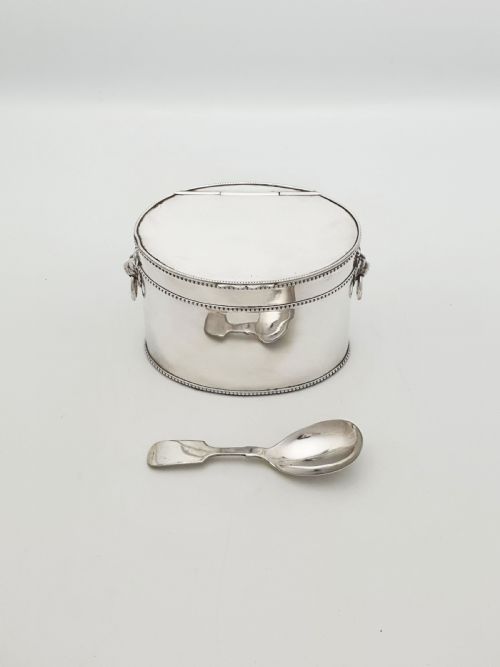
Wooden variations frequently exhibit marquetry or inlaid decoration such as shells and husks, while metal iterations feature embossed bodies, lion mask handles and pull-off lids. The profile remains consistently curved, though proportions shift between miniature vessels, single compartments and paired sets. Georgian and Edwardian examples dominate the available selection, spanning diverse stylistic revivals from Neoclassical to Victorian.
Materials and technique
Cabinetmakers constructed wooden oval tea caddies by applying fine veneers like satinwood, harewood and mahogany over a sturdy structural core, often accentuating the curved edges with contrasting stringing in boxwood and ebony. This technique required precise bending and fitting to maintain the smooth continuous radius characteristic of the shape. Artisans then polished the timber to reveal the natural grain and depth of the wood.
Silver equivalents involved skilled smiths hammering, casting or fluting sterling silver to form the bulbous oval bodies and secure lids. Makers such as William Rudkins and Thomas Shepherd utilised techniques like embossing and detailed chasing to decorate the metal surfaces. Cut glass options demonstrated alternative skill sets, combining heavy pressed or cut crystal with fitted mounts.
Listings feature wooden pieces in satinwood and mahogany alongside sterling silver and cut glass examples.
Judging quality
Quality rests upon the crispness of the inlay work and the harmonious integration of contrasting timbers such as satinwood and ebony. Superior wooden examples display deliberate grain selection and intricate marquetry details like urns and husks that follow the difficult curved contour without distortion. Inferior pieces rely on simple plain veneers with minimal attention to balance or proportion.
Silver and glass versions depend on the weight of the metal, the clarity of the hallmarks and the sharpness of any embossed or fluted decoration. Finer metal vessels retain sturdy hinges, well-fitted pull-off lids and substantial cast elements such as lion mask handles. The overall integrity of the construction dictates whether a piece remains a disciplined antique or a lesser production.
William Rudkins·Thomas Shepherd
The Oval Tea Caddy Glossary
- Satinwood
- A lustrous tropical timber with a golden sheen, frequently utilised for veneers on late eighteenth-century furniture and tea caddies. It provides a bright yellow ground that accepts inlay decoration exceptionally well.
- Harewood
- Sycamore wood treated with a stain to produce a distinctive greyish-green hue, popular among Georgian cabinetmakers for marquetry panels. It offers a muted contrast against darker woods like mahogany and ebony.
- Stringing
- Thin lines of contrasting wood inlay used to outline the edges and panels of decorative boxes. This linear detail defines the geometry of the oval shape.
- Marquetry
- The art of applying pieces of veneer to a structure to form decorative patterns and pictorial designs. Craftsmen arrange different timbers to create motifs such as shells and husks on caddy lids.
- Pull-off lid
- A cover that lifts directly upwards without the use of hinges or a locking mechanism, commonly found on silver tea caddies. It relies on a snug friction fit to keep the contents sealed.
Oval Tea Caddy: Frequently Asked Questions
What were oval tea caddies used for?
These vessels served to store dry black and green tea leaves when tea was an expensive and heavily taxed commodity. The containers were kept locked to prevent servants from taking the valuable leaves.
Today, they function primarily as decorative decorative objects on sideboards or mantelpieces, maintaining their historical charm without holding tea.
How do I date an antique oval tea caddy?
Dating relies on identifying the prevailing wood choices, inlay styles and construction methods associated with periods like the Georgian or Edwardian eras. Faint hallmarks on silver versions or maker signatures provide precise chronological markers.
Examining the interior construction, hinges and lining materials also helps distinguish eighteenth-century pieces from later nineteenth-century revivals.
Are wooden caddies lined inside?
Many surviving wooden tea caddies retain remnants of foil or paper linings within their internal compartments to preserve the aroma of the leaves. Some feature fitted wooden lids inside the main enclosure to partition different tea varieties.
Over the centuries, many linings have deteriorated or been removed entirely by previous owners.
How should I care for a wooden tea caddy?
Wooden caddies require stable indoor humidity away from direct sunlight and heat sources to prevent the delicate satinwood or mahogany veneers from cracking or lifting. Gentle dusting with a dry cloth is sufficient for routine maintenance.
Avoid using modern liquid polishes, which can seep into old hairline cracks and damage the historic finish.