



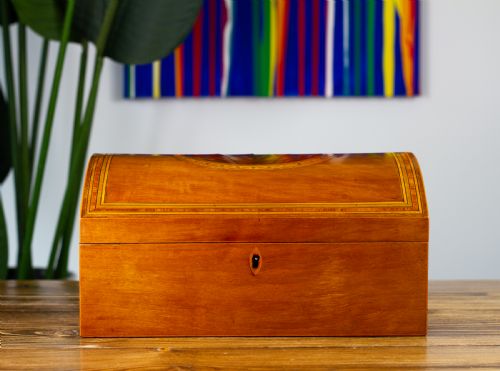
Inlaid Satinwood Tea Caddy
An inlaid satinwood tea caddy brings bright figured timber and precise contrasting stringing into a room.
Inlaid Satinwood Tea Caddy
An inlaid satinwood tea caddy is a lidded wooden box designed to store loose tea leaves securely under lock and key. The pieces found here belong predominantly to the Georgian, George III, and Regency periods, spanning the late eighteenth century into the nineteenth.
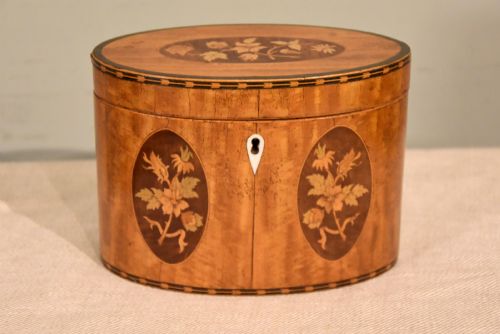
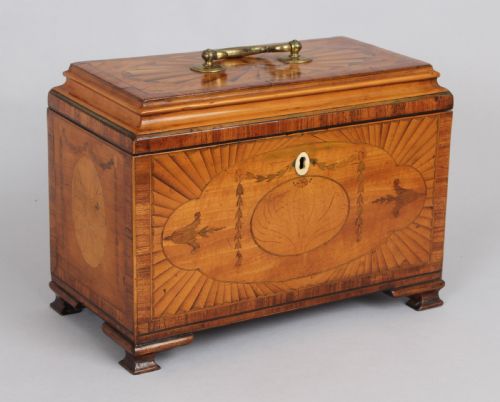
Buyers most frequently encounter oval and octagonal forms alongside occasional sarcophagus shapes. These boxes often feature contrasting wood veneers, geometric banding, and pictorial central motifs.
Makers utilised light-reflecting timbers to create decorative surfaces that stood proudly on parlour tables. The form reflects a time when tea was an expensive commodity requiring dedicated containment.
How they were made
Cabinet makers built these caddies using fine timber veneers laid over a sturdy secondary wood carcass. Satinwood provides the pale, shimmering primary surface, complemented by contrasting dark stringing and banding.
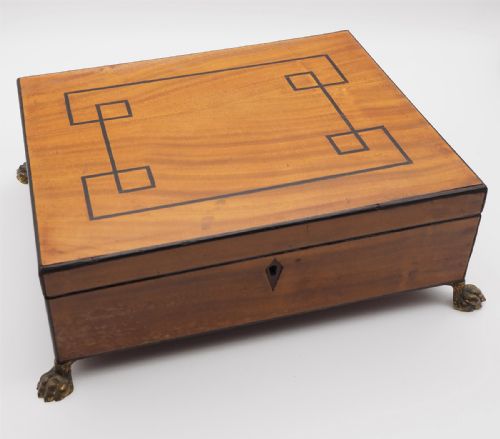
Inlay work incorporated ebony, boxwood, harewood, and rosewood to form geometric borders and pictorial motifs like shells or butterflies. Brass escutcheons and hinges completed the construction, securing the lids and internal compartments.
Some boxes hide tiny bone knobs on their internal tea canister lids, preserved from eighteenth-century workshops.
What varies in quality
Quality rests in the crispness of the marquetry and the selection of the timber figures. Finely grained satinwood with deep chatoyancy commands attention over plain, flat surfaces.
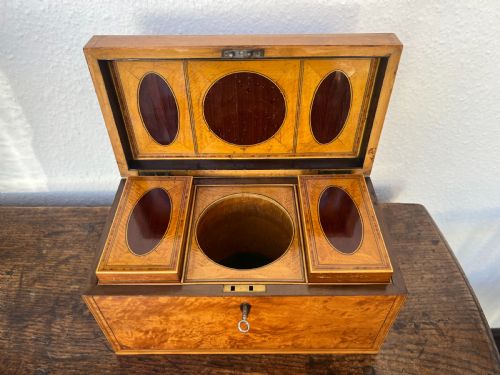
The precision of the contrasting stringing and the complexity of the inlaid motifs distinguish standard boxes from exceptional examples. Interior arrangements, such as surviving mixing bowls and lidded canisters, elevate a piece.
The Inlaid Satinwood Tea Caddy Glossary
- Satinwood
- A lustrous tropical timber known for its golden, reflective grain. It serves as the primary veneer for late eighteenth and early nineteenth century decorative boxes.
- Stringing
- Thin lines of contrasting wood inlay used to outline panels and geometric shapes on box surfaces. This technique frames the primary satinwood veneer.
- Marquetry
- Elaborate decorative veneer work forming pictorial designs or patterns. Craftsmen assemble pieces of various coloured woods to create motifs like shells and butterflies.
- Teapoy
- A larger stand or heavy box designed to hold tea canisters. These pieces often sit on central pedestals rather than resting directly on a table.
- Sarcophagus form
- A box shape featuring a steep domed lid and sloping sides reminiscent of ancient stone coffins. Regency cabinet makers favoured this architectural silhouette.
Inlaid Satinwood Tea Caddy: Frequently Asked Questions
What were tea caddies used for?
Tea caddies stored expensive loose tea leaves safely under lock and key in the Georgian home. Servants kept the key to control access to the valuable leaves.
Inside, the boxes often featured separate compartments for different teas and a central mixing bowl for blending.
How do I date an inlaid satinwood tea caddy?
Dating relies on the overall shape, the style of inlay, and the construction methods used inside the box. Late eighteenth-century pieces often take oval or octagonal forms with delicate shell motifs.
Regency examples tend toward heavier sarcophagus silhouettes incorporating rosewood banding and bold brass paw feet.
How should I clean my tea caddy?
Maintenance requires only a soft, dry cloth to remove dust from the delicate satinwood veneer. Avoid liquid polishes and modern sprays that can penetrate old timber pores.
Keep the box away from direct sunlight and radiators to prevent the dry satinwood and delicate stringing from warping.
Why do some caddies have multiple compartments?
Multiple compartments allowed owners to keep black and green teas separate within the same box. A central recess often held a glass or ceramic bowl used for blending the leaves.
Lidded inner canisters ensured the aromatic leaves retained their strong flavours between uses.