


Ornate Gilt Hall Table
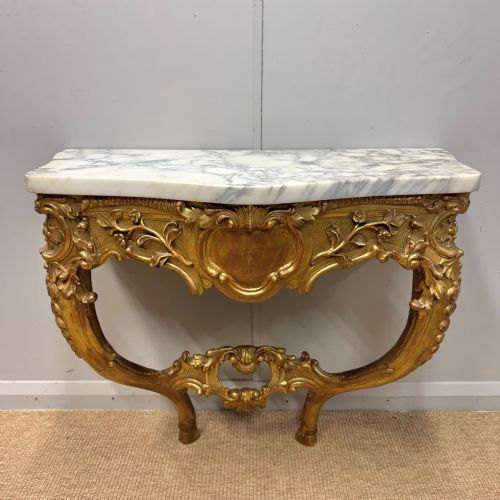
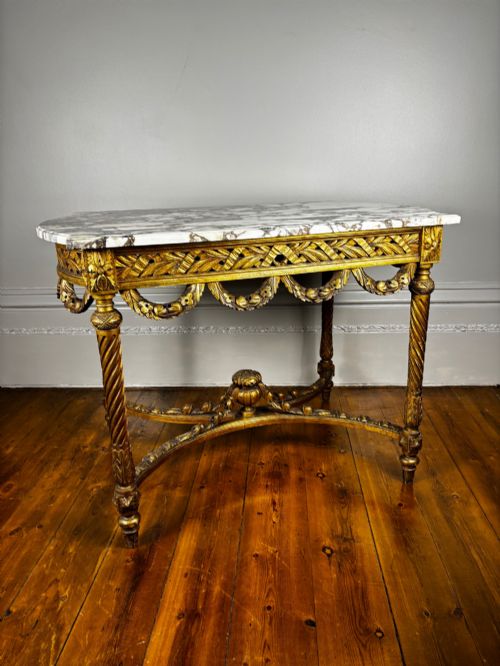
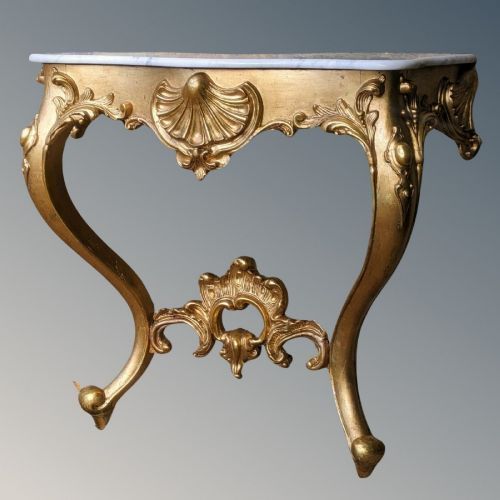
An ornate gilt hall table commands the entrance with gold leaf and marble, bringing unmistakable French and Italian theatricality to an interior.
Ornate Gilt Hall Table
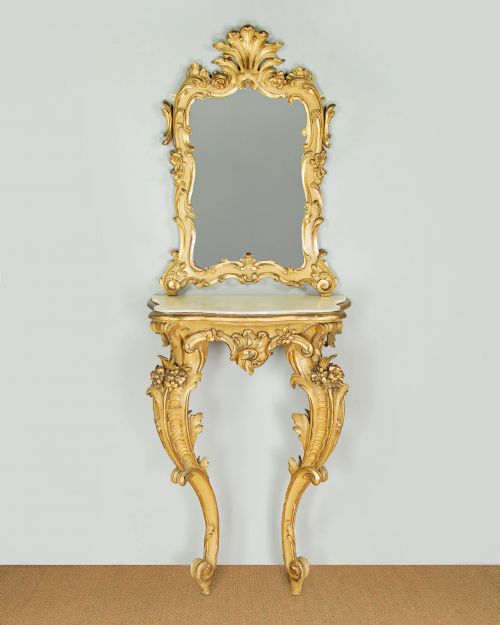
An ornate gilt hall table serves as a grand focal point in an entrance hall, combining a solid marble surface with a decorative framework. When you search for an ornate gilt hall table, you encounter console tables, centre tables, and matching console table and mirror sets.
The pieces appearing here stem from the nineteenth and early twentieth centuries, spanning the Victorian era and the Edwardian period up to 1920. French Rococo and Louis XV revival styles dominate the selection, alongside Italian Rococo revival and Venetian interpretations.
Most examples combine carved wooden frames finished in gold leaf, gesso, or paint with heavy white Carrara marble tops. These pieces often feature sculptural elements such as putto figures, rams, and maiden heads integrated into the carved woodwork.
Materials and construction
Carpenters carved the structural framework from wood, shaping elaborate curves and asymmetrical scrolls typical of the Rococo taste. Artisans applied layers of gesso to smooth the wooden surface before laying down gold leaf or paint.
Materials in these listings span marble, giltwood, gesso, glass, gold leaf, paint, and mirror glass across the nineteenth and early twentieth centuries.
Assessing quality and craftsmanship
Depth and crispness of the hand carving separate standard production from superior craftsmanship. The finest examples display deeply undercut wooden foliage and finely rendered sculptural figures rather than shallow, cast composition ornament.
The quality of the gilding and the weight of the marble top dictate the overall presence of the piece. Genuine gold leaf reflects light with a soft warmth that differs markedly from modern metallic paints, while thick, well-figured marble adds substantial structural integrity.
The Ornate Gilt Hall Table Glossary
- Giltwood
- Wood that has been coated with gold leaf or gold powder. This finish gives the carved surfaces their characteristic metallic brilliance.
- Console Table
- A table designed to stand against a wall, frequently secured to it with brackets. These pieces are shallower than standard tables to fit narrow hallways.
- Gesso
- A plaster mixture applied to wood as a base for paint or gilding. It provides a smooth surface that can be modelled and carved into fine details.
- Rococo Revival
- A nineteenth-century design movement that revived the ornate, asymmetrical scrolls and natural motifs of the eighteenth-century French style. This aesthetic defines the majority of the carved wooden frames seen on these tables.
- Carrara Marble
- A type of white or blue-grey marble quarried in Italy. It provides the heavy, cool-to-the-touch top characteristic of classical console tables.
Ornate Gilt Hall Table: Frequently Asked Questions
How do I style an ornate gilt hall table?
Place the table flat against the main wall of an entrance hallway where its reflective surfaces can catch natural light. Pairing it with a matching giltwood mirror creates a unified focal point upon entering the home.
Keep surface decoration restrained to balance the heavy carving of the base. A simple ceramic bowl or a single sculptural object is sufficient without cluttering the marble top.
Were these tables used in dining rooms?
Console tables were primarily designed for formal reception rooms, hallways, and grand corridors rather than everyday dining spaces. Their shallow profile allowed them to sit against walls without obstructing the flow of movement in a grand entrance.
Centre tables, by contrast, stood freestanding in the middle of a room for display purposes. Both forms served to project status and taste to arriving guests.
How do I care for the marble top?
Wipe the marble surface regularly with a soft, damp cloth using plain warm water. Avoid acidic cleaners, vinegar, or citrus products, which quickly etch and dull polished stone.
Use coasters or felt pads beneath any decorative objects placed on the table. This prevents scratches and protects the historical patina of the stone.
How do I distinguish French from Italian pieces?
French pieces often adhere strictly to Louis XV or Rococo revival lines, emphasising refined asymmetry and subtle parcel-gilt details over painted finishes. The carving tends towards controlled elegance.
Italian examples frequently embrace heavier sculptural elements, such as rams and maiden heads, alongside Venetian painted surfaces and intense gilding. They lean into theatricality and dramatic proportions.