





Gold Leaf Console Table
A gold leaf console table brings theatrical proportion and reflective brilliance to a narrow hallway or drawing-room wall.
Gold Leaf Console Table
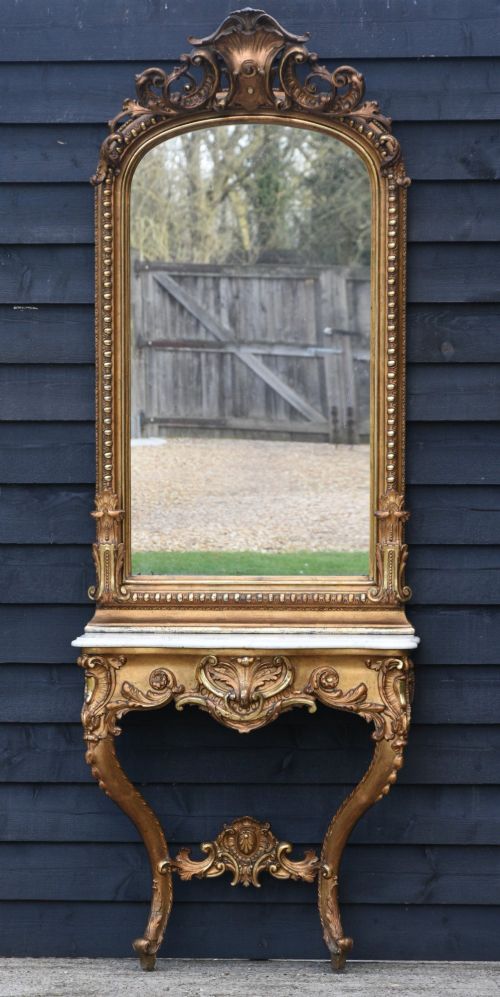
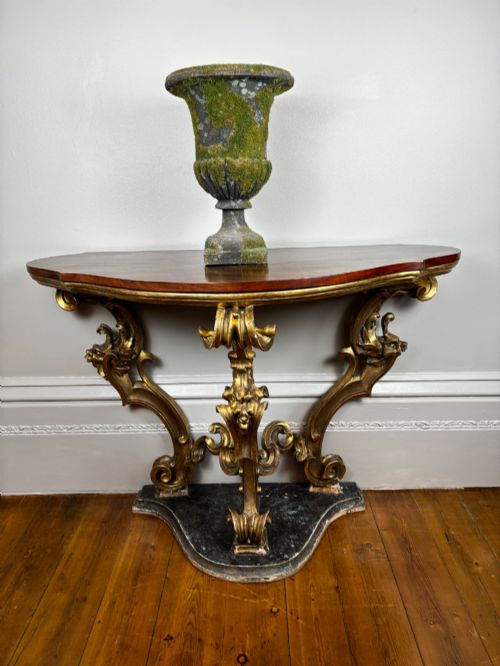
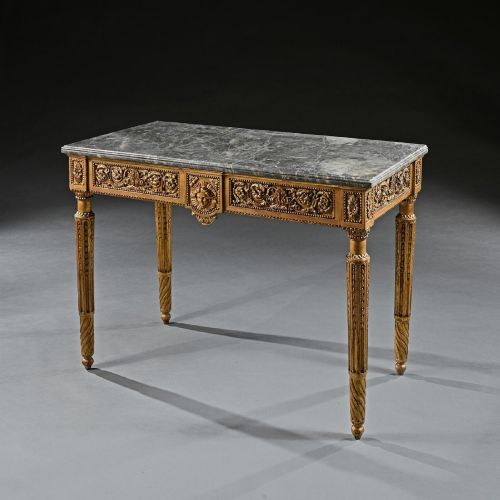
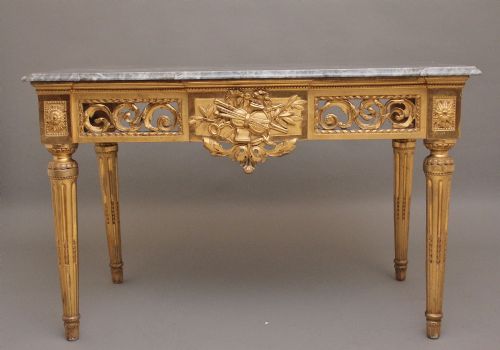
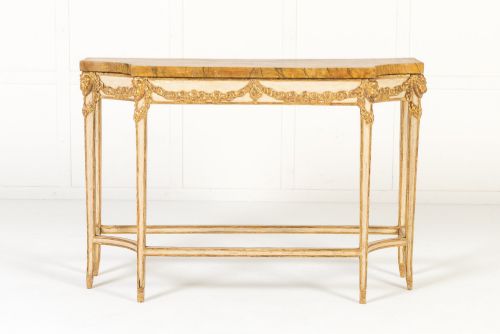
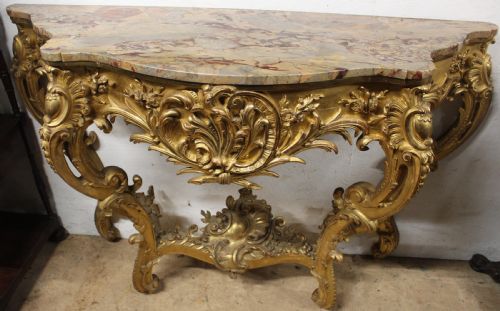
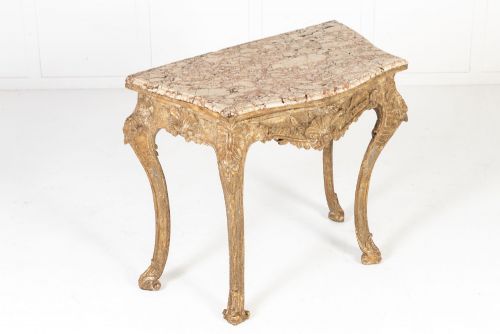
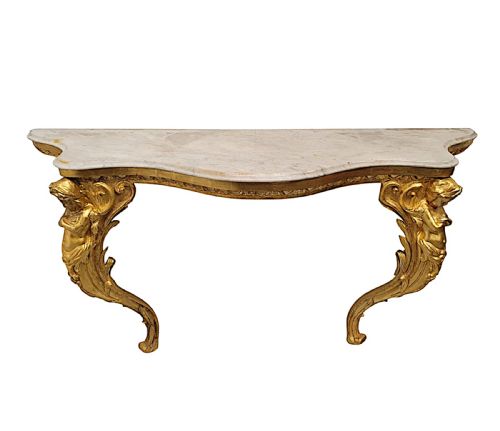
A gold leaf console table is a wall-fixed or freestanding support designed to stand against a vertical surface, frequently paired with a matching mirror. The forms seen here include standard console tables, side tables, and centre tables originating from various European workshops.
Most examples you encounter date from the eighteenth and nineteenth centuries, spanning Georgian, Victorian, and Regency periods. Italian and French pieces dominate the selection, often carrying heavy Baroque, Rococo, or Neoclassical carving.
The standard configuration combines a heavily carved wooden frame with a contrasting stone surface. Marble tops in white, rouge, or dark shades provide a cool, heavy counterpoint to the bright metallic finish of the base.
Assessing Craftsmanship and Condition
The depth and crispness of the hand-carving dictate the artistic merit of the piece. Superior examples display sharp undercutting and lively anatomical or botanical forms, whereas lesser tables rely on shallow, repetitive moulding.
The application of the leaf reveals much about the original workshop standard. Smooth, burnished gold that follows every contour of the wood indicates superior work compared to flat, flaky metallic finishes.
The integrity of the marble top and its relationship to the base matter greatly. Original stone slabs that fit the frame without modern alteration hold more interest than replacement tops fitted at a later date.
Gold Leaf Console Table Retail Price Guide 2026
Typical asking prices for gold leaf console table among the pieces listed under this phrase on Sellingantiques today, from the lower quarter to the upper quarter. They describe what is for sale here now, not the wider market.
Rams and maiden heads peer out from gilded wooden frames, watching over centuries of hallway post.
Whytock and Reid
The Gold Leaf Console Table Glossary
- Console table
- A table designed to stand against a wall, traditionally supported by two front legs and fixed to the wall at the back.
- Giltwood
- Timber that has been coated with gold leaf or gold paint. This finish creates a brilliant reflective surface popular in formal European interiors.
- Gesso
- A plaster-like mixture applied to wood to create a smooth surface for gilding or painting. It allows carvers to achieve sharp, refined details.
- Rococo
- An ornate style characterised by asymmetric designs, scrollwork, and naturalistic plant motifs. It creates a sense of fluid movement in wooden furniture.
- Demi-lune
- Having a half-moon or semicircular shape. These tables fit flush against flat walls while projecting outward with a curved front.
Gold Leaf Console Table: Frequently Asked Questions
Where do you put a console table?
These tables find their traditional home against a hallway or drawing-room wall where floor space is at a premium. They frequently sit beneath a large wall mirror or a matching trumeau set.
Because of their shallow depth, they occupy very little floor area while providing a formal surface for lamps, porcelain, or decorative objects.
How do I spot an 18th-century table?
Eighteenth-century pieces typically display hand-carved wooden frames showing tool marks and minor inconsistencies inherent to manual production. The gilt layers on these older tables often soften over time, revealing the warm red bole beneath the gold leaf.
Construction methods also provide clues, as older frames utilise traditional joinery without modern metal screws or brackets.
Are marble tops always original?
Heavy marble surfaces suffer accidental breakage over centuries of use, meaning replacement tops do occur on antique bases. Inspecting the underside of the stone and the supporting wooden rails reveals whether the marble has been with the frame since its creation.
A snug fit and matching age-related wear on both stone and wood suggest an original pairing.
What is the difference between console and side tables?
Console tables traditionally require wall attachment for absolute stability because they often rely on two prominent front legs. Side tables are fully freestanding structures with four independent legs capable of standing anywhere in a room.
Despite this structural distinction, antique sellers frequently use the terms interchangeably based on general form and proportion.