

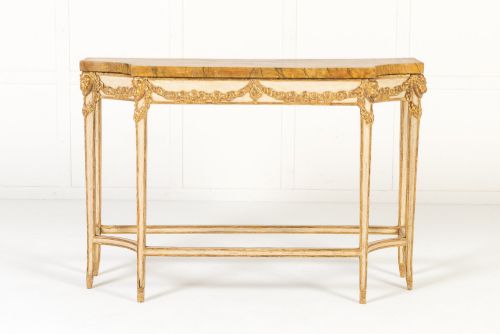

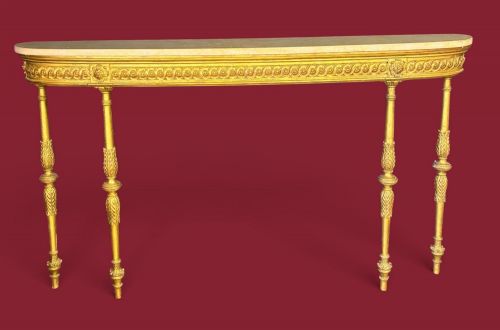

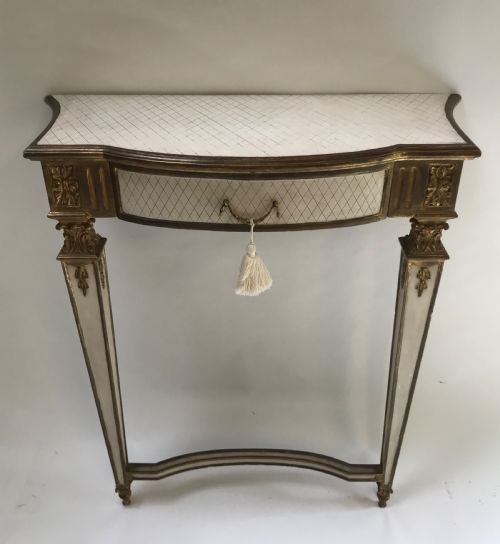


Gilded Entryway Table
These gilded entryway table pieces bring surface brilliance and classical form to a hallway, offering a striking focal point for any interior.
Gilded Entryway Table
A gilded entryway table serves as a primary decorative anchor in a hall or foyer, combining a supportive wooden structure with reflective metallic finishes. When exploring a gilded entryway table, buyers encounter console tables and wall mirrors designed to command a space.
The selections span distinct periods including the eighteenth century, nineteenth century, and early twentieth century. Common configurations feature half-moon shapes, serpentine outlines, and demi-lune forms designed to sit flush against a wall.
Stylistic influences range from George III and Victorian designs to Italian Baroque Revival, Louis XVI style, and Neoclassical interpretations. These pieces frequently incorporate stone or painted surfaces to complement their metallic gilding.
Materials and construction methods
Giltwood, gesso, and gold leaf provide the luminous metallic surfaces characteristic of these items, applied over carved wooden foundations. Artisans shaped timber frames through meticulous hand-carving to achieve intricate ornamental details such as lion's paw supports.
Marble tops, including breccia varieties, provide durable and heavy horizontal surfaces that contrast with the ornate woodwork below. Paint and satinwood are also utilised to finish specific sections, particularly on eighteenth-century and nineteenth-century examples.
Gilded Entryway Table Retail Price Guide 2026
Typical asking prices for gilded entryway table among the pieces listed under this phrase on Sellingantiques today, from the lower quarter to the upper quarter. They describe what is for sale here now, not the wider market.
Materials documented across the collection include marble, giltwood, wood, gesso, gold leaf, paint, satinwood, and glass.
Evaluating craftsmanship and detail
The depth and precision of the wood carving separate standard items from superior examples. Elaborate motifs, balanced proportions, and sculptural elements indicate higher levels of workshop expertise during production.
The application and preservation of gold leaf and gesso dictate the visual impact of the finish. Intact gilding with subtle burnishing reflects light more evenly than coarse or heavily restored paint layers.
The Gilded Entryway Table Glossary
- Giltwood
- Timber that has been coated with gold leaf or gold paint. This technique gives furniture a brilliant metallic sheen while retaining a wooden core.
- Console Table
- A table designed to be fixed against a wall, often supported by ornate brackets or legs rather than four independent vertical posts.
- Demi-Lune
- A half-moon shape used for the tabletops of tables designed to stand flat against a wall. This profile saves floor space in narrow hallways.
- Gesso
- A plaster-like mixture applied to wood surfaces as a smooth base for gilding. It allows craftsmen to carve fine details before applying gold leaf.
Gilded Entryway Table: Frequently Asked Questions
What is a gilded entryway table used for?
These tables provide a decorative surface in hallways and reception spaces for displaying decorative objects or mirrors. Their narrow profiles allow them to fit into confined circulation areas without obstructing movement.
Historically, they served to display the taste of a household immediately upon entering a residence. Today, they continue to function as statement furniture pieces in entrance spaces.
How do I identify a Neoclassical style table?
Neoclassical pieces feature restrained classical ornamentation, symmetry, and architectural motifs inspired by ancient Greece and Rome. They often incorporate straight tapered legs and classical relief carvings rather than heavy baroque curves.
Checking the overall silhouette and decorative vocabulary helps distinguish these pieces from more exuberant revival styles.
What materials are common on these tables?
Wood forms the primary structural base, frequently enhanced with gesso and gold leaf to create a gilded finish. Many examples also incorporate heavy marble tops, including breccia varieties, for durability and contrast.
Satinwood and painted finishes also appear on specific eighteenth-century and nineteenth-century variants.
How do I care for giltwood furniture?
Giltwood requires gentle dusting with a soft, dry cloth to prevent the accumulation of abrasive particles. Avoid using liquid cleaners, polishes, or harsh chemicals that can damage delicate gold leaf and gesso layers.
Keeping these pieces away from direct sunlight and excessive humidity protects the underlying wood and metallic finishes over time.