
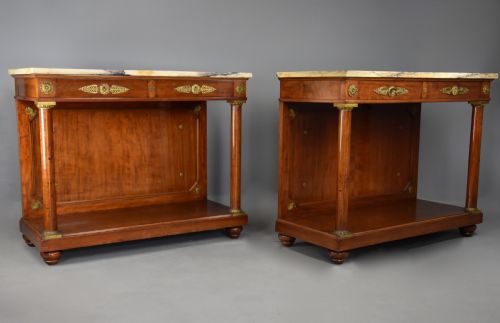
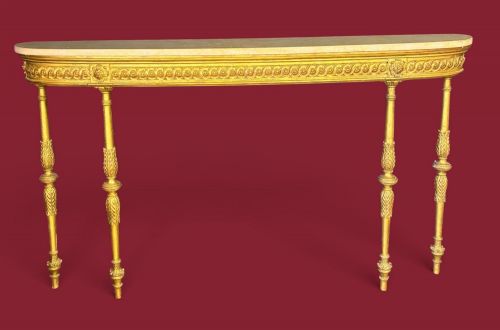


French Style Hallway Table
A french style hallway table brings architectural form and marble surface to narrow spaces through nineteenth-century revival craftsmanship.
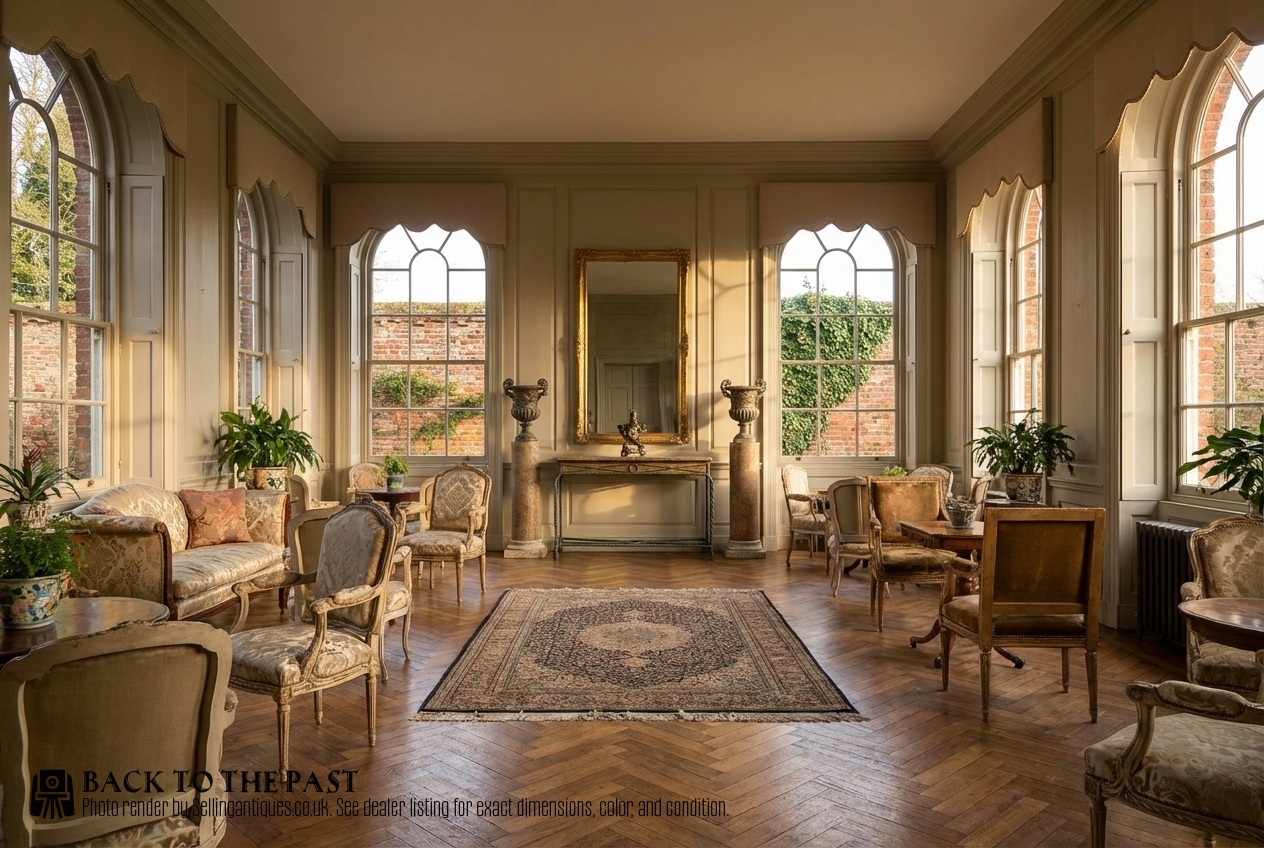
French Style Hallway Table
A french style hallway table combines console and centre table forms designed to stand flush against a wall or anchor a reception space. The selection here spans nineteenth-century Victorian pieces alongside revival works referencing Louis XVI, French Empire, and Rococo styles.
Buyers encounter marble-topped console tables alongside painted wood, mahogany, and giltwood pieces featuring serpentine outlines and demi-lune shapes. Many examples arrive paired with matching trumeau mirrors or form part of coordinated console table sets.
Materials and Technique
Carved giltwood, painted wood, and figured timbers such as mahogany, walnut, and burr birch form the structural basis of these tables. Artisans combined carved wooden frames with heavy polished marble slabs in white, rouge, or sienna tones.
Gilding, parcel-gilding, and hand-painting decorate the wooden framework, whilst specific makers utilised brass mounts and ormolu details to echo eighteenth-century royal workshop practices.
Standards of Execution
Quality rests upon the crispness of the wood carving, the depth of the gilding, and the selection of cabinet timbers such as figured mahogany or burr birch. Heavy marble tops fitted precisely to serpentine or demi-lune wooden frames indicate superior workshop production.
Maker stamps and attributions, such as Krieger Paris or Gillows, separate standard provincial furniture from pieces built by documented cabinet-makers operating during the nineteenth century.
Krieger Paris·Gillows
The French Style Hallway Table Glossary
- Console Table
- A table designed to stand against a wall, frequently fixed with brackets or resting on front legs. These pieces suit hallways and reception rooms where floor space is limited.
- Demi-Lune
- A half-moon shape used for table tops and frames. This curved profile allows the furniture to sit snugly against a flat wall.
- Giltwood
- Wood that has been coated with a thin layer of gold leaf or powder. It defines grand nineteenth-century revival reception furniture.
- Ormolu
- Gilded bronze mounts applied to furniture decoration. The technique creates metallic highlights against timber or painted surfaces.
- Trumeau
- A decorative wall mirror often paired directly above a console table. The frame matches the timber or gilding of the table below it.
French Style Hallway Table: Frequently Asked Questions
How do I style a hallway table?
Place a narrow console table flat against the hallway wall to create an immediate focal point upon entry. Pair the surface with a matching trumeau mirror or decorative lamp to balance the vertical space.
Keep the surface uncluttered to highlight the marble top and carved wooden frame. The shallow depth of demi-lune and serpentine forms ensures clearance for foot traffic.
Are these tables solid marble?
The structural frames are constructed from timber such as mahogany, oak, walnut, or painted wood, topped with heavy slabs of solid marble. These stone surfaces range from white varieties to rouge and sienna tones.
Support brackets and sturdy leg assemblies distribute the considerable weight of the marble top safely across the floor.
What is the difference between console and centre tables?
Console tables feature flat backs designed to stand directly against a wall, frequently supported by two front legs. Centre tables are finished on all sides to stand independently in the middle of a room.
Many nineteenth-century examples bridge this distinction, utilising decorative timber framing suited to both wall placement and open room display.
How do I identify French Empire style?
French Empire style relies on classical architectural symmetry, dark mahogany timbers, and polished marble tops. Ormolu mounts and restrained carving replace the ornate curves found in earlier Rococo designs.
Look for geometric balance and solid proportions that reflect nineteenth-century revivals of Napoleonic-era neoclassical taste.