


Ormolu Portico Clock
An ormolu portico clock brings striking architectural presence to a mantelpiece, framed by slender columns and anchored by a central pendulum.
Understanding ormolu portico clocks
An ormolu portico clock takes its architectural form from the classical temple, supported by columns that frame a swinging pendulum. When you search for an ormolu portico clock, you are looking at mantel clocks primarily originating from France during the eighteenth and nineteenth centuries.
The most common examples combine gilt bronze mounts with white, green, red, or specimen marble bases, often appearing alongside garniture sets. These pieces span stylistic periods including French Directoire, French Empire, and French Restoration, alongside nineteenth century interpretations.
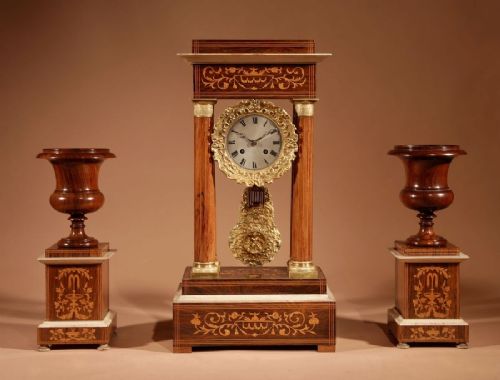
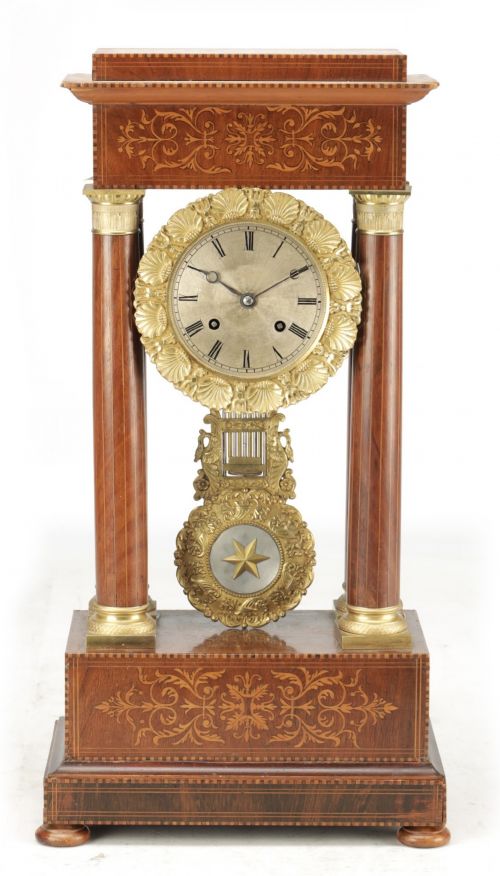
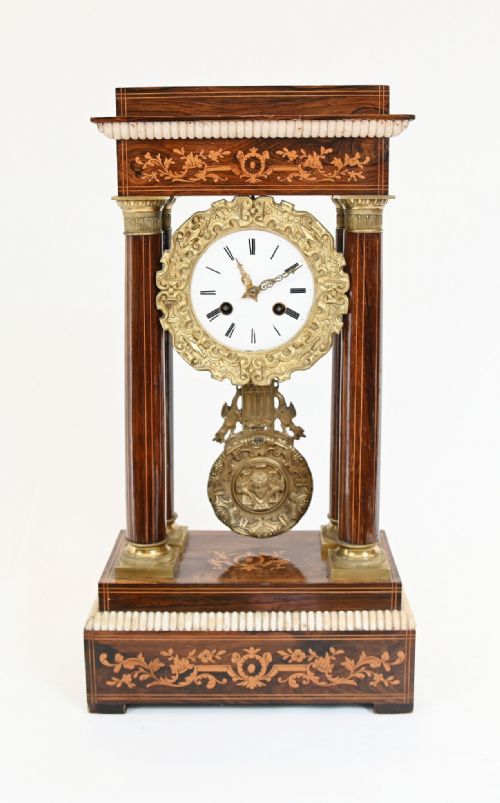
Wood variations also exist in the record, featuring mahogany or rosewood and marquetry cases rather than marble. These wooden mantel clocks maintain the signature portico architectural arrangement while offering a warmer material palette for the domestic interior.
Factors that separate examples
The precision and depth of the ormolu casting largely determine the quality of a portico clock, distinguishing sharp, hand-chased gilt bronze mounts from softer, simpler details. Master bronze-workers achieved crisper definition in the acanthus leaves, architectural capitals, and figurative elements.
Several portico clocks feature cheeky cherubs peering out from behind the columns, keeping perpetual watch over the swinging pendulum.
Japy Freres·Fritz Marti·Samuel Marti·Louis Japy·A. D. Mougin
The Ormolu Portico Clock Glossary
- Ormolu
- Gilt bronze created by applying an amalgam of gold and mercury to a bronze base and heating it to drive off the mercury. This historic technique produces a rich, durable golden surface finish.
- Portico clock
- A mantel clock designed with an architectural case featuring vertical pillars or columns. The pendulum typically swings visibly between these supports.
- Garniture set
- A matching group consisting of a central clock flanked by decorative side ornaments such as urns or vases. These sets were designed to sit harmoniously on a mantelpiece.
- Specimen marble
- Stonework composed of numerous small pieces of various coloured marbles arranged in geometric patterns. This decorative technique creates a variegated, multi-toned surface.
- Silvered metal
- A base metal treated to present a silver surface finish. Dials made this way often feature engraved numerals.
Frequently Asked Questions
How do I identify a portico clock?
A portico clock is easily recognised by its architectural structure, which resembles a classical temple facade. Two or four columns support an upper entablature, leaving a central open space where the pendulum swings.
This architectural arrangement distinguishes portico clocks from standard box or bracket mantel clocks. They frequently incorporate marble bases and gilt ormolu mounts to enhance their classical appearance.
What materials are used in these clocks?
The primary materials are fire-gilded bronze, known as ormolu, and various types of marble such as white, green, red, or multi-coloured specimen marble. Some examples also utilise alabaster, mahogany, or rosewood.
Additional components include enamel or silvered metal dials, glass covers, and brass mechanical movements. Decorative bronze mounts often depict classical motifs, cherubs, or eagles.
Which periods do these clocks come from?
These clocks predominantly date from the eighteenth and nineteenth centuries, spanning distinct French design movements. Examples reflect the neoclassical styling of the French Directoire period and the grander military motifs of the French Empire.
Later pieces from the nineteenth century include French Restoration designs and Victorian interpretations. Each period brought subtle shifts in architectural proportions and decorative detailing.
What is a clock garniture set?
A clock garniture set includes the central portico clock accompanied by matching decorative side pieces, typically designed as urns or vases. These matching items were manufactured as a cohesive display for a mantelpiece.
Finding a complete set preserves the original decorative intention of the maker. The side ornaments repeat the marble and ormolu materials used in the main clock housing.