


19th Century Portico Clock
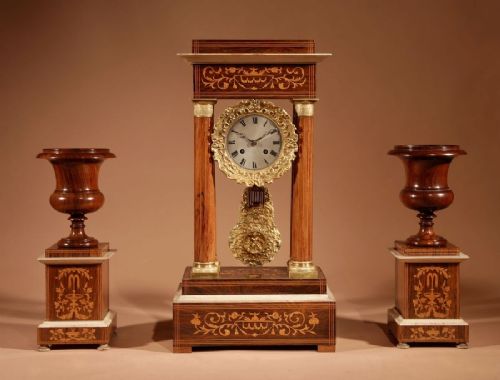
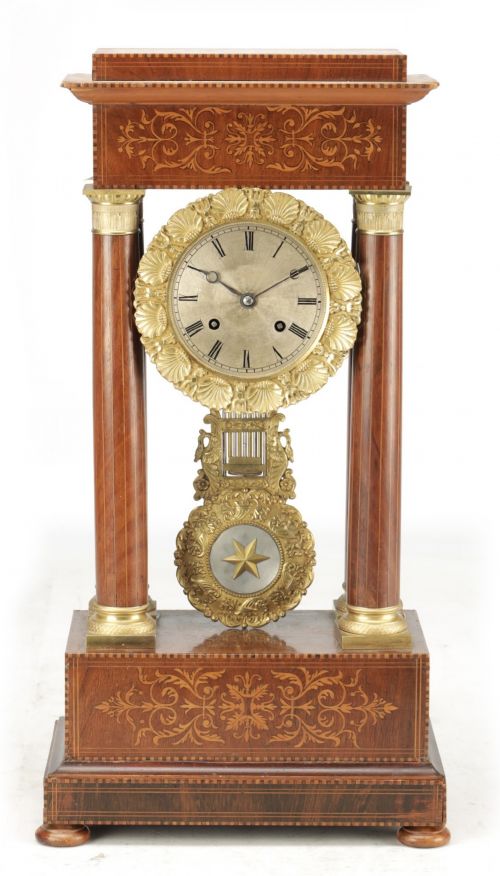
A 19th century portico clock stands on slender columns beneath a pediment, bringing architectural symmetry and precise timekeeping to any mantel.
19th Century Portico Clock
A 19th century portico clock is a distinct mantel timepiece characterised by its architectural frame, featuring twin side columns supporting an upper entablature that houses the dial and movement.
The pieces on this page span the Victorian era and the broader nineteenth century, originating predominantly from French workshops in styles such as Charles X, Louis Philippe, and various revival motifs.
Buyers commonly encounter mantel clock sets and garnitures alongside standalone clocks, frequently accompanied by matching side ornaments or protective glass domes.
How they were made
Cabinetmakers constructed the architectural cases using dense timbers like rosewood, mahogany, and satinwood, often embellishing the polished surfaces with intricate marquetry and fine inlay work.
Foundries cast bronze and brass elements to create gilt bronze and ormolu mounts, which decorators fire-gilded and chased to sit alongside components carved from white, pink, and onyx marbles.
Horologists fitted enamel dials with delicate hands, housed mechanical movements behind bevelled glass, and occasionally incorporated cut crystal shafts within the distinctive column architecture.
19th Century Portico Clock Retail Price Guide 2026
Typical asking prices for 19th century portico clock among the pieces listed under this phrase on Sellingantiques today, from the lower quarter to the upper quarter. They describe what is for sale here now, not the wider market.
Some delicate columns conceal tiny glass tubes where invisible pendulums swing.
What varies in quality
The refinement of the cast ormolu mounts and the crispness of the chased bronze details separate standard production from superior examples.
Cabinetwork precision, such as the exact alignment of rosewood veneer, satinwood stringing, and marquetry panels, dictates the overall architectural integrity.
The sophistication of the internal movement, including signature work by noted makers and specialised suspensions like knife-edge variants, elevates a piece significantly.
Breguet·AD Mougin Paris
The 19th Century Portico Clock Glossary
- Portico clock
- A mantel clock designed with architectural columns framing a central pendulum suspension. This classical layout derives from ancient temple architecture.
- Ormolu
- Gilded bronze produced by applying a mercury and gold amalgam to a bronze base before heating. This technique creates a durable, luminous golden finish.
- Clock garniture
- A set comprising a central clock accompanied by matching decorative side pieces such as urns or candelabra. These sets created a balanced mantelpiece arrangement.
- Marquetry
- The art of applying small pieces of wood veneer to a structure to form decorative patterns and pictures. Craftsmen selected contrasting timbers to achieve tonal depth.
- Knife-edge suspension
- A precise horological mechanism supporting the pendulum on a sharp steel edge. This reduced friction to improve timekeeping accuracy.
19th Century Portico Clock: Frequently Asked Questions
Where should I place a portico clock?
These architectural timepieces suit a prominent mantelpiece, library shelf, or console table where their vertical column structure receives adequate clearance and light.
Ensure the surface remains stable and level to maintain the correct beat of the pendulum.
How do I wind the movement?
Insert the appropriate winding key into the designated arbours on the enamel dial and turn gently until resistance is felt. Avoid over-winding to protect the mainspring.
Many nineteenth-century French movements require weekly attention to keep accurate time.
What is a clock garniture?
A garniture consists of a main clock flanked by matching decorative objects designed to sit together as a unified set on a mantelpiece.
These matching pieces often mirror the marble, ormolu, or timber materials of the central portico clock.
How do I identify the period?
Examine the timber veneers, marble types, and decorative bronze mounts for stylistic clues associated with Charles X, Louis Philippe, or Victorian design. Dial signatures and movement stamps often provide further chronological markers.
Cabinet construction techniques and the presence of cut crystal also help narrow down the decade of manufacture.