


Opaline Glass Vases
Opaline glass vases are milky, translucent vessels prized for their soft colour and decorative presence in nineteenth-century interiors.
Opaline Glass Vases
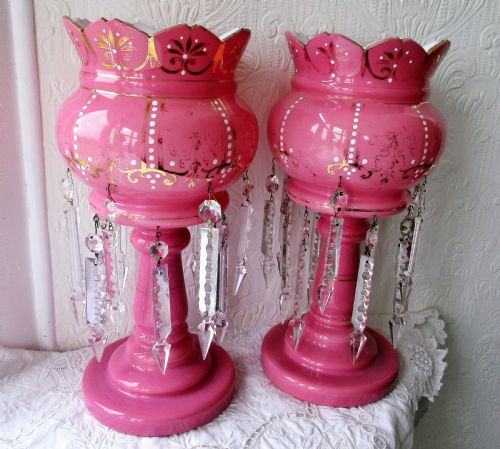
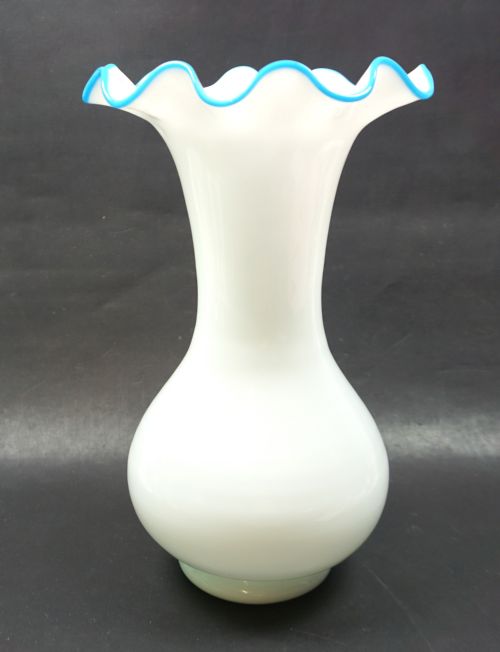
When you search for opaline glass vases, you are looking at nineteenth-century decorative vessels made in opaque or translucent glass of white, pink, blue, green, and yellow tones. These pieces appear as simple bulbous vases, pairs of lustres hung with glass prisms, and tall specimen vessels.
The versions you are most likely to meet on this page hail from French and English workshops of the Victorian era. French makers dominate the selection with classical forms and delicate painted details, while English and Bohemian makers offer vibrant colours and lustred glassware.
Materials and manufacture
These pieces rely on heavy lead crystal or standard glass manipulated while molten to achieve an opaque, porcelain-like density. Makers added bone ash or metal oxides to the batch to create the characteristic milky white, pale blue, pink, and green body colours.
Surface decoration frequently involves hand-painted enamel flowers, raised leaf designs in gold leaf, and gilt trim applied by skilled artisans. Lustre models incorporate cut glass prisms suspended from the rim by brass or metal hooks.
Materials recorded across the archive include lead crystal, enamel, and gold leaf applied to both single vases and matched pairs of table lustres.
Assessing quality and finish
The distinction between standard production and the finest work lies in the crispness of the glass body and the refinement of the hand-painting. Superior pieces exhibit a dense, even opacity without bubbles, paired with finely detailed enamel flowers and secure gilt highlights.
Form and proportion also divide the range, as symmetrical pairs with matching colour saturation and intact prismatic drops command greater appreciation. The presence of documented workshop attribution or distinct neoclassical motifs elevates a piece above anonymous domestic ware.
Baccarat·Jean Francois Robert·Portieux Vallerysthal·Harrach
The Opaline Glass Vases Glossary
- Opaline glass
- An opaque or translucent glass first popular in nineteenth-century France, resembling porcelain in its milky appearance. It was blown or moulded into vases, lustres, and desk accessories before being decorated.
- Lustre
- A decorative table vase or garniture fitted with a scalloped rim and hanging glass prisms. The cut glass drops reflect candle or daylight.
- Enamel
- A powdered glass mixture fused to the surface of the vase through firing, used to paint floral and foliate designs. Hand-painted enamel adds tactile relief to the smooth glass body.
- Gilt
- A thin layer of gold applied to the glass rim or body as leaf or paint. It provides a metallic contrast to the pastel or white opaline background.
- Lead crystal
- A heavy glass variety containing lead oxide, used in better-quality nineteenth-century vases to increase brilliance and weight.
Opaline Glass Vases: Frequently Asked Questions
What is opaline glass?
Opaline glass is a semi-opaque, translucent glass developed in France during the nineteenth century. It comes in shades of white, pink, blue, green, and yellow.
The material has a milky density that diffuses light, making it distinct from clear crystal and opaque ceramic wares.
How do I date an opaline vase?
Dating relies on stylistic clues, manufacturing techniques, and colour palettes typical of the nineteenth century. Victorian and French Empire examples often feature hand-painted florals and neoclassical motifs.
Pontil marks on the base and the weight of the lead crystal also help confirm nineteenth-century production.
What are opaline lustres?
Lustres are decorative mantel or table vases fitted with hanging glass prisms around the rim. They were designed to catch and refract ambient light in nineteenth-century drawing rooms.
These pieces typically survive in pairs and may include gilt or enamel painted decoration on the column.
How should I clean my vase?
Clean opaline glass gently using lukewarm water and a mild soap. Avoid soaking pieces with gilt or hand-painted enamel to protect the surface decoration.
Dry the glass immediately with a soft lint-free cloth, taking extra care around hanging prisms on lustre models.
Are these vases always French?
While French makers produced a large quantity of opaline glass, English and Bohemian workshops also manufactured significant quantities. Makers such as Baccarat and Portieux Vallerysthal operated in France, while Harrach worked in Bohemia.
English glasshouses also created pink and blue Victorian lustres and vases during the same period.