
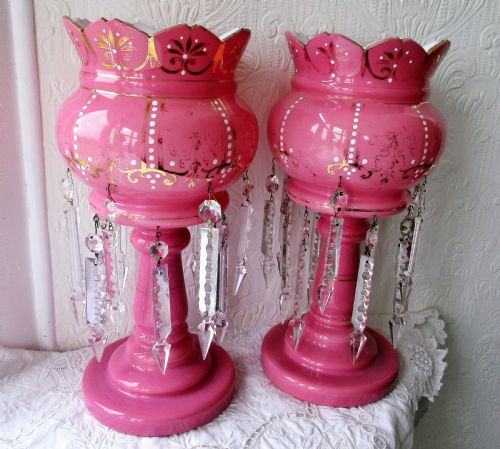


Victorian Gilded Glass Vases
Victorian gilded glass vases combine rich colour and metal leaf, bringing nineteenth-century craftsmanship directly into a modern room.
Victorian Gilded Glass Vases
Victorian gilded glass vases encompass nineteenth-century decorative glassware enriched with gold leaf and enamel, appearing on this page in forms ranging from standard vases to table lustres and garniture sets. Pieces stretch across the Victorian era, utilising styles such as Bohemian, Aesthetic Movement, and Chinoiserie.
The version most commonly met on this page is the lustre or the ruby glass vase, often formed as pairs or single decorative items. Makers shaped glass in ruby, green, pink, blue, cranberry, and opaline hues, applying gilding and surface painting over transparent and opaque bodies.
How they were made
Glassmakers formed these pieces using blown or moulded glass techniques, working with materials such as crystal, opaline glass, and ruby glass. Colour came from mineral oxides added during melting, creating deep tones like cranberry and green.
Decoration relied on hand application of gold leaf and enamel, alongside cutting, engraving, and overshot glass textures. Artisans combined these layers to build dimensional painted portraits, floral motifs, and geometric gilt borders.
Materials recorded across the inventory include ruby glass, opaline glass, cut crystal, and gold leaf.
What varies in quality
Quality rests upon the precision of the hand painting and the crispness of the glass cutting and engraving. Superior examples display detailed enamel work, intact gold leaf with minimal rubbing, and refined proportions.
The depth of the glass colour and the weight of the metal components, particularly on lustres with hanging crystal prisms, separate standard production items from more accomplished works. Clean execution of overlaid or cameo glass layers distinguishes the upper tier.
Baccarat
The Victorian Gilded Glass Vases Glossary
- Lustre
- A decorative vase fitted with a rim of hanging glass prisms designed to catch the light. They typically appear in matched pairs for mantelpieces.
- Opaline glass
- An opaque, pale glass with a delicate translucent quality resembling opal. It provides a smooth surface for painted and gilded decoration.
- Ruby glass
- A deep red glass coloured with gold chloride during production. It forms the base for many nineteenth-century gilded and panelled vessels.
- Gilding
- The application of gold leaf or gold paint to the glass surface. It creates contrasting metallic highlights against coloured glass grounds.
- Overshot glass
- A technique where molten glass is rolled over rough fragments of glass to create a textured, iced surface. It scatters light across the decorated vessel.
Victorian Gilded Glass Vases: Frequently Asked Questions
What are glass lustres?
Glass lustres are ornamental vases featuring a bowl fitted with a ring of hanging glass prisms.
They were designed during the nineteenth century to sit on mantelpieces and reflect candlelight through the cut crystals.
How do I clean them?
Cleaning requires a soft, dry cloth to remove dust from the glass and any hanging prisms.
Water and harsh detergents must be avoided to prevent damage to the delicate gold leaf and enamel decoration.
Are they all English?
The pieces originate from various European centres of glass production during the nineteenth century.
English workshops appear alongside prominent continental makers from Bohemia and France.