


Oak Candle Holders
These oak candle holders combine solid timber and turned or carved forms to bring warmth and character to any room.
Oak Candle Holders
When you search for oak candle holders, you are looking at items designed to hold illumination safely on a table, wall or shelf. The pieces available span several centuries, reaching from the eighteenth century through the Victorian and Edwardian eras into the nineteen-twenties.
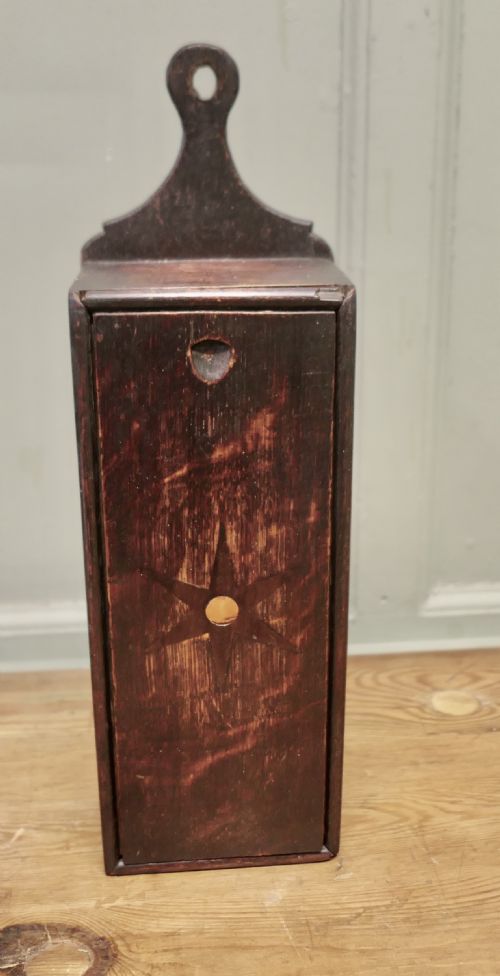
The most common forms you will encounter on this page are candlesticks, often found in matched pairs with turned stems. Alongside these upright pieces, the selection includes wall boxes and wall sconces designed to hang securely.
Stylistic influences range widely across the inventory, taking in Georgian elegance, Gothic Revival, Jacobean Revival and Arts and Crafts design. Folk art also appears, bringing carved figures and hand-shaped details into the mix.
Materials and construction
The makers relied primarily on oak, timber and hardwood, turning the dense grain on a lathe to create spiral barley twist shafts and smooth columns. Hand-carving also shapes the wood, producing textured surfaces and figural elements such as folk art poachers.
Metal components frequently complement the timber. Brass sockets, nozzles and drip pans sit atop wooden stems to protect the oak from melting wax, while iron elements appear on certain wall-mounted pieces.
One exceptional folk art piece depicts poachers carrying game, proving that eighteenth-century illumination could tell a story.
Assessing quality and craftsmanship
The standard of an oak candle holder depends largely on the precision of the turning and the depth of the carving. Crisp, well-defined barley twists and deeply incised details reveal a higher degree of maker skill than softer, simpler profiles.
Proportion and balance also set examples apart, particularly in matched pairs where symmetry and matching grain patterns matter. The integration of brass fittings with the turned wooden body shows care in assembly.
The Oak Candle Holders Glossary
- Barley twist
- A carved or turned spiral column resembling a twisted stalk of barley. This form appears frequently on table candlesticks from the early twentieth century.
- Pricket
- A sharp metal spike set in the drip pan to hold a candle in place. Such fittings are typical on older ecclesiastical or heavy utilitarian candle lights.
- Sconce
- A wall-mounted lighting fixture with a bracket to support a candle. These save table space and direct light outward from a wall.
- Folk art
- Items created by self-taught or traditional makers outside academic traditions. Examples here include hand-carved pieces depicting human figures.
- Hardwood
- Dense timber from broad-leaved deciduous trees, chosen for strength and durability. Oak falls into this category and resists splitting during heavy turning.
Oak Candle Holders: Frequently Asked Questions
How do I date an oak candle holder?
Dating relies on combining clues from the turned profile, the style of any brass fittings, and the type of wood finish. Eighteenth-century pieces generally show heavier hand-tooling, whereas nineteen-twenties examples often feature precise mechanical lathe work.
Comparing the form to documented styles like Arts and Crafts or Gothic Revival helps narrow down the decade of manufacture.
Are these candle holders safe to use with real candles?
Most pieces are fully functional and equipped with metal brass nozzles or drip pans to catch melting wax safely away from the wood. It remains wise to check that the socket fits your chosen candle securely.
Extinguishing the flame before it burns down to the wood ensures the antique timber stays protected from heat damage.
Why do many barley twist candlesticks come in pairs?
Pairs were traditionally produced to balance symmetrical arrangements on dining tables, mantelpieces or sideboards. Makers turned them together to ensure matching heights and similar grain patterns.
Finding an intact pair today offers a complete decorative set ready for display.
What is the difference between a candlestick and a sconce?
A candlestick is a freestanding base designed to stand on horizontal surfaces like tables and desks. A sconce attaches directly to a vertical wall surface to project light outward.
Both forms utilise turned oak bodies and brass holders, but their mounting hardware differs entirely.